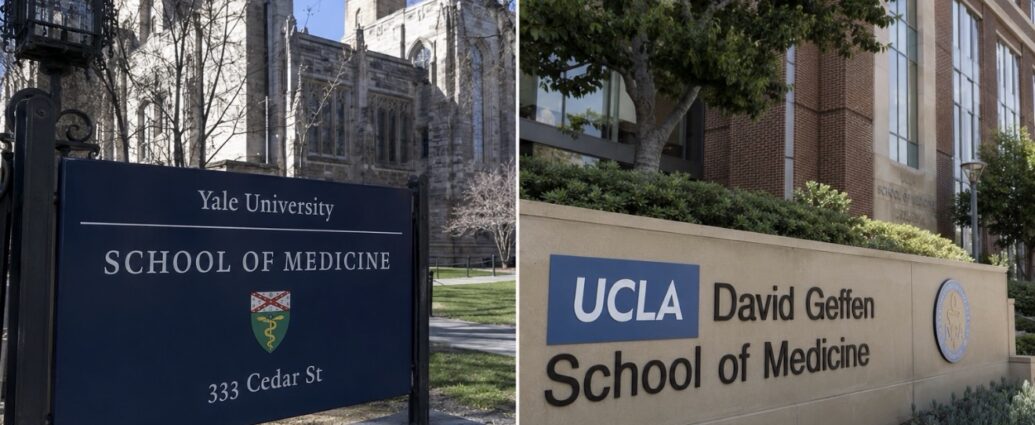
The U.S. Department of Justice’s Civil Rights Division notified the Yale School of Medicine on Thursday that a yearlong investigation concluded the school is illegally favoring Black and Hispanic applicants over White and Asian ones in violation of federal civil-rights law, citing admissions data from 2023 through 2025 that the department says shows substantial and unexplainable gaps in test scores and grade-point averages between admitted students of different racial groups, according to the Justice Department’s official press release and a copy of the letter posted by the agency. The Yale finding came one week after the Civil Rights Division announced parallel findings against the David Geffen School of Medicine at the University of California, Los Angeles. Assistant Attorney General Harmeet K. Dhillon said in the agency’s release that “Yale has continued its race-based admissions program despite the Supreme Court and the public’s clear mandate for reform.”
The findings rest primarily on Medical College Admission Test scores and grade-point averages broken down by race. At Yale, the department said admitted Black students in the 2025 cycle had a median MCAT score of 518 and admitted Hispanic students 517, compared with a median of 524 for both White and Asian admitted students against a top possible score of 528. GPA disparities followed the same pattern: a median 3.88 for Black admits and 3.91 for Hispanic admits, against 3.97 for White and 3.98 for Asian admits. For the 2023 cycle, the department said White and Asian admits had a median MCAT of 523, compared with 517 for Black and 518 for Hispanic admits. The agency calculated that at Yale, a Black applicant had as much as 29 times higher odds of being invited to interview than an Asian applicant with equivalent academic credentials, calling the gap “substantial” and stating it “cannot be explained by a coincidence.”
At UCLA, the department applied the same statistical framework, citing 2023 data showing White and Asian admits with a median MCAT score of 514 versus 507 for Black and Hispanic admits. The Civil Rights Division said internal UCLA documents reviewed during the investigation revealed leadership “intentionally selected applicants based on their race” and adhered to what the agency described as “the dubious contention that patients receive the best care when treated by a doctor of the same race, rather than by the most qualified.” The UCLA matter originated in a lawsuit filed by the anti-DEI advocacy group Do No Harm, which the Justice Department joined in January.
Both findings are framed as enforcement of the U.S. Supreme Court’s June 2023 decision in Students for Fair Admissions v. Harvard, which struck down the consideration of race in college admissions. DOJ argues that the schools have continued de facto race-conscious admissions despite the ruling, and that the consistency of demographic outcomes in admitted classes — even as the court banned the practice — points to the use of “racial proxies” to achieve the same result. The letter to Yale cites a slide from a 2024 admissions presentation as part of the documentary evidence, and references the 2023 Department of Education investigation into Yale’s collaboration with a doctoral-program diversity initiative, which resulted in a resolution agreement in February 2026.
Yale’s medical school has not yet publicly responded to the new finding. In 2020, when the first Trump administration’s DOJ brought a parallel allegation against Yale undergraduate admissions, the university “categorically” denied the conclusion and the matter was dropped by the Biden administration in early 2021. UCLA has not publicly responded to the DOJ’s May findings either, though the school is a named defendant in the ongoing Do No Harm litigation. The Justice Department said it is seeking a voluntary resolution agreement with both schools but may pursue formal enforcement, including litigation under Title VI of the Civil Rights Act of 1964, if no agreement is reached.
The financial stakes are substantial. Yale received roughly $899 million in federal research funding in fiscal 2024, with a large share flowing through the National Institutes of Health to the medical school and affiliated Yale New Haven Health system. UCLA’s David Geffen School of Medicine is among the largest NIH grant recipients in the country, with the broader UC system collecting more than $2 billion annually in federal research and training dollars. Title VI allows the federal government to suspend or terminate federal financial assistance to institutions found to be in noncompliance, an enforcement tool that the Trump administration has signaled it is prepared to use more aggressively than prior administrations.
The medical-school cases are part of a broader DOJ focus on elite university admissions after the SFFA ruling. A study published in the Journal of the American Medical Association in late 2025 found that the share of admitted medical-school applicants from groups historically underrepresented in medicine fell to about 20% in the first cycle after the ruling, from 24% in prior years. Critics of the DOJ approach, including the Association of American Medical Colleges, argue that MCAT scores are an imperfect measure of physician potential — citing 2019 data showing that students scoring between 510 and 513 still complete their first year of medical school 98% of the time — and that holistic admissions remain legal under the SFFA framework so long as race is not the determining factor.
The DOJ said it will continue similar investigations at other medical schools, signaling that Yale and UCLA are likely the opening rather than the conclusion of the federal enforcement push.
— JBizNews Desk
© JBizNews.com. All rights reserved. This article is original reporting by JBizNews Desk. Unauthorized reproduction or redistribution is strictly prohibited.