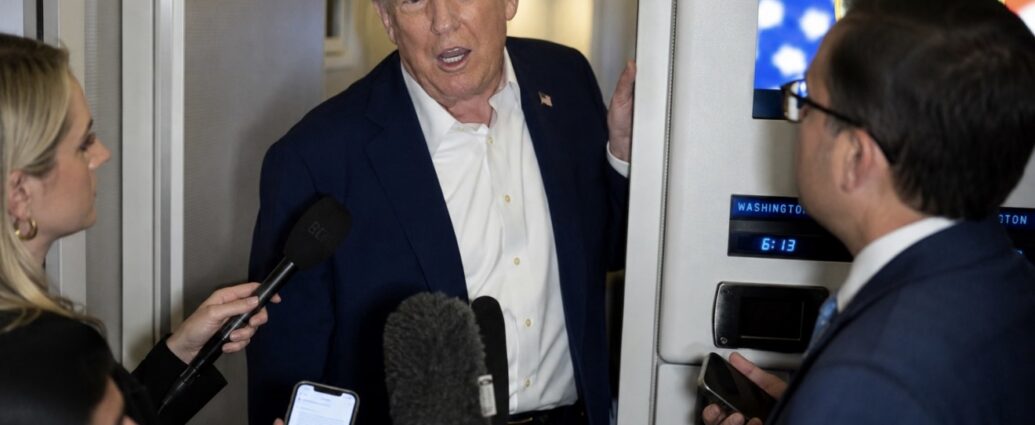
The Justice Department served grand jury subpoenas on Friday to four New York Times reporters who wrote about security gaps in President Donald Trump’s new Qatari-gifted Air Force One, an escalation that David McCraw, senior vice president and deputy general counsel of The New York Times Company, denounced in a statement Saturday as a bid to frighten journalists out of doing their jobs. The subpoenas were signed by Jay Clayton, the U.S. Attorney for the Southern District of New York and Mr. Trump’s nominee to lead the Office of the Director of National Intelligence, and order the reporters to appear before a federal grand jury in Manhattan on Wednesday.
The four journalists — Julian E. Barnes, Eric Lipton, Tyler Pager and Eric Schmitt — carried the bylines on reporting this week that the Secret Service pressed the president to leave a NATO summit in Turkey aboard an older presidential jet because the newer plane lacked some defensive systems. Federal agents hand-delivered several of the subpoenas to the reporters’ homes, the paper said, a detail that press advocates seized on as unusually aggressive. Mr. McCraw said the sight of federal law enforcement at reporters’ front doors should trouble anyone who values the Constitution and a free press.
The dispute traces back to an abrupt switch of aircraft. Mr. Trump flew to Turkey on the newly delivered Boeing 747-8 that Qatar gave the United States and that underwent a $400 million retrofit before entering service. He then departed for a Royal Air Force base in England on an older jet, with both planes flying to the same stop before he boarded the new aircraft for the trip home to Joint Base Andrews. The Times reported the swap came at the Secret Service’s urging, and that the retrofitted jet lacked some advanced protections, including antimissile capabilities, found on the older aircraft. The episode landed as a cease-fire with Iran collapsed and the U.S. resumed strikes, sharpening questions about the president’s exposure to threats.
The administration cast the matter as a leak investigation, not an attack on the press. In a rapid-response statement, the Justice Department said reporters were not the targets and that those disclosing classified information were. A department spokesperson told news organizations that every administration has confronted the crime of leaking national-security material and that it would keep investigating breaches. Acting Attorney General Todd Blanche, who also serves as deputy attorney general, said last month that his office would not stop pursuing government employees who share secrets with journalists. White House spokesman Steven Cheung defended the new plane as a state-of-the-art aircraft fitted with high-level security, adding that the administration uses distraction and misdirection to protect the president.
For The New York Times Company, which trades publicly and has built its subscription business on original, source-driven reporting, the fight cuts at a core asset: the confidential relationships that produce national-security scoops. A protracted legal battle carries direct costs — outside counsel, management time and the risk of contempt exposure for reporters — and a subtler one, the chance that sources go quiet across the industry. The company said it will fight the order in court.
The move fits a broader pattern that has rattled newsrooms as businesses. Earlier this year the Justice Department issued grand jury subpoenas to reporters at The Washington Post and The Wall Street Journal in separate national-security leak probes, then withdrew them after the outlets pushed back. That the department has now returned to the same tactic against a third major publisher suggests the earlier retreats were tactical rather than a change in posture, leaving media companies to price in recurring legal risk as a cost of covering the federal government.
Press-freedom organizations lined up against the subpoenas. Bruce D. Brown, president of the Reporters Committee for Freedom of the Press, said the action breaks from a longstanding department practice of seeking information from reporters only as a last resort. Stephen J. Adler, the group’s chairman, warned that crushing the public’s right to know inflicts lasting harm. The National Press Club, led by Mark Schoeff Jr., urged the department to withdraw the subpoenas immediately, calling agents at reporters’ homes an extraordinary assault on the First Amendment. Seth Stern of the Freedom of the Press Foundation argued the government’s real concern was reputational, not national security.
The timing adds a political wrinkle. Mr. Clayton faces a Senate Intelligence Committee confirmation hearing on Wednesday — the same day the reporters are told to testify — for the intelligence post he was tapped to fill after Tulsi Gabbard stepped down. The Reporters Committee has called on senators to press him on the subpoenas. Whether the grand jury appearances proceed as scheduled will likely turn on how fast the Times can get before a judge.
JBizNews Desk |Washington D.C. © JBizNews.com All Rights Reserved. Reproduction or distribution without written permission is prohibited.