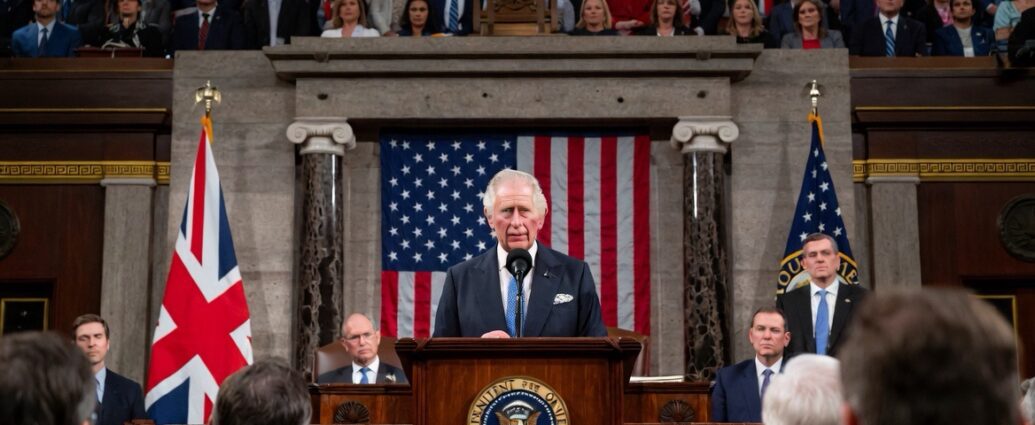
King Charles III used a rare address to a joint meeting of the U.S. Congress to argue that the U.S.-U.K. alliance remains central to security, trade and democratic stability at a moment of strain between Washington and London. In remarks reported by Associated Press, the British monarch said, “For all that time, our destinies have been interlinked,” framing the relationship as a long-running strategic partnership rather than a ceremonial bond.
The speech carried unusual weight because Charles became only the second British sovereign to speak from the Capitol, following Queen Elizabeth II in 1991, a milestone highlighted by AP and echoed in broader coverage. In that earlier address, Queen Elizabeth II said “our peoples have stood together through triumphs and trials,” and the comparison underscored how the monarchy and both governments now want to project continuity even as policy differences widen.
Those differences have become harder to ignore as friction grows between President Donald Trump and Prime Minister Keir Starmer, particularly over the conflict involving Iran and over trade policy. In his Capitol remarks, Charles condemned political violence, saying, “Let me say with unshakeable resolve, such acts of violence will never succeed,” according to AP, a line that landed as lawmakers and diplomats weigh how far public symbolism can offset strategic disagreements.
At a White House ceremony earlier in the day, Trump sought to wrap the visit in historical language while also signaling his own political style. He called the weather a “beautiful British day” and said, “American patriots today can sing, ‘My country, ’tis of thee, sweet land of liberty,’ only because our colonial ancestors first sang, ‘God save the King,’” according to AP and Reuters, remarks that blended pageantry with a reminder that the relationship still matters to his administration.
Behind the ceremony, however, trade remains a live fault line. Reuters reported that Trump recently threatened a “big tariff” on Britain if London keeps its digital services tax on large U.S. technology groups, a dispute with direct implications for cross-border investment and broader trans-Atlantic commerce. The tariff threat has drawn scrutiny because it arrives as businesses on both sides of the Atlantic push for more predictable rules, and because legal constraints on unilateral tariff action in the U.S. have become a bigger issue after recent court scrutiny cited by Reuters.
Congressional Democrats used the visit to press that point more directly. House Democratic leader Hakeem Jeffries said, “Hopefully, the king’s visit is going to go a long way toward repairing the damage that this administration has done to one of our most important allies in the world,” according to AP, a statement that reflected how Britain’s standing in Washington now intersects with domestic U.S. political arguments over alliances, tariffs and diplomatic credibility.
Security policy formed the other major pillar of the king’s message. AP reported that Charles called for “unyielding resolve” in support of Ukraine and warned that the allies “cannot rest on past achievements,” language that aligned him closely with the broader NATO view that Western cohesion remains under pressure. That message also resonated with reporting from the Financial Times, which said NATO officials see royal backing for the alliance as a useful counterweight to recurring U.S. rhetoric questioning long-term commitments.
The political sensitivity of the visit extended beyond foreign policy. Representative Ro Khanna said he had been told by the British ambassador that the royal program would include acknowledgment of survivors tied to the Jeffrey Epstein scandal, according to AP. Khanna said, “The acknowledgment will signal a commitment to justice and healing,” a comment that suggested the palace and British diplomats aim to show that the visit addresses not only statecraft but also wider public concerns about accountability and values.
The private Oval Office meeting between Trump and Charles offered little immediate policy detail, but the president described it as “really good” and called the king a “fantastic person,” according to AP. Bloomberg noted that the closed-door session contrasted with the more performative diplomacy that often defines Trump’s public engagements, leaving business leaders and diplomats to look instead at follow-up talks on trade, defense and technology for evidence of substantive progress.
The king’s itinerary continues with stops in New York and Virginia, where meetings with business and civic leaders could give the visit more practical economic content. A spokesperson for the Royal Family told AP that “the King looks forward to deepening dialogue on trade, security and cultural exchange,” and that next phase matters more than the ceremony itself: if Washington and London can narrow differences on tariffs, Iran and alliance commitments, the visit could help stabilize one of the world’s most important bilateral relationships at a time when markets and governments increasingly prize dependable partners.
JBizNews Desk