Late in 1940, a Japanese scholar took five or six Kobe police officials to the best restaurant in the city and told them nothing. There was shellfish soup, lobster in soy sauce, sake, and a geisha with a shamisen.
He said not a word about the thousands of Jewish refugees sleeping on borrowed mattresses a few streets away, their 10-day transit visas almost spent, deportation back toward Europe waiting on the other side.
Two days later he fed the same men again, and yet again said nothing. Only at the third dinner did he bow his head and ask. The extensions were granted, 15 days at a time, renewable. Over the following months, some 6,000 people passed safely out of Japan.
The scholar was Setsuzo Kotsuji, and the money was borrowed. He had gone to a wealthy brother-in-law in Osaka and came away with 300,000 yen, a small fortune, telling him only that it was “for the lives of human beings.”
What the money bought was time. He fed the police twice and asked for nothing, raising the refugees only at the third dinner, once the officials had come to trust him.
What no one could later explain, including the man who spent more than a decade chasing him, was how a stern Hebrew scholar knew how to charm a room with geisha and sake at all.
Kotsuji’s Gift: The Daring Rescue of Japan’s Jewish Refugees is really two books bound as one. The first is Kotsuji’s own memoir, From Tokyo to Jerusalem, written in English, published in America in 1964, then left to go quiet for 60 years.
The second is the work of Jundai Yamada, a Japanese actor who came to the story through learning about Oskar Schindler (Schindler’s List), then about Sugihara Chiune, the vice-consul at Kaunas whose transit visas are rightly famous.
‘We are Asian, like you’
Yamada kept pressing the question the Sugihara story leaves open: Who kept the refugees alive through the months it took to place them somewhere?
The answer was Kotsuji. If Sugihara was the pitcher, in the book’s own phrase, Kotsuji was the catcher.
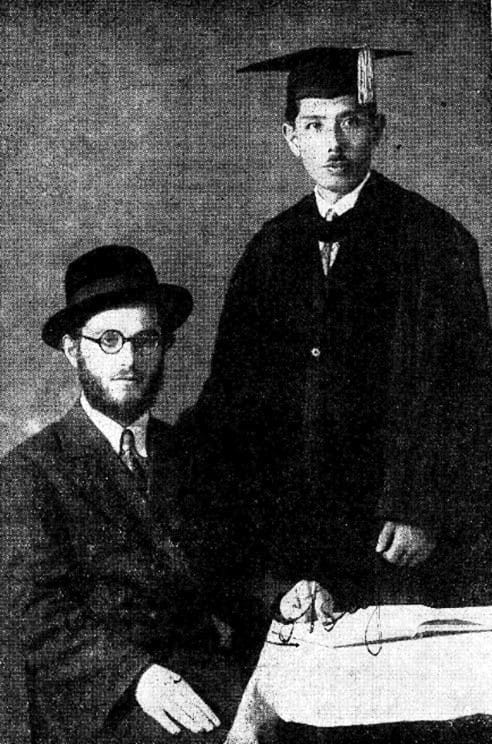
Rabbi Meir Soloveichik, whose grandparents reached Japan on those visas, supplies the foreword and the book’s governing image. A bestseller by the psychologist Robert Cialdini reproduces a 1941 photograph of the rabbi who answered the Japanese generals: “We are Asian, like you.”
The picture is cropped. A Japanese man standing to one side has been cut away. That man is Kotsuji, and the book is the long work of putting him back.
He was born in Kyoto in 1899, into a family that had served as Shinto priests for 14 centuries.
His father trained him as a boy to light the sacred fire. As an adolescent, shaken by a famous general’s ritual suicide after Emperor Meiji’s death, he wandered into a secondhand shop and opened a Japanese Bible.
The Pentateuch undid him. When he told his parents he could no longer perform the old rites, his father’s reply, carried to him by his mother, held no anger: “You may go ahead with your new faith. Only remember your ancestors, honor them, and be proud of your great heritage.”
Kotsuji was baptized and became a Presbyterian minister, yet spent decades unable to accept the Trinity.
He taught himself Hebrew, took a doctorate in America and came home to found the Institute of Biblical Research and write the first Hebrew grammar in Japanese.
By the time the refugees reached Kobe, he was the one Japanese man who could address them in their own tongue.
The research supplies the reason
THE BOOK’S finest pages are Yamada’s, and they explain the one thing the rescue could not.
After his Japanese edition appeared in 2013, Kotsuji’s daughters sent Yamada the family registry, and the birthplace recorded in it stopped him cold.
The address was the Kaburenjo, a theater in Kamishichiken, believed to be the oldest of Kyoto’s geisha districts and dating to 1444. Apprentice geishas trained there in song and dance, and Kotsuji’s father, a figure in the local teahouse guild, had helped build the place.
The boy who would one day disarm the Kobe police had grown up in the craft of hospitality before he was old enough to kindle a flame.
Stranger still: Yamada had spent years of his own adult life in that same summery garden, never knowing whose birthplace it was. The part of Kotsuji’s life that lay furthest from Scripture turned out to be the part that saved thousands.
That two books share these covers is at once the volume’s flaw and its quiet engine. The episodes repeat. The three dinners, the Bible found in a Kyoto bookshop, the conversion in Jerusalem – each arrives twice: once in Kotsuji’s hand, and once in Yamada’s plainer translated prose.
A reader feels the seam. The memoir is the stronger book. Yet the doubling is exactly what lets the new findings land. The Kamishichiken discovery detonates only because the rescue has already been read in the words of the man who lived it. The memoir supplies the deed.
The research supplies the reason.
There was a price, and Kotsuji paid it. During the war, he toured the country answering Nazi propaganda, was summoned by the military police, and held for hours under threat of water torture while they pressed him on his ties to world Jewry.
He thought of Dreyfus who, under endless interrogation, had begun to answer “Yes,” and made himself keep saying no. On the train home, he recited Psalm 23 in Hebrew. In 1945 he fled to Harbin, and when the Soviets overran the city, it was the Jews there who protected him as best they could.
The guardian, in Yamada’s phrase, had become the guarded.
Kotsuji converted to Judaism in Jerusalem in 1959 at the age of 60, the first Japanese to do so. Asked by the rabbinic court why he had come, he answered, “My entire past answers that question.”
He died in 1973, and had asked to be laid to rest in Jerusalem. The airport was shut down due to the Yom Kippur War, but a former Kobe refugee, then Israel’s minister of religion, had it open so his friend could come home.
The Knesset did not formally recognize Kotsuji’s deeds until 2022. Near the end, he had told his daughters, “Maybe in 100 years, someone who truly understands me will appear.”
Yamada had appeared within 40.
An Israeli ambassador once told Yamada that the 6,000 were only the beginning, that including children and grandchildren in the count, the rescued now number in the tens of thousands.
Kotsuji spent his life keeping others inside a picture the world meant to crop him out of. His own book restores him.■
KOTSUJI’S GIFT:
THE DARING RESCUE
OF JAPAN’S JEWISH REFUGEES
By Setsuzo Kotsuji and Jundai Yamada
Maggid Books
380 pages; $30