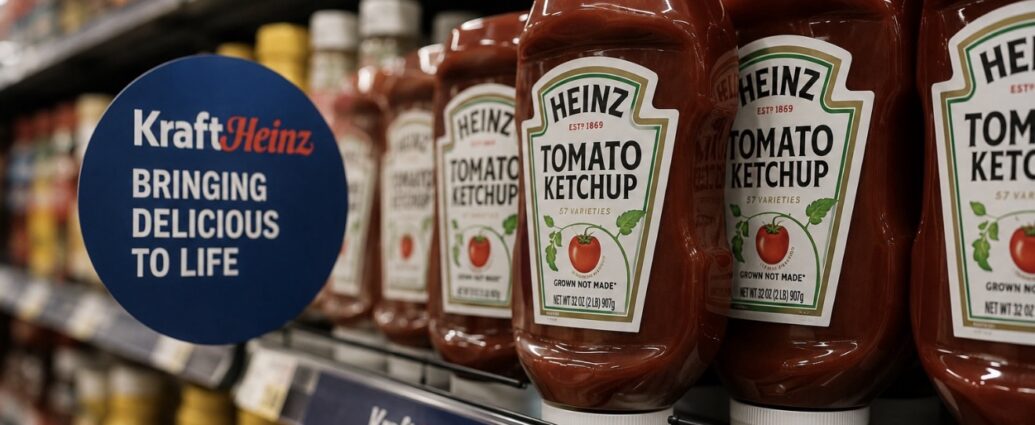
Kraft Heinz lifted its full-year sales forecast Wednesday after a quarter that beat Wall Street on both lines — and the improvement it is celebrating is that sales are shrinking less than expected rather than growing.
Quarterly net sales came in at $6.26 billion, down 1.4% from a year earlier but ahead of the $6.12 billion consensus, which had implied a 3.6% decline. Adjusted earnings of 56 cents a share fell 18.8% year over year while topping the 53 cents analysts forecast.
The company now expects organic sales to decline between 0.5% and 2.0% for the full year, an improvement over prior guidance of a 1.5% to 3.5% decline, with adjusted earnings per share of $2.03 to $2.09.
Spending Its Way Out
Chief Executive Steve Cahillane said results exceeded expectations across U.S. retail, global away-from-home and emerging markets, and that improving share performance gave the company confidence to raise its sales outlook. He announced an additional $100 million in incremental investment, bringing the 2026 total to roughly $700 million, arguing that the brands respond when the company spends behind them and that accelerating now positions the business better heading into 2027.
That money goes into marketing, sales, research and development, product superiority and pricing initiatives, with marketing spending reaching at least 6% of net sales.
The cost of that strategy is visible immediately. Operating income fell 18.4%, and the company booked a $7.4 billion non-cash impairment charge. Operating margin dropped 350 basis points. Shares slipped roughly 1% in premarket trading to $26.37.
For the third quarter, the company expects organic sales down 1% to 2.5% and adjusted operating income down 23% to 25%.
The Volume Problem
The strategic pivot underneath the numbers is the part worth watching for anyone tracking the packaged food sector.
Management is moving away from defensive pricing toward volume-led growth, using the $700 million to lift consumption rates and market share. The approach to pricing is described as surgical — focused on price-pack architecture and opening price points rather than broad cuts to base prices.
For several years, the entire packaged food industry papered over declining volumes by raising prices. Revenue held up while households bought fewer units. That trade has run out of room. Consumers have traded down to private label, shrunk basket sizes and stopped absorbing increases.
Kraft Heinz appears to have concluded that the only durable fix is getting units back into carts — and that it will cost several hundred million dollars in near-term profit to try.
There is early evidence it is working at the margin. Market share trends have stabilized, with a first-half decline of 30 basis points against losses of 90 basis points in early 2025.
North America Down, Overseas Up
The regional split explains the raised guidance. Improved coffee and ready-to-drink pricing plus 10.4% growth in emerging markets covered a 2.7% sales decline in North America. The Heinz brand grew 12% in emerging markets on distribution and consumption gains.
The full-year outlook assumes inflation running slightly above 4% and includes an expected 100-basis-point headwind tied to changes in federal food assistance benefits.
That last item is a real signal about the domestic consumer. When a company building a turnaround has to carve out a full percentage point of sales for reduced government food assistance, it is describing a customer base operating with less money for groceries.
Costs Ahead
Chief Financial Officer Andre Maciel flagged a specific risk for later this year. The company’s hedges on energy and edible oils extend through most of 2026, but protection on certain resins and metals expires around the middle of the third quarter. As those roll off, he said, the company expects greater exposure to spot prices in the fourth quarter.
Packaging costs, in other words, are about to reprice at whatever the market offers — in a period when energy-linked inputs have been climbing.
Year-to-date free cash flow reached $1.7 billion with 123% conversion, up 27 points from a year ago on favorable working capital changes. Net leverage held at 3.0 times, and the company returned $949 million to shareholders in dividends.
Cahillane, who took over in January, has pushed the portfolio toward protein-heavy foods and electrolyte drinks aimed at shoppers focused on health. He said the company is ahead of plan and focused on returning to volume-led, sustainable and profitable growth.
The word doing the work in that sentence is volume.
JBizNews Desk | New York
© JBizNews.com All Rights Reserved. Reproduction or distribution without written permission is prohibited.