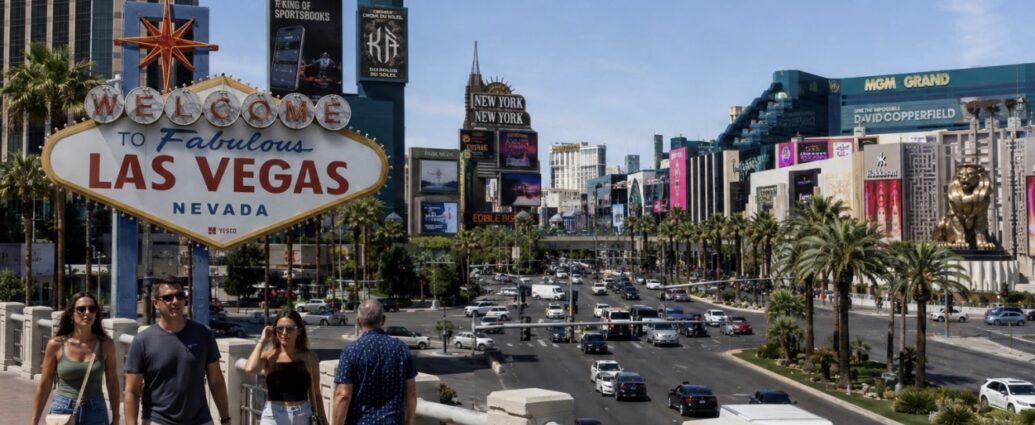
For decades, Las Vegas sold itself on a simple promise: cheap rooms, cheap food and free parking, all designed to get visitors through the door and keep them spending once they arrived. That formula helped transform a desert gambling town into one of America’s biggest tourism engines.
Today, that promise is fading.
According to the Las Vegas Convention and Visitors Authority (LVCVA), approximately 38.5 million people visited Las Vegas in 2025, down about 7.5% from the previous year and the lowest annual total since 2021. The decline marked the steepest drop outside the pandemic period and capped a year in which visitor numbers fell month after month.
The city remains one of the world’s most popular destinations, but it is attracting a different kind of customer than it once did.
Ironically, while fewer people are showing up, the casinos are making more money than ever.
According to the Nevada Gaming Control Board, gambling revenue on the Las Vegas Strip reached a record $8.8 billion in 2025, while casinos across Nevada generated nearly $15.8 billion, also an all-time high.
In simple terms, Las Vegas is earning more from fewer visitors.
The reason is that the people still coming are spending significantly more money. High-limit table games, premium slot machines, luxury hotel suites, celebrity-chef restaurants and VIP experiences have increasingly replaced the value-focused model that once defined the city.
LVCVA President and CEO Steve Hill has acknowledged the slowdown in visitation but noted that gaming revenue has remained remarkably strong despite the decline.
That gap between fewer visitors and higher revenue explains much of what is happening in Las Vegas today.
Consider what an average trip now costs.
The average daily hotel room rate on the Strip was approximately $183 per night in 2025. But that figure often excludes mandatory resort fees that can add $35 to more than $50 per day to a bill.
Parking, once free across most major casinos, now frequently costs between $18 and $25 daily, while valet parking can exceed $40 per day.
Food costs have climbed as well. Visitors routinely report paying double-digit prices for basic items such as coffee, sandwiches and snacks that would cost far less at home.
Many of the perks that once defined Las Vegas have also become harder to find.
Complimentary meals, free show tickets, room upgrades and other casino giveaways have become increasingly reserved for higher-spending customers. At the same time, some gamblers complain that table-game odds have become less favorable than they were years ago.
The overall message is clear: Las Vegas is no longer targeting budget travelers the way it once did.
The shift is visible among different visitor groups.
International tourism has softened considerably. Travel from Canada, one of Las Vegas’ largest foreign visitor markets, fell sharply in 2025. Families and value-conscious travelers are increasingly choosing shorter vacations or less expensive destinations closer to home.
The visitors who remain tend to fall into three categories: gamblers, convention attendees and luxury travelers.
That is exactly the customer base casino operators have been pursuing.
Major resort companies have invested heavily in luxury hotel towers, high-end dining, entertainment residencies, championship sporting events and premium experiences designed to attract travelers willing to spend thousands of dollars during a visit.
Events such as Formula One, the Super Bowl, UFC championship fights and major conventions have become central pillars of the city’s growth strategy.
The convention business remains particularly important.
In one of the strongest months of 2026, convention attendance surged more than 30% year-over-year, helping push average room rates above $200 per night and generating some of the strongest hotel revenue figures in city history.
There is logic behind the strategy.
Analysts at commercial real-estate firm CBRE note that resorts face rising labor, insurance, utility and operating costs. Charging resort fees, parking fees and premium prices allows casinos to maintain profitability even if overall visitor traffic declines.
From a corporate perspective, earning more from each guest can be more attractive than chasing larger crowds.
But there is also a risk.
Las Vegas built its reputation as a destination where ordinary Americans could feel wealthy for a weekend. If travelers increasingly believe they are being nickel-and-dimed at every turn, the decline in visitation could become a longer-term problem.
Fewer visitors ultimately affect more than casino profits. Hotels, restaurants, retail stores, entertainment venues and service workers all depend on steady tourism traffic.
A prolonged slowdown could eventually impact jobs and economic growth across southern Nevada.
There are signs the situation may stabilize.
The UNLV Center for Business and Economic Research projects visitation could climb back toward 40 million visitors in 2026 if economic conditions remain favorable and the city’s packed events calendar continues to draw crowds.
Still, the larger question remains unresolved.
Can Las Vegas successfully position itself as a luxury destination while remaining affordable enough for the middle-class travelers who built the city in the first place?
For most of its history, Las Vegas made visitors feel like high rollers regardless of their budget.
Its latest wager is that enough people will be willing to pay premium prices to keep that illusion alive.
JBizNews Desk | Las Vegas
© JBizNews.com All Rights Reserved. Reproduction or distribution without written permission is prohibited.