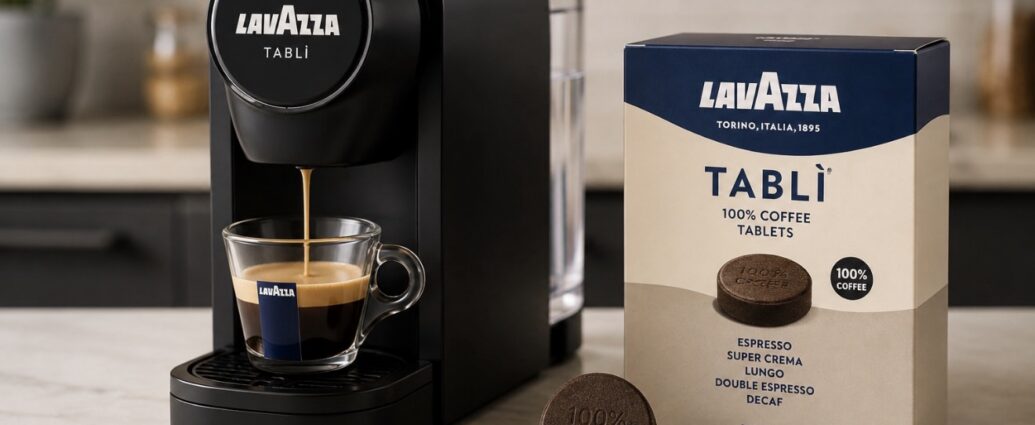
Italian coffee giant Lavazza announced Monday, June 8, that it is bringing its Tablì single-serve system to the United States, a launch the company called its biggest U.S. investment ever in a press release issued from West Chester, Pennsylvania. Instead of the plastic pods that dominate American kitchens, Tablì uses a small, solid tablet made entirely of compressed ground coffee — no capsule, no wrapper, and no coating.
Each tablet consists solely of pressed coffee, dosed and tamped into a ready-to-use disk marked “100% coffee.” The tablets work exclusively with Lavazza’s proprietary Tablì machine. At launch, consumers can choose from five varieties: Super Crema, Espresso, Double Espresso, Lungo, and Decaf.
Getting the tablet to hold together was the difficult part. Antonio Baravalle, CEO of Lavazza, told CNBC that the company spent roughly five years developing the technology, filed more than 15 patents, and built a dedicated factory in Gattinara, Italy, to manufacture the tablets. He described the process as a complex engineering challenge requiring the coffee to be compressed tightly enough to survive shipping while still brewing properly once inside the machine.
The larger story is the market Lavazza is targeting. The U.S. single-serve coffee segment has long been dominated by Keurig Dr Pepper, whose K-Cup pods account for about 50% of fresh ground coffee pod sales in the United States, according to Euromonitor International. Nespresso holds roughly 7%. Keurig’s coffee business generated approximately $3.99 billion in net sales during 2025. By comparison, Lavazza’s U.S. retail business, sold through chains such as Target and Walmart, exceeds $100 million annually.
Baravalle has been candid that Lavazza is not attempting to dethrone the industry leaders. He told CNBC the company is focused on creating its own category while maintaining existing partnerships. One of those partners is Keurig itself, which currently sells Lavazza-branded K-Cup products. The result is an unusual dynamic in which Lavazza is competing with a company that also helps distribute its products.
The marketing pitch centers heavily on sustainability. Keurig’s pods have faced years of criticism over plastic waste. While the company announced that all K-Cups were recyclable as of late 2020, the U.S. Securities and Exchange Commission charged Keurig in 2024 with making misleading statements regarding recyclability. Keurig agreed to pay $1.5 million to settle the matter without admitting or denying the findings. Its website now advises customers to verify local recycling capabilities because many communities do not process the pods. Lavazza is betting that a product made entirely of coffee, with no capsule at all, will appeal to environmentally conscious consumers.
Pricing places Tablì firmly in the premium category. A pre-order bundle on TabliCoffee.us, including the machine, milk frother, tweezers for handling the tablets, and a 60-count variety pack, is being offered for $99.99, discounted from a stated value of $249.99.
Daniele Foti, Vice President of Marketing at Lavazza North America, said the company views Tablì as an opportunity to strengthen its position among American consumers, describing the United States as one of the world’s most dynamic coffee markets. The full retail launch is scheduled for August through LavazzaUSA.com, with availability on Amazon expected later this year.
The timing is notable. Keurig is preparing to launch its own plastic- and aluminum-free single-serve option, a puck-shaped product called K-Rounds, developed with Swiss manufacturer Delica and expected to reach stores this fall. Both companies are now racing to persuade consumers that convenience and sustainability can coexist in the single-serve coffee category.
For Lavazza, the stakes extend far beyond one product line. North American revenue rose 26.9% last year, and Baravalle has publicly stated his goal of building the U.S. market into a €1 billion business. Whether American consumers embrace coffee tablets over traditional pods is now a test that will play out in kitchens across the country.
JBizNews Desk — Business
© JBizNews.com All Rights Reserved. Reproduction or distribution without written permission is prohibited.