WASHINGTON — A bipartisan coalition of lawmakers from auto-heavy battleground states is publicly pressuring President Donald Trump not to use the U.S. car market as a bargaining chip in his Beijing summit with Chinese President Xi Jinping, warning that any opening for Chinese automakers would devastate domestic manufacturing in the Rust Belt and reverse one of the few sectors of American industry where U.S. policymakers from both parties have held a unified line for two decades, according to a CNBC report Thursday from Washington correspondent Christina Wilkie. The lobbying push has grown urgent because Trump told the Detroit Economic Club in January that it would be “great” if Chinese automakers wanted to build plants in the United States and employ American workers — a statement that immediately set off alarm bells across Detroit, the United Auto Workers, and the broader auto supply chain.
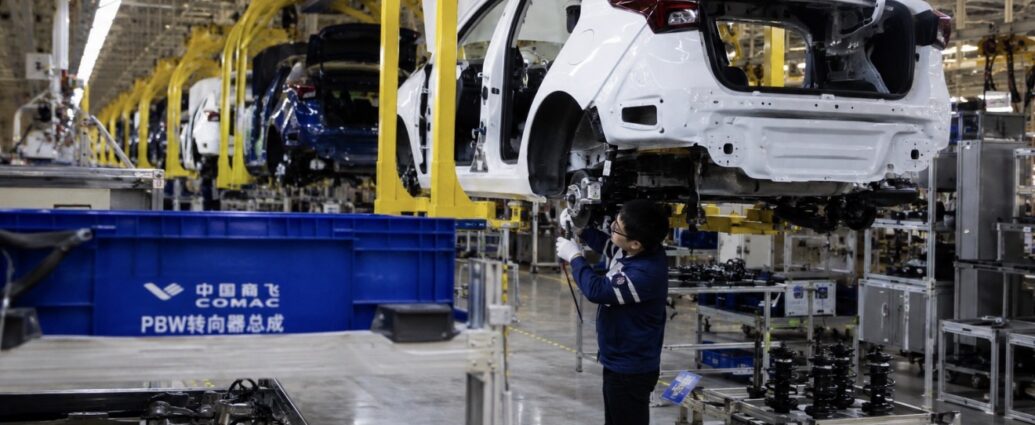
The hidden complication, and the part of the story that CNBC placed at the center of its reporting, is that Chinese companies are already deeply embedded in the American auto industry. More than 60 U.S.-based parts suppliers are now owned by Chinese corporate parents, according to industry tracking, and Chinese-origin components — batteries, electronics, semiconductors, software modules, wiring systems, and rare-earth-derived materials — sit inside virtually every vehicle currently rolling off American assembly lines. The political fight in Washington is therefore not about eliminating Chinese influence from the U.S. automotive ecosystem; that influence already exists at scale. The battle is over whether BYD Co., Geely Automobile Holdings Ltd., SAIC Motor Corp., Chery Automobile Co., and Great Wall Motor Co. should be allowed to directly sell branded Chinese vehicles to American consumers in the same way they now do across Europe, Mexico, Brazil, and other major global auto markets.
The legislative centerpiece of the pushback is the Connected Vehicle Security Act of 2026, introduced last week by Senator Bernie Moreno (R-Ohio) and Senator Elissa Slotkin (D-Michigan), alongside a House companion bill led by Representative John Moolenaar (R-Michigan), chairman of the House Select Committee on the Chinese Communist Party, and Representative Debbie Dingell (D-Michigan). The legislation would prohibit the import, manufacture, sale, and operation of vehicles produced in China or in any nation designated as a national-security threat, with software restrictions beginning in 2027 and hardware bans phased in by 2030. The proposal expands upon a Bureau of Industry and Security rule finalized by the Biden administration in January 2025 restricting certain Chinese-origin connected-vehicle systems. Slotkin described connected Chinese cars as “TikTok on wheels,” framing the issue primarily as one of surveillance, cybersecurity, and data access rather than traditional tariff protectionism.
The coalition behind the legislation is unusually broad for Washington. The Alliance for Automotive Innovation, which represents nearly every major automaker selling vehicles in the United States, endorsed the bill publicly and said it “sends a clear message: the U.S. will not throw open the doors to Chinese automakers.” General Motors Co. separately backed the legislation. Honda Motor Co. Ltd., despite suffering its first-ever annual loss this week tied partly to its collapsing EV strategy, also endorsed the proposal. The United Auto Workers has signaled support, and major steel-industry groups followed with their own letter to the administration. Even the Information Technology and Innovation Foundation, typically skeptical of broad Trump-era tariffs, praised the measure. ITIF Vice President Stephen Ezell told CNBC that “Chinese automakers are not normal market competitors. Their EVs are the product of decades of state-backed mercantilism designed to help China capture global leadership in advanced industries.”
The pricing gap between Chinese and American electric vehicles is the core economic fear driving the political reaction. BYD’s entry-level Seagull EV starts at roughly $10,300 in China. Geely’s EX2 electric vehicle sells in Mexico for about $22,700 — still dramatically below the cheapest Tesla Inc. Model 3 sold in the United States at roughly $38,630. General Motors’ upcoming Chevrolet Bolt EV is expected to retail near $28,995. The average new vehicle transaction price in the United States now exceeds $51,000. Chinese automakers have already rapidly gained global market share through aggressive pricing: Chinese brands doubled their share of Europe’s EV market to roughly 6% in 2024, while dominating EV growth in Brazil and rapidly expanding in Mexico and Canada. In Mexico alone, 34 Chinese automotive brands are now operating, collectively controlling about 15% of the market. Even Toyota Motor Corp., the company that once disrupted Detroit itself, has publicly acknowledged difficulty competing against subsidized Chinese pricing structures.
The political implications are especially acute because the states most exposed to auto manufacturing — Michigan, Ohio, Pennsylvania, Indiana, and Wisconsin — remain central to both the 2026 midterm elections and the 2028 presidential map. For Republicans, restricting Chinese automakers aligns directly with the administration’s economic-nationalism messaging and its broader China strategy. For Democrats, the issue centers on preserving unionized manufacturing jobs and preventing further industrial erosion in the Midwest. Few major economic sectors currently produce this level of bipartisan alignment in Washington.
What President Trump ultimately signs with Xi Jinping in Beijing could determine whether the Connected Vehicle Security Act becomes a symbolic statement or an urgent congressional firewall. The Boeing aircraft announcement earlier Thursday already disappointed Wall Street by falling short of expectations. Auto-sector language emerging from the summit will now be scrutinized just as closely by lawmakers, unions, suppliers, and investors. If the final Beijing readout suggests even a limited path for BYD, Geely, or SAIC to build or sell vehicles directly in the United States, Congress appears prepared to move rapidly — and the political consequences would land squarely in the industrial swing states both parties view as decisive.
— JBizNews Desk
© JBizNews.com. All rights reserved. This article is original reporting by JBizNews Desk. Unauthorized reproduction or redistribution is strictly prohibited.