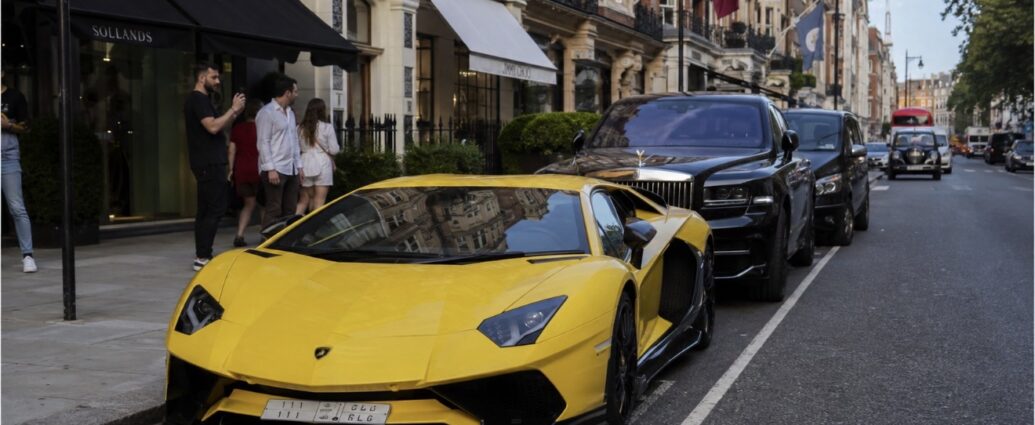
A £160 parking ticket means very little to someone who has spent tens of thousands of dollars flying a Lamborghini, Ferrari or Rolls-Royce into London for the summer.
That is the basic arithmetic behind an annual standoff playing out across some of London’s wealthiest neighborhoods.
Every summer, wealthy visitors from Saudi Arabia, Qatar, Kuwait and the United Arab Emirates arrive in Knightsbridge, Mayfair and Belgravia — and many bring their cars with them.
The vehicles can be transported by air at enormous cost, sometimes running into tens of thousands of dollars each way.
Against that expense, an ordinary parking ticket barely registers.
And that is exactly the problem London authorities are trying to solve.
Luxury cars are routinely found sitting on sidewalks, in restricted areas and outside high-end hotels and boutiques, while residents complain about blocked pedestrian routes, engine revving and late-night noise.
For many owners, simply issuing another ticket is not much of a deterrent.
The enforcement problem becomes even harder when the car is registered outside Europe.
Authorities can issue a penalty notice, but collecting the money later from the owner of a Saudi-, Qatari- or Emirati-registered vehicle can be difficult because Britain does not have the same access to foreign vehicle-registration information that it has within Europe.
The numbers show how large that gap can become.
Between 2018 and 2022, only about 1% of more than 13,000 parking tickets issued to UAE-registered vehicles were paid, according to data reported by The Wall Street Journal.
In 2025 alone, vehicles registered in Qatar received roughly 2,570 parking citations in Westminster, more than vehicles registered in any other foreign country.
So Westminster has started changing tactics.
If the Fine Does Not Hurt, Move the Car
One of the clearest examples came in Grosvenor Square.
After repeated complaints about luxury vehicles blocking the pavement outside the Chancery Rosewood hotel, Westminster moved a Saudi-registered Rolls-Royce worth roughly £250,000.
The council had acknowledged that issuing £160 penalty notices was not doing enough to deter wealthy drivers.
Instead of merely leaving another ticket under the windshield wiper, enforcement officers physically relocated the vehicle.
Other owners began moving their cars once the enforcement truck appeared.
That demonstrated something important.
A wealthy owner may not care much about losing £160.
But he may care about walking outside a five-star hotel and discovering that his Rolls-Royce is no longer where he left it.
Inconvenience can succeed where a fine does not.
London Is Going Further
The crackdown now extends well beyond parking.
Westminster and neighboring Kensington and Chelsea have spent years dealing with complaints about exotic cars racing, revving engines, performing stunts and gathering late at night.
In July 2026, the High Court granted authorities a sweeping injunction covering areas including Knightsbridge, Belgravia, St James’s, Hyde Park and the West End.
The order prohibits dangerous driving, racing, driving in convoys, performing stunts, excessive engine revving, unnecessary horn use and other disruptive behavior linked to organized car gatherings.
The order also carries a power of arrest.
Drivers who breach it can potentially face much more serious consequences than an ordinary parking ticket.
Authorities have also warned that major violations could ultimately result in large fines or the seizure of assets.
That changes the calculation considerably.
Seizing a Lamborghini Gets Attention
Police have already shown how effective taking the vehicle itself can be.
In a major operation supported by the Motor Insurers’ Bureau, Metropolitan Police seized 72 vehicles valued at almost £7 million while targeting dangerous and uninsured driving around Hyde Park, Kensington and Chelsea.
High-end supercars made up a significant portion of the vehicles.
Among them were two nearly identical purple Lamborghinis that had been flown into Britain for their owner’s summer visit.
According to the Motor Insurers’ Bureau, one driver had been in Britain for only about two hours and driving for roughly 15 minutes before the Lamborghini was seized for lacking valid insurance.
That kind of enforcement matters because it removes the financial imbalance.
A £160 ticket can become part of the vacation budget.
Having a multimillion-dollar collection of cars impounded cannot.
Why London Cannot Simply Declare War on the Supercars
There is another side to the story.
These visitors are also extremely valuable customers.
London’s luxury hotels, restaurants, jewelers, fashion boutiques and department stores depend heavily on wealthy international travelers.
Mayfair and Knightsbridge are built around precisely this type of spending.
The same visitor whose Lamborghini annoys residents may also be spending thousands of pounds on hotel rooms, restaurants and shopping.
That leaves London with a delicate economic problem.
The city wants the tourist.
It wants the spending.
It wants the hotel bookings, restaurant bills and luxury retail purchases.
What it does not want is the pavement outside the hotel becoming a private parking bay — or residential streets becoming an overnight racetrack.
That is why authorities increasingly appear to be moving away from simply writing tickets and toward enforcement that actually affects the vehicle.
For the wealthiest visitors, the lesson is becoming increasingly clear:
If money makes the fine meaningless, London may have to make the car itself the leverage.
JBizNews Desk | London
© JBizNews.com All Rights Reserved. Reproduction or distribution without written permission is prohibited.