Commutes for more than 250,000 daily Long Island Rail Road riders were upended Monday as workers at the nation’s busiest commuter rail service remained on strike amid a wage dispute. More than 3,500 workers represented by five unions walked off the job Saturday, shutting down rail service as they pushed for a 14.5 percent raise over four years, which union leaders say is necessary to keep pace with inflation, according to ABC News. A full day of negotiations that began Sunday and ran into Monday morning failed to produce an agreement, forcing commuters to rely on alternate transportation or work from home while talks continue.

The strike, the agency’s first in more than 30 years, has been building for months. The unions and the Metropolitan Transportation Authority have been negotiating a new contract since 2023, with talks repeatedly stalling over wages and healthcare premiums, according to the Associated Press.
Last September, a strike was narrowly avoided after the unions asked the Trump administration to establish an emergency board to help broker a deal with the MTA over wage increases.
The five unions involved are the Brotherhood of Locomotive Engineers and Trainmen (BLET), Brotherhood of Railroad Signalmen (BRS), International Association of Machinists and Aerospace Workers, International Brotherhood of Electrical Workers, and Transportation Communications Union.
Before the strike began Saturday, both sides attempted to avoid service disruptions, agreeing to retroactive wage increases of 3 to 3.5 percent for each of the past three years. However, a pay increase for this year remains the sticking point, with unions originally seeking a 6.5 percent raise while the MTA is seeking to cap it closer to 3 percent, according to Time.
According to a BRS press release, the unions agreed to lower their demand from 6.5 percent to 5 percent in March, and as of May 15, had brought it down to the upper 4 percent range, while the MTA’s offer stood in the mid-3 percent range.
Janno Lieber, chairman and CEO of the MTA, said the unions’ wage demands would “implode” the agency’s budget, adding that the average salary for workers in the five unions is $136,000, among the highest for rail workers nationwide.
“Obviously, this is not the result we were looking for. Like Governor Hochul said, everybody loses in a strike – the MTA, the thousands of workers who are going to lose wages, and most of all, the riders who rely on the railroad every day,” Lieber said in a statement on Saturday.
“I—and this MTA Board—have been clear that we cannot responsibly make a deal that implodes MTA’s budget. We refuse to make a deal that puts it on riders and taxpayers to fund outsized wage increases—far beyond what anyone else at the MTA is getting —and for folks who are already the highest-paid railroad workers in the country.”
During a press conference on Sunday, Gov. Kathy Hochul said she values the work of LIRR workers and believes they deserve fair wages. But, she added, the MTA has “made multiple generous offers with real wage increases.”
“New York, everyone knows, is a pro-labor state. We believe in working men and women receiving a fair wage and benefits,” Hochul said. “But the MTA cannot agree to a contract that would raise fares as much as 8 percent and risk hiking taxes for Long Islanders. I have worked too long and hard to reduce costs for our residents, and I will not allow that to be undone.”
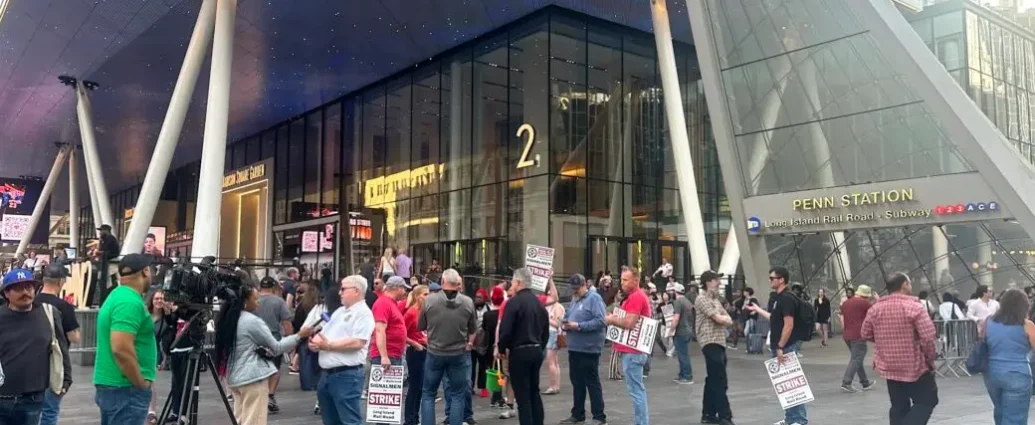
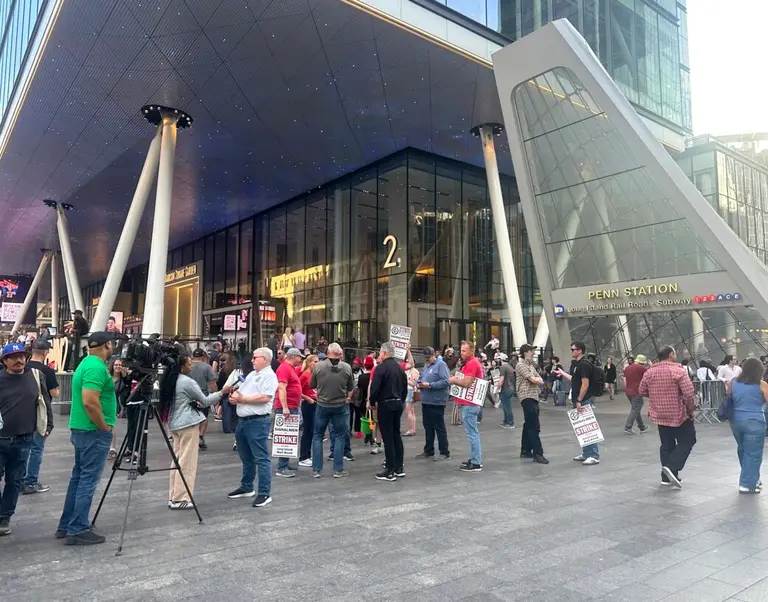
Since Saturday, striking LIRR workers have picketed outside the Long Island Rail Road entrance to Penn Station, calling for fair wages, a fair contract, and “dignity,” according to the BBC.
“This strike would not have happened if the MTA and LIRR offered our members the reasonable terms the government recommended multiple times. But management refused,” Mark Wallace, president of BLET and the Teamsters Rail Conference, said in a press release.
“We hope LIRR gets serious soon to avoid further unnecessary disruptions for hundreds of thousands of New Yorkers. They know where to find us when they’re ready: on the streets,” he added.
During the strike, the MTA is running limited weekday shuttle bus service for essential workers and those unable to work from home. Buses will operate during peak hours—toward Manhattan from 4:30 a.m. to 9 a.m. and toward Long Island from 3 p.m. to 7 p.m.—from six locations, with limited reverse-peak service available on select routes.
Peak and reverse peak direction service:
- Bay Shore to Howard Beach-JFK Airport
- Huntington to Jamaica-179th Street at Hillside Avenue and 179th Street
- Ronkonkoma to Jamaica-179th Street at Hillside Avenue and 179th Street
Peak direction service only:
- Hempstead Lake State Park, near Lakeview, to Howard Beach-JFK Airport
- Hicksville to Howard Beach-JFK Airport
- Mineola to Howard Beach-JFK Airport
The MTA will also issue refunds to riders with monthly rail passes for business days without train service, pending approval from the agency’s board, according to the New York Times.
The last time LIRR workers went on strike was in 1994, a two-day work stoppage over pay and work-related rules. The strike ended with then-MTA Chairman Peter E. Stangl conceding to the union’s demands, as 6sqft previously reported.
RELATED:
- LIRR strike avoided for now after unions ask Trump to intervene
- LIRR strike: Here’s what riders need to know
The post Long Island Rail Road workers strike for first time in more than 30 years first appeared on 6sqft.