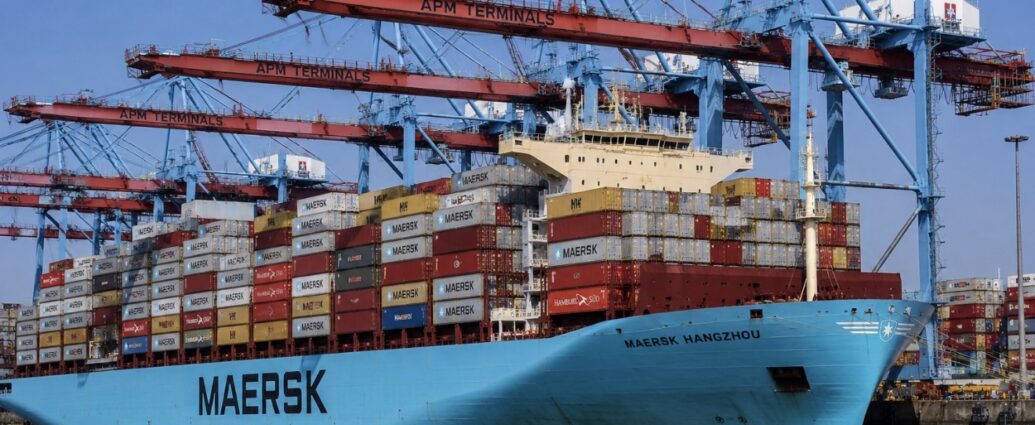
A.P. Moller-Maersk, one of the world’s largest shipping companies and among the clearest barometers of global trade activity, warned investors that the Iran war is now adding roughly $500 million per month to operating costs and that the disruption is likely to worsen through the second half of the year.
The warning from the Danish shipping giant underscores how rapidly the conflict is spreading beyond energy markets into the core infrastructure of global commerce.
Chief Executive Vincent Clerc told CNBC last week that the war has become a “new wake-up call” for international trade, warning that higher fuel, insurance and rerouting costs are now flowing through virtually every segment of global shipping.
Maersk, which handles roughly 14% of worldwide containerized trade and operates a fleet of approximately 700 vessels, reported first-quarter revenue of $13 billion, down 2.6% year over year.
The company’s operating profit collapsed nearly 75% to $340 million, while underlying EBITDA fell sharply to $1.75 billion from $2.71 billion a year earlier.
Although the EBITDA figure modestly exceeded Wall Street expectations, investors focused heavily on the company’s warning that conditions are likely to deteriorate further.
Shares fell as much as 7.5% in Copenhagen trading following the report.
The economics confronting the shipping industry have become increasingly punishing.
Maersk consumes roughly 8 million tonnes of bunker fuel annually, making it one of the world’s largest non-refining oil consumers. With Brent crude trading near $107 per barrel and West Texas Intermediate hovering around $101, fuel costs have surged structurally higher since the conflict intensified earlier this year.
At the same time, insurance premiums for Persian Gulf shipping routes have risen sharply as commercial traffic through the Strait of Hormuz remains heavily disrupted.
Clerc warned investors that the economic damage tied to the conflict will likely persist even after any eventual ceasefire.
“The energy crisis does not go away the day peace comes,” Clerc said, adding that oil companies expect elevated costs to continue for “at minimum several more months.”
The implications extend far beyond shipping companies themselves.
Maersk’s customer base includes some of the world’s largest retailers and manufacturers, including Walmart, Target, IKEA, Carrefour, Apple and countless midsize importers that now face increasingly difficult decisions about whether to absorb higher freight costs, raise consumer prices or reduce inventory orders altogether.
The company maintained its full-year guidance, projecting underlying EBITDA between $4.5 billion and $7 billion, but management acknowledged that risks remain heavily tilted toward weaker demand and continued supply-chain disruption.
One of the most important questions raised during the earnings call centered on consumer demand destruction.
Clerc openly questioned whether elevated shipping and energy costs would eventually weaken global consumer spending enough to trigger broader economic slowdown.
“Will we see demand destruction at the consumer level? And will that then reverberate throughout the supply chain with softer demand in the second part of the year?” the CEO asked investors.
The concern is increasingly shared across the broader energy and logistics sectors.
The International Energy Agency recently revised down its 2026 global oil-demand forecast, now projecting a contraction of approximately 80,000 barrels per day compared with earlier expectations for significant growth.
Meanwhile, shipping companies face another problem entirely: oversupply.
Despite weakening demand conditions, large new vessels ordered during the post-pandemic shipping boom continue entering the market. Maersk itself ordered eight additional ships earlier this year, while competitors including MSC, CMA CGM, Hapag-Lloyd, COSCO Shipping and ONE continue managing excess capacity through increasingly aggressive rate-discipline strategies.
Asia-Europe freight rates briefly surged after the war began but have since drifted back toward prewar levels even as fuel costs remain structurally elevated — a dynamic analysts at Morgan Stanley warned could significantly compress industry margins.
For American consumers, the consequences are direct.
Roughly 40% of all containerized imports entering U.S. ports either move on Maersk-operated vessels or pass through Maersk-managed terminals. When freight rates rise, those costs ultimately filter through to retail shelves at Home Depot, Costco, Nike, electronics distributors and countless other consumer-facing businesses.
Recent earnings warnings from companies including Birkenstock have already begun quantifying the impact.
The military situation itself also remains fragile.
The U.S. Navy has started escorting selected commercial vessels through Hormuz, including Maersk’s U.S.-flagged Alliance Fairfax, but six company-owned or chartered vessels remain trapped inside the Persian Gulf because, as Clerc put it, “we cannot risk the lives of our crews.”
A “large part” of the strait, he warned, is currently mined.
For global markets, the message from one of the world’s most important shipping companies is becoming increasingly difficult to ignore: the Iran conflict is no longer merely an oil shock. It is rapidly becoming a full-scale supply-chain and trade crisis with direct consequences for inflation, consumer prices and global growth.
JBizNews Desk
© JBizNews.com. All rights reserved. This article is original reporting by JBizNews Desk. Unauthorized reproduction or redistribution is strictly prohibited.