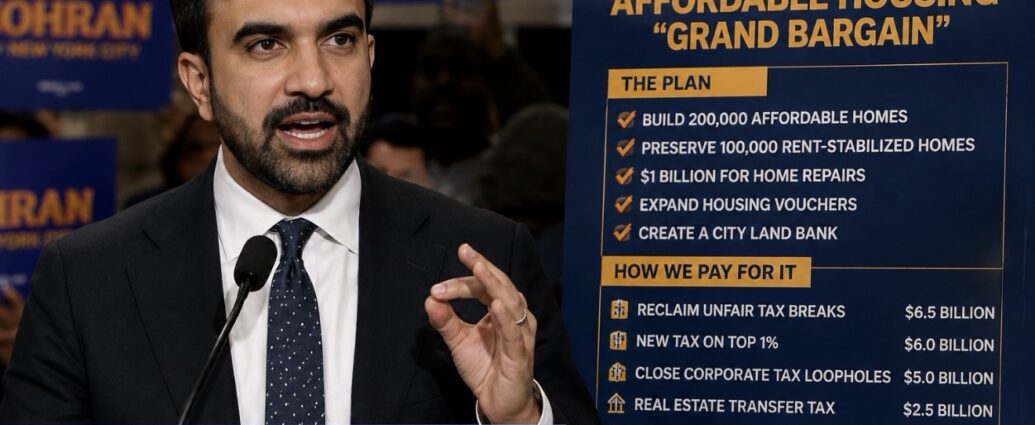
Zohran Mamdani ran for mayor on one promise: make New York City affordable again.
This week, he moved to further dismantle the rules New York spent decades erecting to prevent residential density. Mamdani released a 10-year housing plan pledging to build 200,000 new affordable homes while preserving 200,000 more.
“These are the most ambitious affordable housing goals any mayoral administration has set to date,” Deputy Mayor for Housing and Planning Leila Bozorg wrote in the plan.
The stakes extend well beyond New York. Cities nationwide are struggling to contain runaway rents and shrinking vacancy rates. Austin, Texas, has shown one path forward. Aggressive zoning reform fueled a building boom that pushed rents down for more than 30 consecutive months.
Now, all eyes are on the Big Apple. With the nation’s largest public housing authority and its strongest tenant protections, the city is testing a harder proposition. Can a denser, older and more politically complex city do the same while protecting tenants from displacement?
The affordable housing plan
The plan, titled “Block by Block: The Housing Plan for a New Era,” commits more than $22 billion over five years. It addresses tenant protections, code enforcement, public housing repairs, zoning reform, homeownership and homelessness prevention.
“New York cannot remain a city of opportunity if the people who make this city run are priced out of it,” Mamdani wrote in the report.
During a press conference, he addressed the looming rent freeze directly. The Rent Guidelines Board is to vote in June on whether to freeze rents across the city’s roughly one million rent-regulated apartments, a signature Mamdani campaign pledge. The Mayor noted that the Department of Housing Preservation and Development (HPD) has existing tools available to distressed landlords on a case-by-case basis. He was firm that tenants would be protected.
“No tenant would see their rent increase beyond that which the RGB determines,” he said.
Beyond the rent debate, the plan’s centerpiece targets roughly 8,000 new affordable homes per year, leveraging the HPD toolbox. Of those, 30% will serve extremely low-income households. Another 20% will target very low-income residents. Production scales from 14,000 homes in fiscal year 2027 to more than 21,000 annually by fiscal year 2031.
Enforcement and zoning
Public housing is a central focus. The New York City Housing Authority serves more than 500,000 residents across 177,000 apartments in all five boroughs. The plan dedicates $5.6 billion in a five-year capital plan for the authority, the most in recent history. Funds target heating systems, elevators, roofs and mold remediation.
On enforcement, the plan launches “Fix the City.” The program directs HPD to conduct roof-to-cellar inspections and pursue legal action against the city’s worst landlords. HPD fielded 835,011 code complaints in fiscal year 2025, an 18% jump over fiscal year 2023.
The Bronx gets targeted attention. A new interagency initiative launches there in fall 2026, focusing on the South Bronx and Northwest Bronx, where 10% of households face an eviction filing every year. More than a quarter of Bronx households reported three or more serious maintenance deficiencies in their homes.
On zoning, the plan pursues citywide transit-oriented development and an Affordable Housing Fast Track. Public review would be capped at 90 days, down from a typical seven months, in 12 underbuilt community districts.
The urgency is plain. New market-rate apartments now rent for roughly $3,000 per month, nearly double the citywide average of $1,650.
The plan also takes direct aim at homeownership gaps. It launches “Our Home,” a new program to convert rental buildings into resident-controlled cooperatives. HPD expects to support 300 new affordable co-op units in fiscal years 2027 and 2028. The plan also expands community land trusts, doubles production through the Open Door homeownership program and launches a new Mortgage Assistance Program to help low-income owners avoid foreclosure.
Early affordable housing wins
Tuesday’s plan builds on five months of early groundwork. Mamdani convened first-of-their-kind Rental Ripoff Hearings in all five boroughs and re-established the Mayor’s Office to Protect Tenants. He launched the SPEED Task Force to eliminate bureaucratic delays. Its May 13 report identified reforms that will cut development timelines by eight months, and by two years for projects requiring zoning changes.
Mamdani is also building on zoning changes that predate his administration. State lawmakers lifted restrictive floor-area ratio caps in 2024, scrapping 1960s-era density limits.
Then-Mayor Eric Adams followed with City of Yes for Housing Opportunity, a sweeping zoning amendment that expanded where multifamily buildings can be built, enabled more commercial-to-residential conversions and legalized accessory dwelling units. Mamdani has moved to capitalize on both.
One early example of the new zoning framework taking shape is 395 Flatbush in Brooklyn. City officials issued permits in March for a mixed-use tower that will rise 32 stories on a lot now holding a two-story building. It is among the first projects to fully exploit the higher residential FARs state law unlocked.
Also in March, his administration launched “ADU for You,” a digital platform offering pre-reviewed plans for backyard cottages, basement apartments and attic conversions. A companion program, Plus One, provides low- or no-interest financing to eligible owners who agree to keep new units affordable.
Mamdani also announced Neighborhood Builders Fast Track, designed to accelerate affordable projects on city-owned land. Combined with referendums approved last November, Mamdani said the program could shave two and a half years off housing construction timelines.
City Hall projects the program could add up to 1,000 affordable homes over the next two years.
Historical ambition
History sets a high bar. At its peak in the 1950s and 1960s, New York City was adding thousands of public housing units annually. Federal dollars flowed freely. Regulatory constraints were few.
Much of that era was shaped by Robert Moses. He accumulated power across multiple city roles simultaneously: parks commissioner, city construction coordinator and chairman of the Mayor’s Committee on Slum Clearance.
He never ran NYCHA. But as construction coordinator under Mayor William O’Dwyer, no federally funded housing project could advance without his approval. His slum clearance committee used the National Housing Act of 1949 to seize and demolish neighborhoods deemed blighted. Entire communities in the Bronx, Harlem and Brooklyn were razed to make way for dense towers.
The backlash was swift and lasting. New York City’s 1961 zoning resolution dramatically reduced permissible housing density across the outer boroughs. New apartment buildings became nearly impossible to erect across large swaths of Brooklyn, Queens and the Bronx. Process reforms followed. Community boards, environmental review procedures and the Uniform Land Use Review Procedure added multiple veto points to any large development proposal. The intent was to ensure no one would ever again wield Moses-level power over neighborhoods.
Those same guardrails, built to prevent another Robert Moses, hardened into the regulatory thicket that helped produce the affordability crisis Mamdani and previous mayors inherited. Dismantling them, piece by piece, through changes to state law and city zoning reforms, has become central to the affordability effort.
Mamdani’s effort broadens the full circle the city has taken to address long-term affordability. The city that once demolished neighborhoods to build housing is now tearing down the rules it put in place to prevent that from happening again.