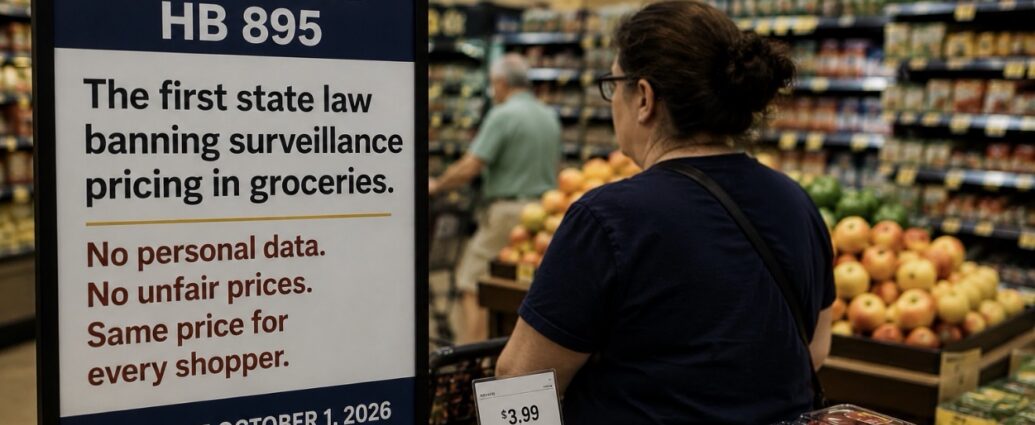
Maryland has become the first U.S. state to outlaw surveillance pricing in grocery stores and delivery services, with Governor Wes Moore signing the Protection from Predatory Pricing Act on April 28, 2026. The law, formally known as House Bill 895, takes effect October 1 and prohibits supermarkets larger than 15,000 square feet, along with third-party grocery delivery platforms, from using shoppers’ personal data to charge different prices for the same item at the same time.
The legislation directly targets the growing use of AI-driven pricing systems that analyze consumers’ location data, browsing behavior, shopping history, and other digital signals to personalize prices in real time. Supporters say the practice increasingly allows retailers and delivery apps to quietly charge some consumers more than others without their knowledge.
The law follows a December 2025 investigation by Consumer Reports, conducted alongside Groundwork Collaborative and More Perfect Union, which documented significant price disparities across grocery delivery platforms. Researchers found that some shoppers purchasing identical grocery baskets simultaneously through Instacart faced prices up to 23% higher than others, potentially costing households more than $1,200 annually.
Instacart discontinued the specific pricing experiment shortly after the investigation became public but acknowledged that retailers and brands would continue testing promotional and discount structures through its platform.
“Marylanders should never have to wonder whether the price on the shelf is the same one their neighbor is seeing,” Moore said when announcing the measure earlier this year, framing the law as both a consumer-protection and affordability initiative.
The legislation builds on Maryland’s 2024 online privacy law and arrives amid growing federal scrutiny over algorithmic pricing practices. The Federal Trade Commission, which opened its own surveillance-pricing investigation in 2024, previously concluded that retailers increasingly use personal information — including location tracking and browsing behavior — to determine individualized pricing strategies.
Under the Maryland statute, “dynamic pricing” is narrowly defined as charging a personalized price based on a consumer’s personal data, regardless of whether the retailer collected or purchased the information itself.
The law applies to many of the nation’s largest grocery and retail chains, including Walmart, Kroger, Albertsons, Costco, Target, Whole Foods Market, Aldi, Wegmans, Giant Food, and major delivery platforms such as Instacart, Amazon Fresh, DoorDash, and Uber Eats.
Violators face civil penalties of $10,000 for a first offense and $25,000 for subsequent violations. The law also prohibits retailers from using protected demographic data — including race, ethnicity, or gender — to deny discounts or pricing advantages available to other customers.
Consumer advocates, however, caution that the legislation contains important exemptions that could limit its impact. Loyalty programs, subscription discounts, promotional offers, geographic pricing differences, supply-and-demand adjustments, and temporary pricing errors remain permitted under the law.
Following the bill’s passage, Consumer Reports warned that retailers may still be able to continue forms of surveillance-style pricing through loyalty programs or promotional structures that technically comply with the statute.
The Maryland Retail Alliance, which initially opposed the legislation, withdrew objections after lawmakers added several of the exemptions during negotiations.
The issue has gained urgency as retailers rapidly deploy digital shelf-label technology capable of changing prices almost instantly across entire store networks. Walmart announced in 2024 that it plans to install electronic shelf labels in 2,300 stores by the end of 2026, while chains including Kroger, Whole Foods Market, and several regional grocers have piloted similar systems.
AI-powered pricing software from companies such as Eversight — whose technology was reportedly involved in the Instacart pricing tests highlighted by Consumer Reports — has also spread rapidly throughout the retail industry.
Other states are now closely watching Maryland’s approach. Legislators in California, Colorado, Illinois, New Jersey, and New York are considering similar measures, with some proposals extending restrictions beyond grocery retail into broader consumer categories.
For national retailers, the practical business strategy may increasingly become operating under the strictest state standard nationwide rather than maintaining multiple pricing systems across jurisdictions — a complexity that many retailers may find operationally costly.
Legal experts say the ultimate effectiveness of Maryland’s law will depend heavily on enforcement and how businesses classify various pricing practices. Attorneys at Greenberg Traurig and analysts at the International Association of Privacy Professionals have noted that regulators will likely scrutinize how retailers document the difference between legitimate promotional pricing and prohibited personalized pricing.
Between now and the October 1 implementation date, retailers are expected to conduct extensive compliance reviews, auditing how customer data enters pricing systems and reassessing loyalty-program structures, marketing algorithms, and AI-driven promotional tools.
For Maryland consumers, however, the message behind the law is intended to be straightforward: the price displayed on the shelf should be the same price every shopper pays — regardless of what retailers know about them digitally.
JBizNews Desk
© JBizNews.com. All rights reserved. This article is original reporting by JBizNews Desk. Unauthorized reproduction or redistribution is strictly prohibited.