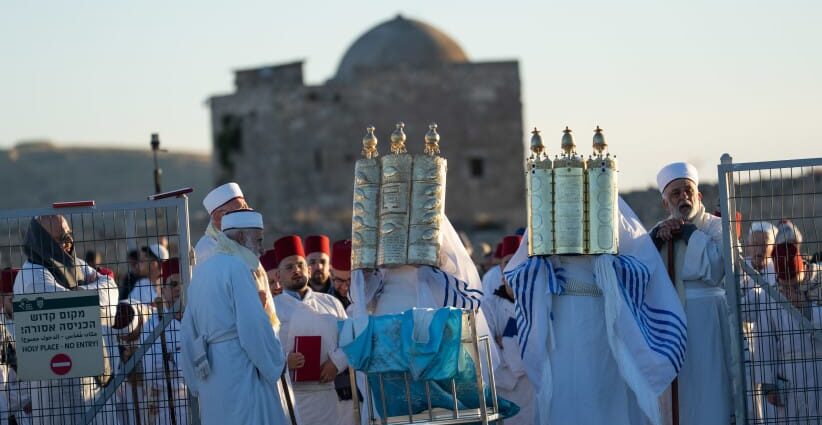
Earlier this week, I had the privilege of attending the Samaritan Shavuot ceremony on Mount Gerizim, courtesy of a fabulous tour led by tour guide David Fensterheim.
It was one of those experiences that leaves a lasting impression. Fascinating, uplifting, and, if I am honest, slightly unsettling.
As an Orthodox Jew brought up in an ostensibly Christian country, attending a non-Jewish high school and a multicultural university, I have spent much of my life thinking about Jewish faith and the challenges posed by modernity and by other religions.
Christianity and Islam, despite their many differences, are relatively straightforward from a Jewish perspective. They accept our foundational story but claim that a later revelation superseded it. I have never found those claims threatening to my own beliefs.
The Samaritans are different. They are a tiny community of around 800 souls, divided between Holon and Kiryat Luza near Nablus. They trace their ancestry back to the ancient Israelites and possess a version of the Torah that differs only slightly from our own. Their central point of departure from mainstream Judaism is their belief that Mount Gerizim, rather than Jerusalem, is the divinely chosen place, together with their rejection of the Oral Law and rabbinic tradition.
As I stood among them, watching ancient rituals performed with immense sincerity, hearing Hebrew prayers and seeing Torah scrolls carried with reverence, I could not help feeling that I was encountering not strangers, but long-lost cousins.
Their Torah is, with only relatively minor differences, our Torah. Abraham, Isaac, Jacob, and Moses are their ancestors no less than ours. Yet somewhere in the distant past, our paths diverged.
They maintained a more literal reading of the written text. We embraced a tradition of interpretation and transmission that became the foundation of rabbinic Judaism.
Seeing the landscapes of the Bible brought the biblical narrative vividly to life. Places that I had read about since childhood suddenly became tangible realities.
Ancient Nablus, where Dina was raped and where Joseph is buried; Mount Gerizim and Mount Ebal, where the blessings and curses were proclaimed in the days of Joshua, ceased to be names on a page and became living history.
Living in the Land of Israel has many blessings, but one of the greatest is the privilege of walking through the landscapes in which our national story unfolded.
I found myself reflecting on a profound question: How do we affirm our own tradition while acknowledging the sincerity and antiquity of another?
Perhaps the answer lies in understanding what Judaism has always claimed about itself.
Rabbi Yehuda Halevi, writing nearly a thousand years ago in the Kuzari, offered an insight that remains deeply relevant. Judaism, he argued, rests not merely upon a sacred text, but upon the continuous testimony and transmission of an entire people.
Books can be interpreted in different ways. Geography can be contested. Communities can disagree. But the enduring chain of national memory carries a weight all of its own.
The first Mishnah in the Ethics of the Fathers begins: “Moses received the Torah from Sinai and transmitted it to Joshua. Joshua to the Elders, the Elders to the Prophets.” Judaism is not merely a book. It is a tradition, a living chain stretching from generation to generation.
Had Judaism consisted only of the written Torah, the Samaritan challenge would indeed be much stronger. After all, they possess virtually the same text and preserve traditions of impressive antiquity and sincerity.
Yet Judaism always understood Torah differently. Revelation was entrusted not to isolated readers but to a people. The written word and its interpretation were transmitted together. Torah was never intended to stand alone, detached from the community that received it.
A living tradition, not just a text
History itself provides striking testimony to this. Jewish communities separated for centuries by oceans, languages, and cultures nevertheless continued to read the same Torah, celebrate the same festivals, and direct their prayers toward the same Jerusalem.
This remarkable continuity was made possible by the very rabbinic tradition that some have viewed as an addition to the Torah. In reality, it proved to be the means by which Torah remained alive.
None of this diminishes my admiration for the Samaritan community. Quite the opposite. They have preserved ancient traditions against overwhelming odds. Their survival is itself extraordinary and deserves respect.
Perhaps their existence teaches us something else as well. In an age increasingly characterized by certainty and intolerance, we often imagine that acknowledging the sincerity of others somehow weakens our own convictions. I believe the opposite is true.
Confidence in one’s faith does not require contempt for another’s. Recognizing that others seek God with honesty and devotion does not undermine our beliefs. Rather, it deepens our appreciation for the extraordinary heritage we have inherited.
In 2002, Rabbi Lord Jonathan Sacks famously wrote in the first edition of his book The Dignity of Difference: “No one creed has a monopoly on spiritual truth.”
At the time, the phrase generated controversy, and Sacks was made “to clarify” his view. Yet perhaps one of his enduring insights was that humility and confidence are not opposites.
Acknowledging that others possess elements of truth does not mean that all ideas are equally true. Differences matter. The choice between Mount Gerizim and Jerusalem matters. The Oral Law matters. Jewish history matters.
But humility matters too.
Standing on Mount Gerizim, I did not come away doubting Jerusalem. If anything, I came away with a deeper appreciation for the miracle of Jewish continuity.
The existence of the Samaritans reminds us that possessing a text is not enough. The greater wonder is the survival of a people and a living tradition.
Perhaps that is one of the deepest lessons of living once again in the Land of Israel.
After two thousand years of exile, we can walk through the landscapes of the Bible, encounter communities whose roots stretch back thousands of years, and appreciate the astonishing tapestry of faith and history that surrounds us.
Standing on that mountain, among people whose ancestors once parted company with our own, I felt no weakening of my faith. Quite the contrary. I felt gratitude.
Gratitude that ancient disputes are no longer fought with swords. Gratitude that I can see with my own eyes the places where our history unfolded. Gratitude that after two millennia of exile, the Jewish people have returned home.
And gratitude that the hills and valleys of this land still echo with the voices of those who have sought God here for thousands of years.
That, in itself, is nothing short of miraculous.
The writer is a rabbi and physician. He writes and teaches on Jewish ethics, leadership, and resilience. His work appears on rabbidrjonathanlieberman.substack.com and youtube.com. @rabbidrjonathanlieberman.