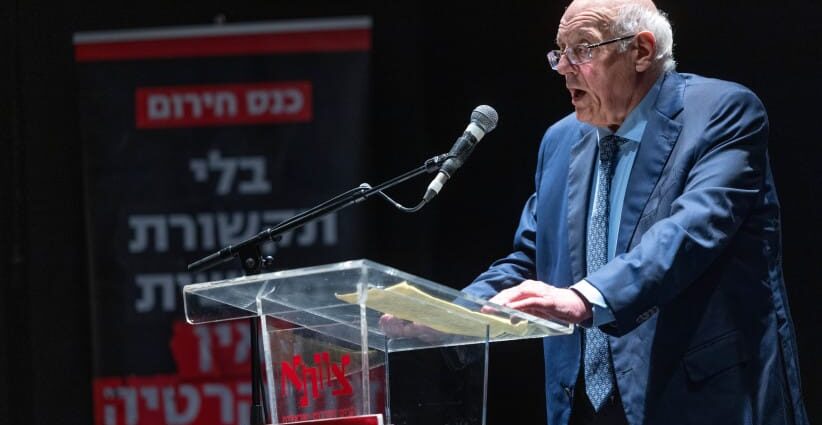
Former deputy Supreme Court president Prof. Hanan Melcer warned on Tuesday that Israel’s election integrity was at risk ahead of a possible early election, but he said the danger could be prevented through preparation against artificial intelligence (AI), anonymous online activity, and foreign interference.
“Election integrity is in danger,” Melcer said during a panel at the Herzliya Conference of the Institute for Policy and Strategy at Reichman University. “But the danger can be prevented.”
Melcer, who previously chaired the Central Elections Committee, said election officials must constantly consider possible threats to the voting process. “You always have to think about what could happen,” he said.
He noted that social media had become a central part of campaigning during his term and said he had issued a precedent-setting decision aimed at limiting anonymous election activity online.
“In everything concerning social networks, there should effectively be no anonymity during an election period,” he said.
AI had created a further challenge, Melcer added.
“Today, AI has entered the picture, which did not exist in my time,” he said.
Melcer: Israel must prepare for election interference
Melcer also warned that Israel should prepare for attempts at foreign or domestic interference in elections, though he said that, based on publicly available information, such efforts had not succeeded in the two elections he oversaw.
On the changing definition of journalism, Melcer said that social media figures who publish factual reporting should receive the protections afforded to journalists.
“If you bring journalistic information and not only opinions, you are considered a journalist,” he said.
He also called for press cards to be issued by the Israel Press Council rather than the Government Press Office, while retaining security screening in consultation with security authorities.
Asked to assess press freedom in Israel, Melcer gave it a score of 70/100 and linked its decline to government policy. Israel ranked 116th out of 180 countries in Reporters Without Borders’ 2026 World Press Freedom Index, down from 112th a year earlier.
Melcer pointed to Communications Minister Shlomo Karhi’s proposed Broadcasting Law, which would overhaul the regulation of commercial broadcasting and streaming services. Critics have warned that aspects of the proposal could increase political influence over the media, while Karhi has argued that it would reduce regulation and increase competition.
“If, God forbid, this progresses, then we will go down even further,” Melcer said.
Petitions remain against High Court decision
He also addressed the government’s decision to close Army Radio. The High Court has frozen the closure while petitions challenging the decision remain pending, and has issued a conditional order requiring the government to explain why the decision should not be canceled.
“We, as the Press Council, are a party to the Galei Tzahal petition, and until now we have succeeded in preventing its closure,” Melcer said. “I am cautiously optimistic.”
He warned that further moves affecting the media, judiciary, and academia could weaken Israel’s democratic character.
“If that happens, we will move from a democracy to something that is not a democracy,” he said.
Sarah Ben-Nun contributed to this report.