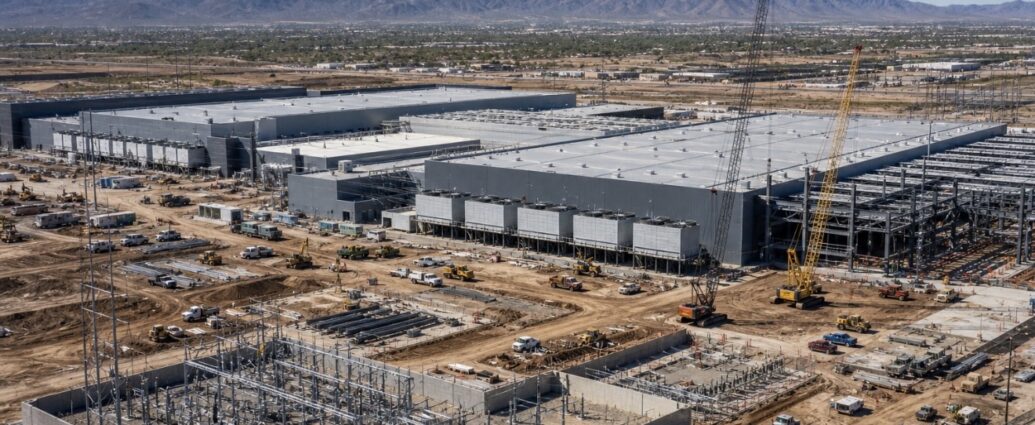
Morgan Stanley and JPMorgan Lead Debt-Heavy Financing for One-Gigawatt El Paso Campus — One of the Largest Single-Site Infrastructure Deals in U.S. History
By JBizNews Desk | New York — May 6, 2026
Meta Platforms has tapped Morgan Stanley and JPMorgan Chase to structure a roughly $13 billion financing package for its massive artificial intelligence data center campus in El Paso, Texas — a deal that highlights how aggressively Big Tech is turning to Wall Street to fund the infrastructure behind the AI boom.
A large majority of the financing is expected to come from debt, with the remainder in equity, according to people familiar with the matter. The deal, first reported by Bloomberg, would rank among the largest single-site digital infrastructure financings ever assembled globally.
The financing comes in addition to Meta’s own capital commitment. In March, the company increased its direct investment in the El Paso project to more than $10 billion, targeting a total capacity of one gigawatt ahead of a planned 2028 opening. The newly structured $13 billion package represents outside capital layered on top of that internal spending — a sign of how quickly the scale of the project has grown.
How the Project Grew
The expansion of Meta’s West Texas campus has been rapid and dramatic.
Originally announced in October 2025 as a $1.5 billion initiative, the project — internally known as “Project Seafox” — has since ballooned more than sixfold. At full build-out, the site will span approximately 1,000 acres and be constructed in five phases.
The first phase alone includes 12 buildings and five substations across 600 acres, with construction costs estimated at $289 million. Contractors JE Dunn Construction and Hensel Phelps are leading development, with more than 4,000 workers expected on-site at peak activity. Once complete, the campus is projected to support more than 300 permanent jobs.
The scale is difficult to contextualize. One gigawatt of power — Meta’s stated target for the site — is enough to supply roughly 750,000 U.S. homes, but instead will be used entirely to train AI models and power services for Meta’s nearly four billion users worldwide.
Why El Paso, Why Now
CEO Mark Zuckerberg has framed Meta’s infrastructure push as a long-term strategic necessity in the race for AI dominance. The company recently launched a new initiative, Meta Compute, with Zuckerberg stating that “Meta is planning to build tens of gigawatts this decade, and hundreds of gigawatts or more over time.”
He added that the company’s ability to engineer and scale infrastructure will itself become a competitive advantage.
El Paso offers a combination of factors that align with that strategy — including available land, access to power infrastructure, and political support for large-scale industrial investment. The project also aligns with federal priorities to expand domestic manufacturing and energy usage in key regions.
Meta has committed to adding more than 5,000 megawatts of clean energy to the grid and is working with El Paso Electric to meet the facility’s demands. The campus will use a closed-loop liquid cooling system designed to minimize water consumption — a critical factor in the desert environment.
The company has also invested over $8 million in local infrastructure improvements, including road upgrades, and is coordinating with El Paso Water to ensure long-term sustainability of the project’s footprint.
Big Tech’s Debt Playbook
The structure of the financing — heavily weighted toward debt — reflects a broader shift across the technology sector.
Rather than funding massive AI buildouts entirely from cash reserves, companies like Meta, Microsoft, and Amazon are increasingly treating data centers as infrastructure assets — similar to large-scale real estate developments — that can be financed through capital markets.
Meta’s total capital expenditure is expected to reach as much as $135 billion in 2026, with the bulk directed toward AI infrastructure. CFO Susan Li has said the company will remain “compute-constrained” through much of the year, meaning demand for AI processing power is already exceeding available capacity.
That dynamic is pushing companies to accelerate construction timelines while simultaneously seeking external financing to preserve balance sheet flexibility.
For El Paso, the implications are substantial.
The project represents one of the largest private investments in the region’s history, bringing thousands of construction jobs and positioning the city as a key node in the global AI economy. It will also reshape local energy demand and infrastructure, embedding West Texas into the backbone of next-generation computing.
As Big Tech races to build the physical foundation of artificial intelligence, projects like Meta’s El Paso campus are no longer outliers — they are becoming the new standard.
And increasingly, Wall Street is helping foot the bill.
JBizNews Desk
© JBizNews.com. All rights reserved.