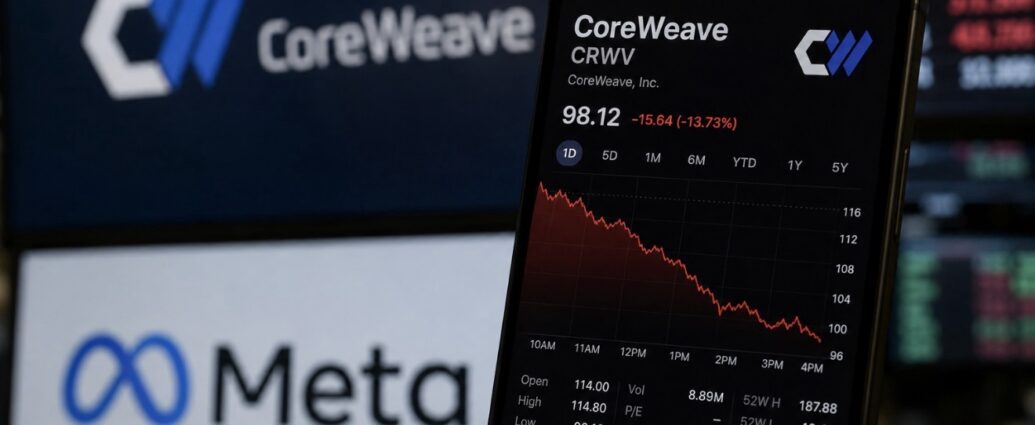
Meta Platforms Inc. is expanding its artificial intelligence infrastructure by developing its own cloud business to market excess computing capacity, a move that could eventually place one of CoreWeave Inc.’s largest customers in direct competition with the AI cloud provider. The development comes just months after the two companies signed a long-term agreement valued at approximately $21 billion, according to CoreWeave’s April filing with the U.S. Securities and Exchange Commission.
CoreWeave, headquartered in Livingston, New Jersey, rents high-performance computing infrastructure powered primarily by Nvidia Corp. graphics processors used to train and operate advanced artificial intelligence systems. Founded in 2017 and publicly listed on the Nasdaq in 2025, the company has rapidly expanded by supplying AI computing capacity to some of the world’s largest technology companies. Chairman and Chief Executive Officer Michael Intrator has said growing demand reflects the increasing need for specialized computing infrastructure capable of supporting the next generation of AI applications.
The relationship with Meta Platforms became one of CoreWeave’s largest commercial wins when the companies announced an expanded agreement in April. Under the contract, CoreWeave will provide dedicated AI cloud capacity through December 2032, including deployments built around Nvidia’s next-generation Vera Rubin computing platform. The agreement represented one of the largest disclosed AI infrastructure contracts in the industry and significantly strengthened CoreWeave’s long-term revenue outlook.
Investor attention shifted this week after reports that Meta is exploring ways to commercialize excess computing capacity by offering cloud services to outside customers. While Meta has historically built AI infrastructure primarily for internal use, expanding into commercial cloud services could eventually place it alongside companies that currently provide AI computing to third parties, including CoreWeave.
CoreWeave’s latest financial results illustrate both the company’s rapid growth and the scale of its ongoing investment. For the first quarter of fiscal 2026, reported on May 7, revenue more than doubled to $2.08 billion, a 112% increase from the prior year and above analysts’ expectations. Net losses widened to $740 million from $315 million as the company continued investing aggressively in new data centers, computing equipment and infrastructure needed to meet rising customer demand.
The company also disclosed signing more than $40 billion in additional customer commitments during the quarter, increasing its contracted revenue backlog to nearly $100 billion. Chief Financial Officer Nitin Agrawal reaffirmed the company’s full-year outlook, saying pressure on profit margins should moderate as recently deployed infrastructure becomes fully operational. CoreWeave expects to invest between $31 billion and $35 billion in capital expenditures this year, reflecting continued expansion and higher equipment costs.
Those figures underscore the balance investors continue to evaluate. CoreWeave benefits from long-term, take-or-pay contracts that generally require customers to pay for reserved computing capacity regardless of actual usage, limiting the immediate impact of changing customer strategies. At the same time, the company remains highly leveraged, carrying approximately $25 billion in long-term debt while continuing to invest heavily to expand capacity.
The development also reflects a broader shift occurring across the artificial intelligence industry. Major technology companies are investing billions of dollars to build proprietary AI infrastructure while increasingly exploring opportunities to monetize unused computing resources. As hyperscale technology companies become both customers and potential competitors, traditional distinctions between cloud providers and cloud users continue to blur.
For businesses and investors, the larger story extends beyond one company’s stock performance. Demand for artificial intelligence computing infrastructure continues to accelerate as companies race to deploy increasingly sophisticated AI models. Whether specialized providers such as CoreWeave can maintain their competitive advantage as major technology companies expand their own commercial cloud offerings will be one of the defining questions shaping the AI infrastructure market in the years ahead.
JBizNews Desk | Wall Street
© JBizNews.com All Rights Reserved. Reproduction or distribution without written permission is prohibited.