By JBizNews Desk
A landmark courtroom battle unfolding in Santa Fe, New Mexico is rapidly emerging as one of the most consequential legal threats ever faced by a technology company, with Meta Platforms confronting the possibility of billions in damages, sweeping regulatory mandates, and a precedent that could fundamentally reshape the social media industry in the United States.
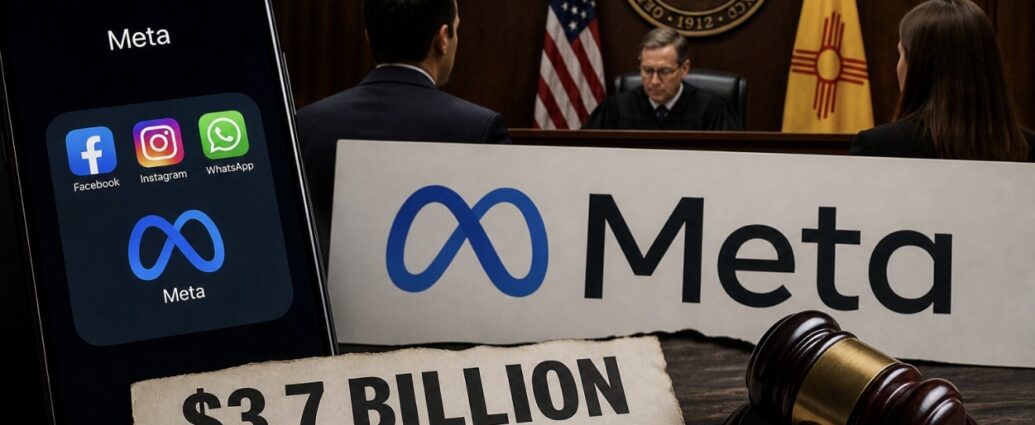
The case has entered its second phase following a jury verdict that ordered $375 million in civil penalties, finding that Meta knowingly contributed to harm against children and failed to adequately address risks tied to exploitation and mental health on its platforms. Prosecutors, led by New Mexico Attorney General Raúl Torrez, are now seeking approximately $3.7 billion in abatement costs, along with court-ordered changes that would significantly alter how Meta operates Facebook, Instagram, and WhatsApp.
The lawsuit stems from a 2023 undercover investigation conducted by the Attorney General’s office, which created a fake account posing as a 13-year-old girl. According to the state, the account was quickly exposed to inappropriate content and predatory outreach. “Meta executives knew their products harmed children, disregarded warnings from their own employees, and lied to the public about what they knew,” Torrez said, framing the case as a systemic failure rather than an isolated lapse.
At the heart of the trial is the state’s argument that Meta’s platforms function as a public nuisance — a legal theory rarely applied to technology companies and one that, if upheld, could dramatically expand liability across the industry. Prosecutors are pushing for aggressive remedies, including enforceable age-verification systems, removal of bad actors, and restrictions on encrypted communications that can shield illegal activity from detection.
Meta has strongly rejected the allegations and is preparing for a prolonged legal fight. The company has already indicated it will appeal the jury’s initial ruling and warned that it may consider withdrawing services such as Facebook and Instagram from New Mexico rather than comply with what it describes as unworkable mandates. A Meta spokesperson said the company “remains committed to providing safe, age-appropriate experiences” and highlighted that more than a dozen safety initiatives have been introduced over the past year.
The presiding judge, State District Court Judge Bryan Biedscheid, has signaled caution about the scope of the court’s authority, raising concerns about whether the judiciary should effectively impose regulatory frameworks typically handled by lawmakers. “I’m probably not the easiest sell on the idea where I would become a one-person legislator, judge and executive branch enforcer,” Biedscheid said during proceedings, underscoring the complexity of the case.
Legal experts say the implications extend far beyond New Mexico. Eric Goldman, co-director of the High Tech Law Institute at Santa Clara University School of Law, described the case as extraordinary. “The fact that we’re having a trial on nuisance is itself a remarkable outcome,” Goldman said. “That theory is not well accepted as applied to the internet.” His comments reflect broader skepticism within legal circles about whether traditional liability frameworks can be effectively applied to modern digital platforms.
Still, momentum appears to be building behind efforts to hold social media companies more accountable. Nikolas Guggenberger, assistant professor at the University of Houston Law Center, pointed to the jury’s initial verdict as a turning point. He noted that the decision has already “punctured the aura of invincibility” surrounding large technology firms, particularly in relation to Section 230 of the Communications Decency Act, the long-standing legal shield that has historically protected platforms from liability over user-generated content.
For policymakers and regulators, the case is being closely watched as a potential inflection point — one that could mirror the legal wave that reshaped the tobacco industry decades ago. Several analysts have already begun referring to the current moment as social media’s “Big Tobacco phase,” where mounting evidence, public pressure, and legal challenges converge to force structural change.
The stakes are significant not only for Meta, but for the broader digital economy. A ruling in favor of the state could trigger a cascade of similar lawsuits across the country, targeting other major platforms including TikTok, YouTube, and Snapchat. It could also accelerate legislative efforts at both the state and federal level to impose stricter standards around child safety, data use, and platform accountability.
At the same time, the case raises complex questions about implementation. Mandating age verification, limiting encryption, and policing user behavior at scale would require fundamental changes to how platforms operate — potentially affecting user privacy, global operations, and business models built on engagement and advertising.
For Meta, the outcome carries both financial and existential implications. Beyond the immediate cost of potential damages, the company faces the risk of being forced into a new regulatory framework that could reshape its core products and limit future growth. For the industry as a whole, the case may define whether social media platforms remain protected intermediaries — or become legally accountable for the environments they create.
The trial is expected to run several weeks, with a final ruling that could set a precedent reaching far beyond New Mexico. As the proceedings unfold, one thing is becoming increasingly clear: this is no longer just a legal battle over content moderation — it is a test of whether the rules governing the internet itself are about to change.
JBizNews Desk
© JBizNews.com. All rights reserved. This article is original reporting by JBizNews Desk. Unauthorized reproduction or redistribution is strictly prohibited.