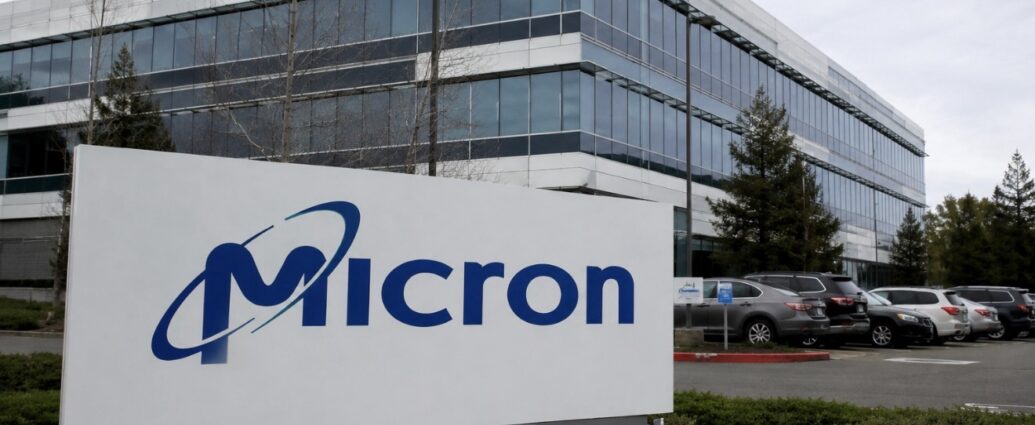
Micron Technology delivered the biggest quarter in its history, reporting record revenue and profit that easily surpassed Wall Street expectations and reignited enthusiasm across the semiconductor sector after a difficult week for chip stocks.
The memory-chip giant said revenue for its fiscal third quarter ended May 28 reached $41.46 billion, shattering both analyst forecasts and the company’s own previous records. The figure was up from $23.86 billion in the prior quarter and $9.30 billion a year earlier, representing growth of roughly 346% year over year.
Profit surged even faster.
Micron reported net income of $28.24 billion, or $24.67 per share, while adjusted earnings came in at $25.11 per share. Analysts had been expecting approximately $35 billion in revenue and adjusted earnings closer to $20.50 per share, making the results one of the largest earnings beats among major technology companies this year.
The company also announced a quarterly dividend of $0.15 per share, payable on July 21.
Investors responded immediately.
Shares of Micron, which finished the regular session at $1,048.51, surged roughly 14% in after-hours trading to around $1,196. The results lifted sentiment across the broader semiconductor sector, which had spent much of the week under pressure as investors questioned whether AI-related spending could continue at its current pace.
The answer from Micron appears clear.
Demand remains extraordinary.
The company sits at the center of the artificial-intelligence infrastructure boom because it produces the memory chips required to power AI systems. Those products include traditional DRAM memory as well as high-bandwidth memory (HBM), one of the most critical components inside advanced AI servers.
Without memory, even the most powerful processors cannot function effectively.
That reality has placed Micron alongside companies such as Nvidia, SK Hynix, and ASML as key suppliers to the global AI ecosystem.
Chief Executive Sanjay Mehrotra said demand for HBM remains so strong that much of the company’s supply is effectively sold out. To secure future production, Micron has been signing long-term strategic agreements with major customers, providing greater visibility into future demand while helping justify enormous investments in manufacturing capacity.
Those investments are accelerating.
Micron now expects capital expenditures to exceed $25 billion this fiscal year, with spending expected to rise again next year. The company is expanding production facilities in New York, Idaho, Taiwan, and Singapore, while simultaneously investing in next-generation manufacturing technologies.
The company also disclosed a multi-year agreement with Dutch semiconductor-equipment manufacturer ASML, whose advanced lithography systems are essential for producing future generations of memory chips.
Perhaps the most important number in the report was not the quarter that just ended.
It was the quarter ahead.
Micron forecast revenue of approximately $50 billion for the current quarter, significantly above Wall Street expectations of roughly $43 billion. If achieved, the forecast would mark another company record and suggest that AI infrastructure spending remains in acceleration mode despite recent investor concerns.
For consumers, the story extends beyond Wall Street.
Memory chips are found in nearly every modern electronic device, from smartphones and laptops to vehicles and cloud-computing systems. The industry’s health influences everything from product availability to pricing throughout the broader technology economy.
Micron’s expansion plans also carry significant economic implications.
Its planned facilities in New York and Idaho are expected to create thousands of jobs while supporting the broader effort to rebuild advanced semiconductor manufacturing capacity inside the United States.
There are risks.
Semiconductor manufacturing is among the most capital-intensive industries in the world. New fabrication plants often cost tens of billions of dollars, and periods of shortage can quickly turn into oversupply if demand weakens.
Competition remains fierce as well.
South Korea’s SK Hynix continues to hold a leading position in the HBM market, while major customers increasingly seek multiple suppliers to reduce risk.
Still, after a week in which investors questioned whether the AI boom was beginning to cool, Micron’s results delivered a powerful message.
The companies supplying the infrastructure behind artificial intelligence are still struggling to keep up with demand.
Whether that pace can continue through the remainder of the year remains one of the most important questions in global markets.
For now, Micron’s record-breaking quarter suggests the AI spending cycle remains very much alive.
JBizNews Desk | New York
© JBizNews.com All Rights Reserved. Reproduction or distribution without written permission is prohibited.