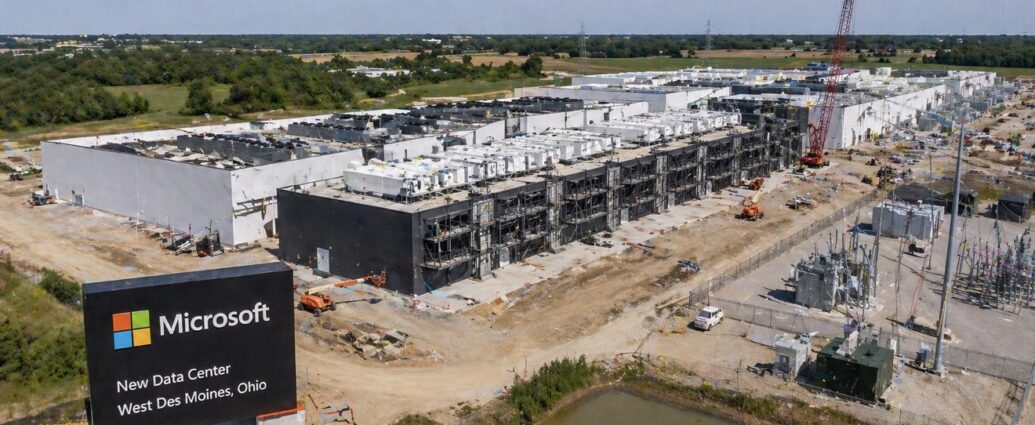
Microsoft is pressing ahead with a major Ohio data-center buildout that underscores how aggressively the company is spending to support artificial-intelligence demand and keep pace in cloud infrastructure. In a statement published by Microsoft in 2024, company vice chair and president Brad Smith said the investment “will ensure that Ohio remains one of the nation’s leading technology hubs,” tying the project directly to the company’s long-term AI and cloud growth plans.
The latest confirmed plan centers on central Ohio, where Microsoft has already acquired land and advanced multiple data-center campuses rather than a single newly disclosed site. According to prior reporting from Reuters and local disclosures cited by the Ohio Tax Credit Authority, the company committed billions of dollars across projects in Licking County, New Albany and nearby areas, with state officials framing the expansion as one of the region’s largest technology infrastructure pushes. Ohio Governor Mike DeWine said in an earlier state announcement that the projects would help “strengthen Ohio’s position in the modern economy,” a view echoed in state development materials.
The spending fits a broader capital-expenditure surge at Microsoft as generative AI workloads drive demand for computing power, networking gear and electricity. On the company’s latest earnings call, Microsoft finance chief Amy Hood said capital spending would “increase materially” on a sequential basis, according to the company transcript, as the group expands data-center capacity to meet cloud and AI demand. Chief executive Satya Nadella told investors that AI infrastructure remains a central priority, saying demand for Azure AI services continues to outstrip available capacity in certain areas.
That backdrop matters because investors increasingly judge the largest cloud companies not only on software growth but on how quickly they can turn capital into usable AI capacity. Bloomberg and CNBC have both reported that Microsoft, Amazon and Alphabet are in an escalating race to secure land, power and chips for data centers, with each company signaling elevated spending through 2025. In recent public remarks, Alphabet chief executive Sundar Pichai said the industry is seeing “extraordinary demand” for AI compute, reinforcing the competitive pressure behind projects such as the Ohio expansion.
Ohio officials continue to pitch the state as a lower-cost, power-accessible alternative to more congested data-center markets in Northern Virginia and parts of the West Coast. In public comments tied to state incentive packages, JobsOhio chief executive J.P. Nauseef said large technology employers are choosing Ohio because of its “talent, infrastructure and location advantages,” according to state development releases. That message has gained traction as hyperscalers search for sites with room to scale and fewer transmission bottlenecks than older data-center corridors.
The economic stakes are significant, though job counts in data-center projects often skew heavily toward construction and supplier work rather than large permanent operating staffs. State materials and local reporting from outlets including The Columbus Dispatch have described the Microsoft projects as supporting thousands of construction jobs and a smaller number of direct long-term roles once campuses open. Brad Smith said in company statements that Microsoft also intends to pair infrastructure investment with workforce training, a strategy the company has used in other U.S. regions to answer criticism that data centers consume large amounts of land and power while creating relatively limited on-site employment.
Power supply and sustainability remain central questions as the Ohio campuses move forward. Microsoft has said publicly that it aims to match its electricity use with carbon-free energy and remain carbon negative by 2030, commitments laid out in company sustainability reports and SEC-linked disclosures. In a company sustainability update, Melanie Nakagawa, chief sustainability officer at Microsoft, said the company is working to ensure growth in digital infrastructure “supports the clean energy transition,” an issue likely to draw close scrutiny from utilities, regulators and local communities as AI-related electricity demand rises.
The Ohio buildout also arrives amid a wider debate over whether hyperscaler spending can stay at current levels if enterprise AI adoption takes longer to monetize. Analysts at firms including Goldman Sachs and Evercore ISI have said in recent research notes, cited by financial media, that investors still want clearer evidence linking AI infrastructure outlays to durable revenue gains. Even so, Microsoft has argued in earnings materials that cloud demand, commercial bookings and AI service uptake justify the spending, with Satya Nadella telling analysts the company is focused on “meeting customers where they are” as AI moves from experimentation into production systems.
For Ohio, the next milestones will center on permitting, utility coordination, construction timing and how quickly the campuses translate into operating capacity for Azure and AI services. For Microsoft, the bigger test is whether projects like this can convert massive capital commitments into sustained cloud growth without squeezing returns. As Amy Hood told investors on the company’s earnings call, the goal is to build capacity “in line with demand signals,” and that balancing act now sits at the center of the AI infrastructure race.
JBizNews Desk Reporting