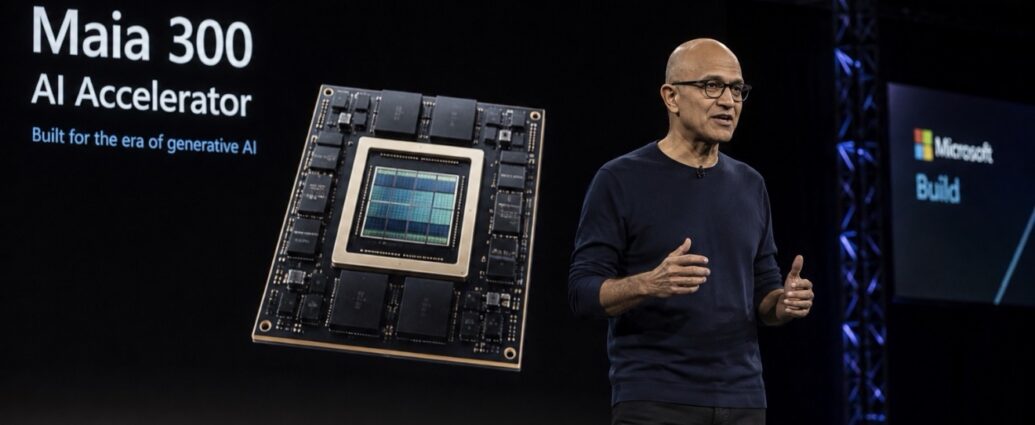
Microsoft is preparing to unveil its next-generation Maia 300 artificial-intelligence processor as soon as September, accelerating one of the most important efforts by a major cloud company to reduce its dependence on Nvidia.
The company is reportedly discussing manufacturing capacity with Taiwan Semiconductor Manufacturing Co. for more than 300,000 Maia 300 chips in 2027, with longer-term ambitions exceeding one million units.
Microsoft also wants outside Azure customers, including major AI developers, to eventually use the processor rather than reserving it only for the company’s own workloads.
That would represent a significant expansion of Microsoft’s chip strategy. Instead of simply building custom silicon to lower its internal computing costs, Microsoft would be positioning Maia as a product customers can choose alongside Nvidia hardware inside Azure.
The economics explain why.
Nvidia’s processors remain the dominant hardware for training and running advanced AI models, but they are expensive and have repeatedly faced supply constraints. Microsoft, Amazon and Google are all designing their own chips partly to gain more control over costs, availability and performance.
For Microsoft, every workload shifted from Nvidia hardware to Maia could reduce the amount it pays outside suppliers while allowing the company to keep more of the economics of AI computing inside Azure.
It also gives Microsoft additional leverage when negotiating future purchases from Nvidia. Even if Maia never replaces Nvidia broadly, a credible alternative makes Microsoft less dependent on a single supplier.
The strategy carries substantial risk. Designing a competitive AI chip is expensive, manufacturing capacity must be secured years in advance, and software developers have spent years optimizing applications around Nvidia’s CUDA ecosystem. Hardware performance alone is therefore not enough.
The larger competitive picture is becoming clearer. Amazon has Trainium, Google has its Tensor Processing Units, and Microsoft is pushing Maia forward. Nvidia’s largest customers are simultaneously some of the companies working hardest to reduce their dependence on it.
That does not mean Nvidia’s growth is ending. AI computing demand is expanding fast enough that Nvidia can continue selling enormous volumes even while custom chips take some workloads.
But the direction matters. The cloud giants increasingly want to own more of the technology stack themselves — from data centers and networking to the processors powering the AI models running inside them.
JBizNews Desk | Redmond
© JBizNews.com All Rights Reserved.
Reproduction or distribution without written permission is prohibited.