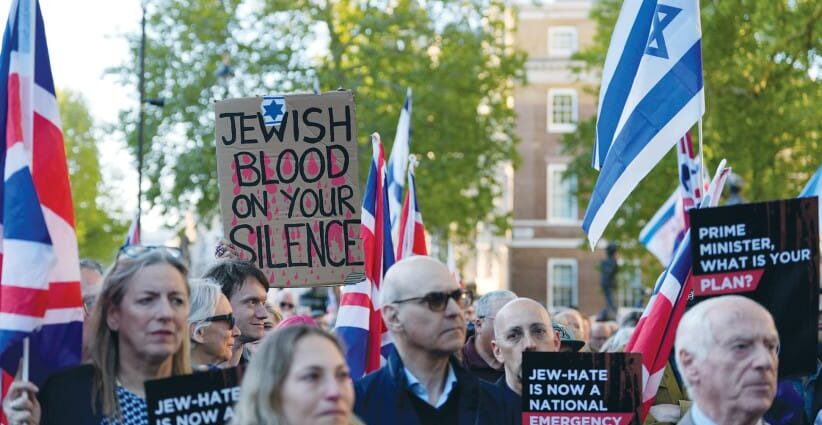
During the 2025 and 2026 wars with Iran, and with some attacks on Iranian agents in between, the Mossad and the IDF eliminated or busted not only local Iranian agents overseas, but many of their spymaster handlers in Iran itself.
If that is true, why are there still so many terrorist incidents against Jews pushed by Iran happening in England and elsewhere?
And are the post-October 7 shaky relations between Israel and the UK and other countries partially responsible?
The answers, which The Jerusalem Post had discussed with a mix of current and former Mossad sources and a variety of other counterterrorism and British officials, are complex.
Even though the attacks that have taken place recently indicate the network has taken significant hits, it would never have been realistic to suddenly eliminate decades of Iranian investment in a global terrorist network.
Furthermore, while British-Israeli relations are shakier in the diplomatic and political spheres than they have been in a long time, intelligence cooperation between the Mossad, the IDF, the Shin Bet, MI6, MI5, and other British authorities is still strong.
But that is at the 30,000-foot level, looking at the whole forest. What about down below in the trees?
How have Israeli attacks on Iran intelligence chiefs in Tehran and local agents affected Iranian terror plans?
During the 2026 war with Iran and Hezbollah, the Mossad and the IDF worked together to kill top Iranian managers in IRGC units 840, 1800, and 4000.
The Post has learned that Israeli intelligence managed to kill some managers in IRGC unit 800.
Units 400 and 840 are part of the IRGC Quds Force focused on international terrorism, including against Jews, usually controlled more directly by Iran’s supreme leader.
Before the war, upon receiving an order from the supreme leader, IRGC Quds Force Unit 400 would recruit foreign operatives for the international terror execution team, train and prepare them in Iran, and then dispatch them to the target location through a third country, in order to obscure Iran’s fingerprints.
Quds Force Unit 840 focuses on managing intelligence assets in target countries and maintaining ties with criminal organizations and dormant cells composed of local operatives from a distance. Unlike Unit 400, which trains agents in Iran, this unit relies on foreign operatives and mercenaries from local crime organizations completely from a distance.
Units 800 and 4000 are more directly controlled by the general IRGC intelligence apparatus, which is not part of the Quds Force.
Unit 800 handles foreign intelligence in a broader sense, while Unit 4000 focuses on “external enemies.”
While Units 400 and 840 may be more directly responsible for the operations side of international terrorism against Jews, the other units also often contribute to aspects of that terrorism.
Unit 1800 is a specialized unit within Hezbollah, established to coordinate and support Palestinian militant organizations in terrorist attacks against Israel.
It also acts as a liaison for transferring funds, training, and military equipment on behalf of Iran’s IRGC, which funds and directs the unit.
Throughout the war, Israel managed to kill dozens of top Iranian intelligence officials. Simultaneously, the Mossad worked with numerous foreign countries to bust local Iranian agents.
One would think that the unique cumulative power of killing the managers at home and busting the local agents in the field would have hobbled attempts to commit terrorism against Jews globally.
But this is not what has happened.
The UK counterterrorism framework
Barak Seener, associate research fellow at the Henry Jackson Society and founder of the Gulf Futures Forum, told the Post that the internal chaos in Iran is providing it with an extra incentive to export terrorist activities, probably at an increased rate.
“As Iran feels more constrained, especially by the US blocking the Strait of Hormuz – which will have an enormous economic toll on Iran – and as its IRGC forces have been really eroded, they will attempt to lash out in unconventional means, which will mean an increase in IRGC activity internationally,” Seener said.
Most recently, on April 29, two London Jews were wounded in a knife attack in the heavily Jewish Golders Green neighborhood. The perpetrator was arrested under suspicion of attempted murder.
This was the second declared terrorist attack on Britain’s Jewish community in seven months, following the Islamist terrorist attack at Heaton Park Synagogue in October 2025, in which Melvin Cravitz and Adrian Daulby were killed.
Besides those two attacks, several premises linked to Britain’s Jewish community and to those who oppose the Iranian regime have been targeted in a series of recent arson attacks claimed online by the group Harakat Ashab al-Yamin al-Islamiya (Islamic Movement of the Companions of the Right).
To date, the group has claimed 17 attacks on Jewish, Israeli, or Iranian dissident sites since March 9. Of these, seven have been in London, five of which involved arson. The Golders Green attack was the first to be declared a terrorist incident.
The UK’s Counter Terrorism Policing is leading the investigations into all these incidents, but it appears that London is the epicenter of Ashab al-Yamin’s activity.
Deputy Assistant Commissioner Vicki Evans, the senior national coordinator of Counter Terrorism Policing, said on April 19 that the CTP is actively investigating whether Iran is using criminal proxies as a tactic in London.
She also mentioned Ashab al-Yamin from a Metropolitan Police podium for the first time, and warned anyone considering getting involved that the UK is considering prosecuting offenses under the National Security Act, which comes with a significant sentence and lifetime restrictions.
National Security Act 2023 was brought in to counter threats from foreign states using espionage, cyberattacks, sabotage, and political interference. Right now, prosecutions under that law are quite rare, mainly because it is new. It primarily targets people working with or on behalf of foreign governments.
The threat from Iran is something UK officials have warned about repeatedly, and Iran is one of the real-world examples of the kind of behavior the act is designed to stop.
It is worth noting that the punishment for national security offenses is severe: Espionage offenses carry up to life imprisonment; assisting a foreign intelligence service carries up to 14 years in prison; and sabotage offenses also carry up to 14 years.
Terrorism and security specialist Roger Macmillan told the Post that this is “incredibly serious” for the youths involved, as they are essentially being groomed by an actor they know nothing about.
“For a 16-, 17-year-old kid, this is no longer a slap on the wrist; this has life-altering repercussions for them, if they’re charged under the National Security Act,” he said.
“There’s a high degree of grooming of children to conduct these attacks. Once they’ve done the attack, the recruiters have dropped them; they don’t care. They potentially just delete their own accounts and move on to something different.”
Seener told the Post that combating the threat from Ashab al-Yamin and its brand of sporadic terrorism is made more difficult because the UK will not proscribe the IRGC as a terrorist organization.
“So, on one hand, the Met’s taking it seriously; but on the other hand, the Labour government’s not abiding by its own manifesto to proscribe the IRGC as a terrorist organization,” explained Seener. “And Ashab al-Yamin is functioning very much like the IRGC, not only in terms of its targets, but in terms of how it reaches out to criminal gangs, how it operates via Telegram. It’s kind of the same shadowy organization, but under a different name.”
Mossad-MI6 cooperation, which grew in 2000s, will continue despite tensions
It is well known that since the Israel-Hamas War started in 2023, there have been major tensions between Jerusalem and London over the intensity of the IDF’s counter-war in response to Hamas’s invasion of southern Israel.
The sides have also disagreed over the Israeli-US war with Iran in 2026.
These tensions existed before British Prime Minister Keir Starmer and his Labour Party took power in July 2024, but his foreign policy has led to banging heads with Prime Minister Benjamin Netanyahu even more than their Conservative Party predecessors did.
Asked about whether this conflict may have pushed even Israeli-UK intelligence cooperation off the rails, Mossad sources told the Post that “British and Israeli spies work together well even when government feuding hits new levels.”
“Intelligence operatives are looking at the raw threat data. They will recommend intelligence cooperation, if there is no interference from the political agenda,” in order to thwart terrorist plots.
This was an interesting response given that Israel recently canceled a French Defense Ministry delegation which had planned to visit the Jewish state, showing that at least in that case, toxic politics has infected defense ties.
One question that has arisen is whether, at some later point, if relations destabilize enough that intelligence ties are affected, Israel might consider carrying out its own covert operations in England, as it did in Europe prior to the 1980s.
Sources responded that “we are less likely to see assassinations like the 1980s and 1970s [merely] due to complications with broader bilateral relations.”
Giving a broader assessment, Mossad sources explained that “there has been a paradigm shift since the 2000s. The Mossad understood we need to rely on allies and operate with them. We can’t do everything blue and white.”
“Israel started to focus more on the convergence of intelligence and diplomatic relations, not just for one specific country but as a general attitude,” said sources.
There have been news reports about Israeli intelligence cooperation with local intelligence agencies in Azerbaijan, the UAE, Uzbekistan, many countries in Asia, in Europe, and elsewhere.
For example, sources said that “Israel uses proxies in Iran to complete many missions. Some colleagues are more willing to help, some work directly together, and some less. It also depends on the political climate of the country.”
Obviously, sources said, when diplomatic relations are closer, intelligence sharing can hit even higher levels, such as with the US. But in general this trend of greater global intelligence cooperation is viewed as irreversible, whether with England or most other countries.
This means that the Mossad and partner agencies like MI6 will share intelligence and might even jointly plan aspects of a raid, but that the host country still runs the show for actual operations, and Israeli agents would not take actions in allied countries without coordination and authorization.
Most importantly, Mossad sources said that, broadly speaking, they still feel Jewish communities in England, the Netherlands, Germany, and other European countries are secure. They feel that the local intelligence agencies are on the case of maintaining security for their citizens, Jewish or otherwise, even if not always to the best standard, and even if they do not always say so publicly enough.
There are some countries regarding which the Post raised larger questions, such as in Spain, where the government has allowed the posting of websites that track and potentially target Jewish businesses, conflating Jewish with Israeli, and ostensibly with hostility to the businesses.
Yet, generally speaking, sources still felt that “there is a lot of noise in the media,” and that European intelligence agencies are working with Israel, however imperfectly, to try to protect their citizens.
Of course, Iran has also targeted some countries with less cooperation with Israeli security.
On April 7, Iranian-sponsored local terror agents tried to attack the Jewish community via the Israeli Consulate in Istanbul.
“They have been desperate to go attack something. An eye for an eye. They went after really soft targets just to get some payback,” said Mossad sources.
Sources said “Istanbul was a desperate attempt. You just release something to show you’ve done it. Very unprofessional. The consulate had been closed for a while. They attacked the back side of the consulate in a complex of four buildings.
“They were shooting [without aiming] God knows where, just demonstrating some sort of force abroad around Jewish communities. They will hook up to anyone local who will work for money or whatever various agendas or motivations,” said the sources.
Sources continued, “The lethality will be more disorganized. It will still exist. Disorganized does not mean not lethal. They will try to ramp it up for any opportunity they have. These things take lots of planning. Istanbul wasn’t very well planned. There will be more disorganized attempts, whether they are lethal or not. Some might still be ‘successful.’”
Even amateur terrorists – if they “gather the right intelligence, the right people, and gather explosives” – can harm people, and since they are amateurs with more sporadic activity, sometimes they are harder for security forces to identify, if they do not make a very conspicuous mistake.
Jewish community’s role in its own security
Dave Rich, head of policy at the UK’s Community Security Trust, told the Post that this style of warfare makes it “far harder to intervene and anticipate beforehand, because if they’re just putting out adverts on the dark Web for ‘here’s a certain amount of money to go and burn someone’s car,’ there’s loads of people who would take that money, and it’s very hard to track them.”
Rich said that, to a certain extent, this type of “gig economy” terrorism indicates “a decline in Iran’s capabilities internationally,” meaning that the “potential lethality is reduced compared to what they did in Buenos Aires 30 years ago.
“If you look at Iranian terrorism against Jewish communities around the world in years gone by, such as the AMIA bombing in Argentina or the Burgas bombing in Bulgaria, they were carried out by either Iranian operatives, Hezbollah operatives, or people who’d been trained, who were ideologically and operationally trained by Hezbollah or by Iran to carry out these attacks. Whereas now, there are quite a few cases around the world where evidence has emerged showing [Iran] is paying local criminals who aren’t ideologically aligned at all,” Rich said.
Following the arson attacks in Hendon and Harrow, CST set out security reminders asking the community to secure buildings by checking all doors, gates, and windows, and ensuring all fire and smoke alarms are recently tested.
The Jewish security group Shomrim also announced that it has increased patrols across Stamford Hill, with additional visibility around synagogues, schools, and community locations.
While it said there is currently no intelligence suggesting any specific threat to Stamford Hill, it stressed the importance of staying alert.
It also released the following safety advice: Keep synagogue entrance doors closed and ensure doors are shut behind you. Refrain from placing zmanim posters or schedules outside synagogue entrances. And report suspicious behavior immediately.
Though heightened measures are being put in place to protect the community, Rich told the Post that the threat of this kind of activity was never underestimated.
“This is reflected in the significant and sustained investment that both we and the government have made in security infrastructure, guarding, and protective measures at Jewish locations. Those arrangements were put in place in recognition of the potential threats the community faces.
“We are a large, vibrant, and active community with a significant number of buildings, and these attacks appear to be crude and unsophisticated in nature,” he said. “Completely preventing this type of low-level, opportunistic attack is extremely difficult, despite extensive security measures, and the priority remains ensuring that the model continues to adapt to emerging risks.”
Mossad sources warned that sometimes local governments and the Jewish communities lacked adequate funding and resources – even if they had good intentions – for competing with Iranian-sponsored terrorists.
In an incident in Birmingham, sources stated, the local authorities had the wrong intelligence and made faulty assumptions which led them to “canceling something [attendance of Maccabi Tel Aviv fans at the team’s UEFA Europa League match against Aston Villa on November 6, 2025] which could have happened.”
They added that “the British attitude is still too weak toward Iran. They don’t fully see it as a specific danger to them as much as it being a general danger.”
Ultimately, while Israel made unique progress against terror managers in Tehran, and while the Mossad and MI6 still work together despite diplomatic tensions, and the British Jewish community is trying some self-help, without a much harsher and sustained crackdown by the UK government, Iranian terrorism against Jews in England is probably not going away anytime soon.