
‘Do Kaftar” (“Two Doves”) is a sad love song that every Iranian child knows. Fun fact: if you look for it on YouTube, you will find the mournful ballad sung by men only. That is because women in Iran are forbidden to sing in public. The haunting words start (translated from Persian):
“Two doves, by sorrow torn apart, took flight, Two lovers, cruelly severed, lost to sight, One sought solace in flames, a fiery nest, The other soared beyond, to realms divinely blessed.”
The lyrics, penned by poet Qahar Asi, were released as a folk song by singer Farhad Darya in 1988. Asi was killed in 1994 in Kabul by a rocket during the Afghan Civil War.
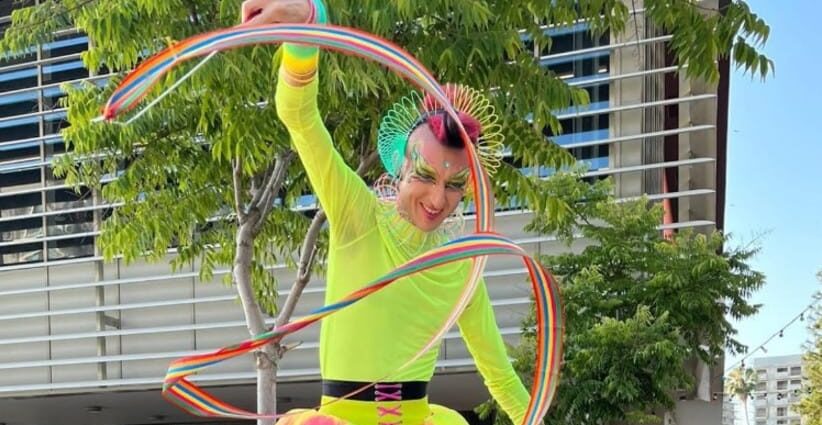
Israeli drag queen Nona Chalant teamed with exiled Iranian singer Jeanette R. Yehudaiyan and music producer Sailo (Lidor Saadia), a renowned deejay, to create a techno dance version of the song that they call “a powerful call for peace, freedom, and the ultimate bridge between ancient culture and the modern world.”
“When I was 11 or 12 years old, a man I had seen around our neighborhood in Tehran knocked on our door,” recalled Yehudaiyan. “He told my mother that he was the director of the state radio’s children’s choir, and that he had heard me singing in the yard and thought I had a unique voice. He asked to have me join the children’s choir to sing on Iranian radio.”
Her father discouraged her from joining.
“From that moment on, I realized that a girl like me had no place there,” Yehudaiyan continued. “I was a curious girl, eager for knowledge, and wanting more. For years, I fought to immigrate to Israel. It was a struggle against circumstances, against social conventions, and also against my own family.
“Finally, when I was 15, my father agreed to sign my release through the Youth Aliyah, on the condition that I be educated in a religious institution.
“The separation was difficult. I left behind not only a family, but also a language, landscapes, smells, and sounds. Perhaps that is why, when I arrived in Israel, I locked away inside myself everything that reminded me of the home I had left. I stopped speaking Persian, I stopped listening to Persian music, and I stopped singing.
“Only many years later did I realize that you cannot truly separate from your roots. The voice I had tried to silence waited patiently, and when it returned, it brought back with it not only the music, but also parts of myself that I had left behind,” she concluded.
Finding Her Voice
Yehudaiyan, who fled from Iran without her parents at age 15, said the message is very close to her heart. She was 30 when her parents were finally released from Iran and allowed to go to Israel.
“When I was a girl in Iran, I wasn’t just fighting for the right to sing,” Yehudaiyan explained. “I was fighting for the right to be who I am. That is why I feel there is a profound connection between that little girl who heard the door close in the face of the conductor who came to bring her to the choir, and the woman who believes today that every single person deserves a space where their voice can be heard.”
“When I watched the students and young people in Iran taking to the streets to make their voices heard, I felt a deep connection to them – not from a political standpoint, but from a recognition of the value of human freedom,” she added.
Nona Chalant, also known as Ronny Chokron, one of Israel’s leading and most established drag artists with a 15-year career on stage, performs on weekends and is a kindergarten teacher by day. He said Jeanette’s story and the song touched him deeply.
“When Jeanette sings it in the traditional Persian genre of singing, it is about a captured couple of doves – forbidden love and freedom and love without boundaries,” he said. “I had a vision that this could fuel a revolution, the song being so part of the culture.
“Add to that a Persian/Israeli woman singer, and me as a drag queen, with the message of no boundaries – it is the very resurrection of freedom. We know who we are and we know we are always changing. We take a familiar traditional and beautiful song to remind the listener that new times can still reflect tradition.”
Chokron said that Iran has a robust underground nightlife, and he thinks the song, with its rhythmic beat and Persian lyrics, female and drag queen collaboration will be a tremendous success – as well as a supportive boost to the Iranians who dare to dance.
“If I’m right, I think it will get to the underground nightlife there. In the underground scene, they can listen to women singing and they can dance. The intention is to encourage them that we know there is a world there – waiting to emerge, and this revolution is happening. We see you, and we support you,” he said.
Today in Iran, solo public singing by women is effectively illegal and heavily policed. Many Iranian women defy this through underground performances or online sharing, often at personal risk.
Female singer Hiwa Seyfizade was arrested mid-performance in Tehran in 2025, while others faced detention after viral videos (e.g., Zara Esmaili, Parastoo Ahmadi) and Instagram accounts of female singers are regularly shut down.
Music producer Lidor Saadia (Sailo) worked with the singers to put together a mesmerizing club track that seamlessly blends ancient cultural roots with a fresh, driving electronic sound. Sailo is known for creating much of the music in the club scene, working with stars like Dana International, Rita, Deborah Cox, and Sarit Hadad. Chokron started as a fan and was very excited about this, their first collaboration.
“At the end of the day, there is something magical and unifying about nightlife,” explained Nona Chalant/Ronny Chokron. “The dance floor is a sanctuary where people let everything go and seek pure joy. At nightclubs, people come to free themselves. They want to be happy. Like in the kindergarten class – they come to play and have fun.”
The beat goes on…
As the song rolls out, the hope is that it goes viral and finds its way to the people who desperately need to hear the message.
“We just released the song for deejays without telling the story yet,” continued Chokron. “We reached out to deejays and influencers in Iran. We are hoping to get a video to them. We aren’t alone in our efforts. There are other people also who are working to free them.
“Because I’m a nightlife person, I know the nightlife is there. We need the music to set them free – for the women who want to sing, or the gay clubber in the closet who is at a party, underground. This song will open something in their heart. Now is the time to spill out freedom and get rid of the ‘war, war, war’ mantra,” he said.
“When I hear Jeanette singing, I feel that the Iranian people are our soul cousins. This is our way in,” he added.
Fortunately, Yehudaiyan was able to reclaim her talent after her husband’s work took her to West Africa, where her connection to music rekindled, and she suddenly began to sing.
“With tears streaming down my face relentlessly, I felt that a deep part of me had been waiting all those years to return home,” she explained. “When I returned to Israel, I already had a profession, academic degrees, and a job at Hadassah Ein Kerem, but I knew I had to give this voice a place too. I decided that I wanted to sing.”
This song, she said, has special meaning to her.
“To me,” she explained, “‘We Were a Pair of Doves’ (“Zug Yonim Hayinu”) is much more than a love song. It is a song about captivity, loss, and longing, but also about the inner freedom of the spirit. One can hear in it the story of two lovers who were separated, but it can also be seen as a metaphor for exile, displacement, and the yearning for a lost home. Perhaps that is why the song continues to move people even today.”
“When I recorded it, I thought of everyone who has ever been forced to part from a place, a person, or a life they once knew. For me, it is a song that reminds us that even after separation and heartbreak, the memory, the love, and the inner voice continue to live on inside us,” she said.
“Today, I no longer have any family members or acquaintances left in Iran. However, despite the distance and time, Iran continues to live within me through the language, the memories, the culture, and above all, through the music,” she concluded. ■
To hear the song: open.spotify.com/track/6gRAtghF7mCikgbbTLLwvE?si=MeSAXe5VRKOWe-Is5-nrOA&nd=1&dlsi=88e39b8dca404f20
74 lashes for ‘offending public decency
There will be no golden buzzer for Parastoo Ahmadi, an Iranian singer, composer, artist, and filmmaker, known for her folk and traditional Persian music, who built a following on social media by sharing songs about cultural heritage and personal expression.
Instead, per an announcement on Instagram by a videographer familiar with the case, on June 18, 2026, Ahmadi and seven to eight members of her production team were sentenced by a criminal court in Qom province to 74 lashes each. They also received two-year bans on leaving Iran and on performing artistic activities.

“This is exactly why we created (the song) ‘Freedom,’” explained Sailo (Lidor Saadia), producer of the recently released song that he hopes will inspire Iranian underground fans. “No artist should be punished for singing, expressing themselves, or simply being who they are. The track was born out of solidarity with those fighting for freedom and human dignity, and unfortunately its message is as relevant today as ever.”
“A society is measured by its ability to preserve human dignity even when it disagrees with a person’s actions or beliefs,” said singer Jeanette Yehudaiyan. “Music is meant to give voice, hope, and connection between people, not to become a reason for humiliation or violence. I feel deep sorrow whenever artists, or any human beings, are subjected to punishments that may harm their bodies, dignity, or freedom.”
Ahmadi is charged with “offending public decency” for singing and for her appearance at historic Deir-e Gachin Caravanserai – an empty music venue where she filmed a music video, wearing a sleeveless dress and no hijab. She is also charged with publishing “vulgar and immoral content” online.
The video immediately went viral, garnering millions of views. But it also apparently caught the attention of the “politeness police,” known as the Prosecutor’s Office for Moral Security, a specialized Iranian security branch dealing with “morality” and public decency cases.
Ronny Chokron added, “It is deeply distressing and infuriating that in the year 2026, women are still being punished for their fundamental freedom of expression. This relentless pursuit in the name of religious authoritarianism causes us to lose sight of the most vital human values: freedom, mutual respect, and empathy.”
“Our creation is simply a reminder to echo peace.” – J.S.