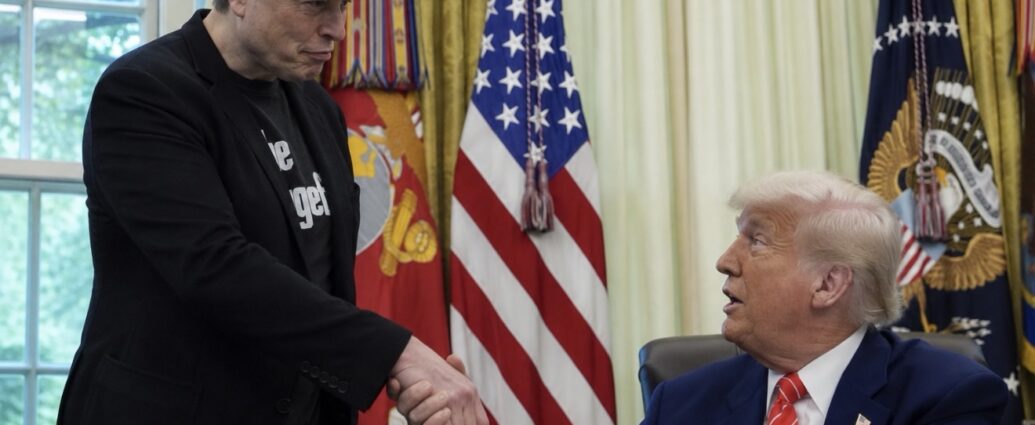
Fourteen months ago Elon Musk accused the president of being named in the Epstein files, threatened to primary every Republican who voted for the White House’s signature tax bill, and announced he was starting his own political party. That party is now dormant, and Musk has authorized his super PAC to spend up to $120 million getting Republicans to the polls on Nov. 3.
The reconciliation happened in stages, and money moved even when the words were hostile. Musk cut $15 million in checks to three Republican committees roughly two weeks after apologizing for the Epstein post, saying he had gone too far — and then, days later, resumed threatening Republicans who backed the bill. Federal Election Commission filings showed the money split among Trump’s MAGA Inc. super PAC, the Congressional Leadership Fund and the Senate Leadership Fund.
The thaw ran through Vice President JD Vance, who is close to Musk and organized a dinner at the Naval Observatory attended by White House chief of staff Susie Wiles, former deputy chief of staff Taylor Budowich, and Jared Birchall, the low-profile lieutenant who manages Musk’s political giving. In early January, Musk posted a photograph from Mar-a-Lago describing a dinner with the president and first lady and predicting a strong year ahead.
The result, reported in late July, is a commitment of $100 million to $120 million for a field program in at least eight states. The initial targets are Senate races in Alaska, Iowa, Maine, Michigan and Ohio, with possible involvement in North Carolina, Georgia and Texas, alongside several House contests. The group has described the plan as a large-scale get-out-the-vote operation working both offensively and defensively. Axios reported the focus is on mobilizing Republican voters who typically skip non-presidential elections.
The commercial logic is not hidden. Musk’s companies depend heavily on the federal government: SpaceX holds substantial NASA and Defense Department contracts, its Starlink business runs on federal spectrum and licensing decisions, and Tesla operates under vehicle-safety and autonomous-driving regulators. SpaceX is also moving toward the public markets, a process in which regulatory posture and political stability carry real value. A third party competing for conservative votes would have split the coalition Musk’s businesses do business with, which is the practical case against the America Party that observers cited when it went quiet.
The scale is smaller than last cycle. Musk gave roughly $291.5 million in 2024, most of it to elect Trump, making him the largest donor of that campaign. America PAC has spent about $52.3 million since January 2025 against roughly $50.3 million raised, nearly all of it from Musk, who has personally contributed more than $85 million to political organizations this cycle. The new authorization would roughly triple that.
It lands on top of an already lopsided money picture: Republican super PACs and committees hold an advantage of more than $300 million over Democratic counterparts, before counting the $400 million in Trump’s MAGA Inc. Axios reported the cash edge is meant to offset a political environment favoring Democrats, with the president’s approval ratings weak on the economy and the Iran war putting House control, and possibly the Senate, in play. A senior White House political adviser, James Blair, called the PAC’s return a significant boost for Republicans nationally.
There is reason for caution on the number. Announced super PAC spending is an authorization, not a wire transfer, and Musk’s political commitments have moved quickly in both directions before. Commentators noting his record have cautioned that the pledge should not be treated as fixed, nor assumed to grow toward 2024 levels. The 2024 operation itself drew scrutiny when Reuters reported that canvassers had fallen short of door-knocking targets and that some were alleged to have overstated their work.
For business readers, the takeaway is less about the personalities than about what the episode demonstrates. The wealthiest individual in the country severed ties with an administration his companies depend on, discovered the cost of that position, and rebuilt the relationship inside a year — with a nine-figure check as the closing argument. Whether the money delivers turnout in November is a separate question, and one the filings will answer only after the votes are counted.
JBizNews Desk | Washington, D.C.
© JBizNews.com All Rights Reserved. Reproduction or distribution without written permission is prohibited.