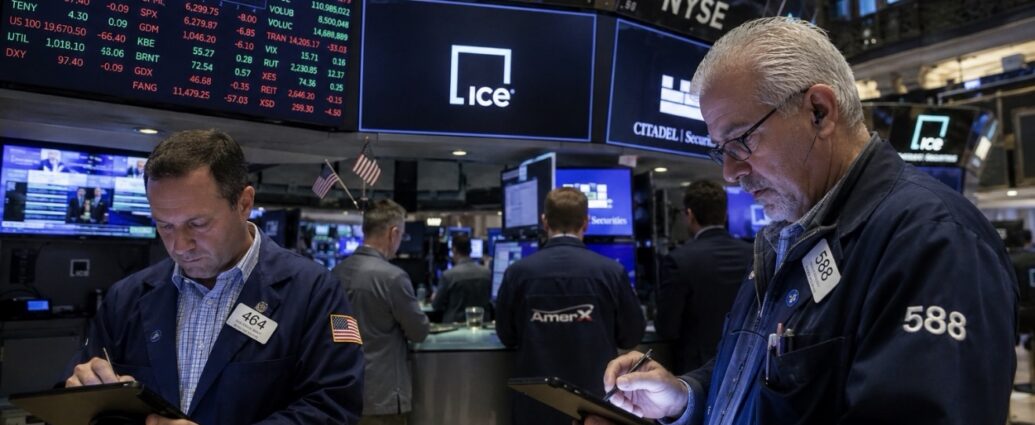
According to Reuters, the U.S. Bureau of Labor Statistics, LSEG and company earnings reports, July 14, 2026 — U.S. stocks opened mixed Tuesday after a cooler-than-expected June inflation report boosted technology shares, while rising oil prices tied to renewed U.S.-Iran tensions and disappointing corporate news kept broader market gains in check.
The Consumer Price Index declined 0.4% in June, bringing the annual inflation rate to 3.5%, below economists’ expectations of 3.8%. Core inflation, which excludes food and energy, remained unchanged from May, with the annual rate holding at 2.6%, also coming in below forecasts. The report eased concerns that inflation was accelerating again and strengthened hopes that price pressures continue to moderate.
The inflation data helped fuel buying in technology stocks, although investors remained cautious ahead of testimony from Federal Reserve Chair Kevin Warsh, who is scheduled to appear before the House Financial Services Committee later Tuesday. Markets are looking for additional guidance on the Federal Reserve’s outlook for interest rates after recent comments from policymakers suggested inflation risks have not completely disappeared.
Where the Indexes Stood
Shortly after the opening bell, the Nasdaq Composite climbed about 0.7% to roughly 26,073, led by gains in large-cap technology shares. The Dow Jones Industrial Average slipped to around 52,472, while the S&P 500 traded near unchanged as investors balanced encouraging inflation data against higher oil prices and a busy earnings calendar.
Monday’s session ended lower across the board. The S&P 500 closed at 7,515.34, down 0.79%. The Nasdaq Composite finished at 25,873.18, down 1.55%, while the Dow Jones Industrial Average lost 138.37 points, or 0.26%, to close at 52,498.64.
Market Movers
Bank earnings dominated Tuesday morning trading.
Goldman Sachs surged after reporting earnings of $20.98 per share, well above analysts’ expectations of $14.48 per share, while revenue of $20.34 billion also exceeded estimates. Shares climbed roughly 8% in early trading.
JPMorgan Chase reported earnings and revenue above Wall Street forecasts but still fell approximately 2.5% as investors took profits following the strong results.
Wells Fargo gained more than 1% after beating expectations, while Bank of America slipped about 0.8% despite reporting better-than-expected quarterly results. Citigroup also reported quarterly earnings as investors continued evaluating the health of the banking sector.
The biggest drag on the Dow was International Business Machines (IBM). Shares plunged nearly 22% after the company warned preliminary second-quarter results would fall below expectations. The decline alone erased roughly 425 points from the Dow’s price-weighted index.
Elsewhere, HCA Healthcare fell 9.2%, while Virtu Financial lost 6.2%. Semiconductor-related stocks outperformed, with Applied Materials rising 5.3%, Teradyne gaining 4.9%, and Monolithic Power Systems advancing 4.5%.
Wall Street analysts also issued several notable rating changes. Citigroup raised its price target on Apple to $365 from $315, citing the company’s pricing power and the expected launch of the iPhone 18. Evercore ISI initiated coverage of SpaceX with an Outperform rating and a $230 price target, while Jefferies upgraded Shopify to Buy and reiterated its Buy rating on Amazon.
Commodities and Markets
Energy markets remained a major focus.
Oil prices continued climbing after Brent crude recorded its biggest single-day gain in years on Monday, rising 9.6% to settle at $83.80 per barrel. The rally followed a third consecutive night of U.S. military strikes against Iran and attacks involving commercial tankers in the Strait of Hormuz, one of the world’s most important energy shipping routes.
President Donald Trump announced that the United States would reinstate a blockade of Iranian shipping beginning Tuesday afternoon, adding another layer of uncertainty to global energy markets.
Safe-haven assets also benefited from the geopolitical uncertainty. Gold climbed about 2.1% to approximately $4,089 per ounce, while the CBOE Volatility Index (VIX), Wall Street’s widely followed fear gauge, eased to around 16.5.
The Takeaway
Tuesday’s market open highlighted the competing forces driving Wall Street. A cooler inflation report provided investors with renewed confidence that price pressures continue to ease, supporting technology stocks and improving expectations for future Federal Reserve policy. At the same time, rising oil prices, escalating geopolitical tensions in the Middle East, and mixed corporate earnings reminded investors that significant risks remain.
For businesses, lower inflation offers hope for improving financing conditions and stronger consumer demand. However, sustained increases in energy prices could raise transportation, manufacturing, and operating costs, offsetting some of those gains. Investors will closely monitor Federal Reserve Chair Kevin Warsh’s testimony, additional bank earnings, and developments in the Strait of Hormuz for direction as trading continues.
JBizNews Desk | New York
© JBizNews.com All Rights Reserved. Reproduction or distribution without written permission is prohibited.