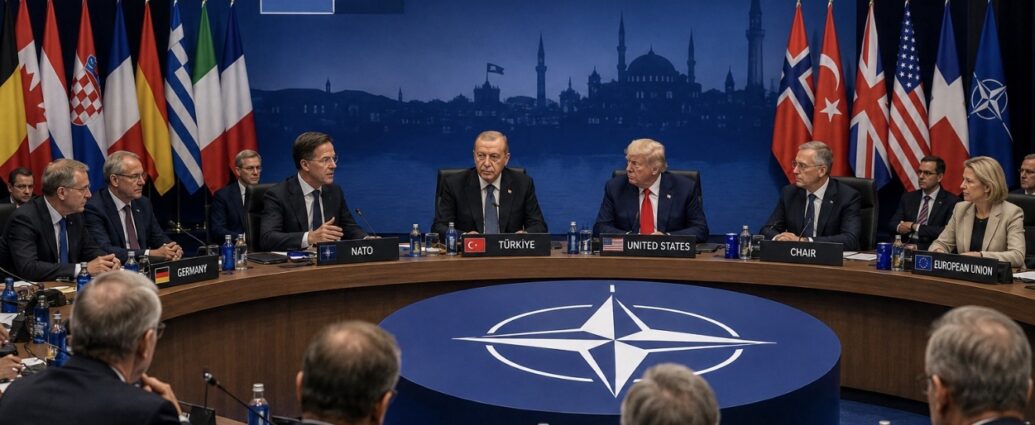
When leaders of all 32 NATO members meet in Ankara, Turkey, the biggest business story on the table won’t be troops or treaties. It will be money — specifically, the roughly $300 billion in European orders for American-made military equipment that NATO Secretary General Mark Rutte has been highlighting to the White House. Rutte displayed that figure during a June 24 Oval Office meeting with President Donald Trump, pairing it with the claim that the buying wave is creating tens of thousands of U.S. factory jobs. He credited the American president directly for the shift.
That pitch is the commercial engine behind this week’s gathering. In a report prepared for the summit, the Congressional Research Service said allied leaders are expected to announce tens of billions of dollars in new defense contracts in Ankara, while outlining Rutte’s three priorities: raising allied defense spending, expanding transatlantic defense-industrial production, and sustaining support for Ukraine. Rutte has described a “sea change” in how European governments approach military budgets since Trump returned to office.
The spending numbers are substantial. According to NATO‘s own accounting, European allies and Canada increased defense spending by 20% in 2025 and together spent more than $574 billion, adjusted to 2021 prices. Those increases stem from the pledge reached at last year’s summit in The Hague, where every member except Spain committed to spending 5% of GDP on defense by 2035 — 3.5% for core military capabilities and 1.5% for security-related investments such as infrastructure and cybersecurity. The Ankara meeting is where governments are expected to show how those commitments will translate into real procurement.
A significant share of those contracts is expected to benefit American manufacturers. U.S. defense companies dominate many of the categories NATO is urgently seeking to expand, including air and missile defense systems, precision-guided munitions, and combat aircraft, after the war in Ukraine exposed major shortages across Europe. NATO’s new capability targets call for a fivefold increase in air defense, while officials have warned that ammunition stockpiles remain insufficient across much of the alliance. That backlog is the “$300 billion” Rutte continues to reference, pointing directly to U.S. production lines and manufacturing jobs. Germany, now Europe’s largest defense spender at roughly $120 billion in 2025, has more than doubled its military budget since 2022.
For the first time, the defense industry itself takes center stage. The full day of the summit’s opening session is dedicated to the NATO Summit Defence Industry Forum, which organizers say will run longer than the leaders’ own formal meeting. One of the key initiatives under discussion is what NATO describes as a “front door” for industry—an AI-enabled platform designed to help companies navigate the alliance’s procurement process more efficiently. Jason Israel, a senior fellow at the Center for European Policy Analysis and a former National Security Council defense-policy director, has pointed to joint purchasing and interoperability as essential goals while cautioning that NATO’s procurement system was never designed to move at today’s pace.
The political backdrop remains complicated. Trump has pushed for more than increased military spending, repeatedly calling for greater allied “loyalty.” He has threatened to reduce the U.S. military presence in Europe, floated annexing Greenland—a semiautonomous territory of NATO ally Denmark—and questioned whether the United States should defend members he believes are not contributing enough. Former NATO Secretary General Jens Stoltenberg wrote in his memoir that the alliance nearly fractured during the 2018 summit amid disputes with Trump, warning that NATO’s collective-defense guarantee loses credibility if an American president openly questions it. Fresh disagreements following the recent U.S.-Iran conflict, in which several allies declined to participate, have added new strains ahead of the Ankara meeting.
Hosting duties fall to Turkish President Recep Tayyip Erdoğan, whose relationship with Trump could help keep the American president engaged despite broader disagreements within the alliance. Turkey also has its own commercial interests. Its drone manufacturers have become major suppliers across Europe, yet Ankara has been excluded from parts of the European Union’s joint procurement efforts. Rutte has repeatedly argued that limiting Turkish participation raises costs and slows defense production.
Despite the political friction, public support for NATO remains strong in the United States. A Chicago Council on Global Affairs survey conducted June 5–7 found that roughly two-thirds of Americans favor maintaining or increasing the nation’s commitment to the alliance. Whether that support translates into signed contracts—and how many of those contracts go to American manufacturers—will be the key measure of the summit’s success.
JBizNews Desk | Ankara, Turkey
© JBizNews.com All Rights Reserved. Reproduction or distribution without written permission is prohibited.