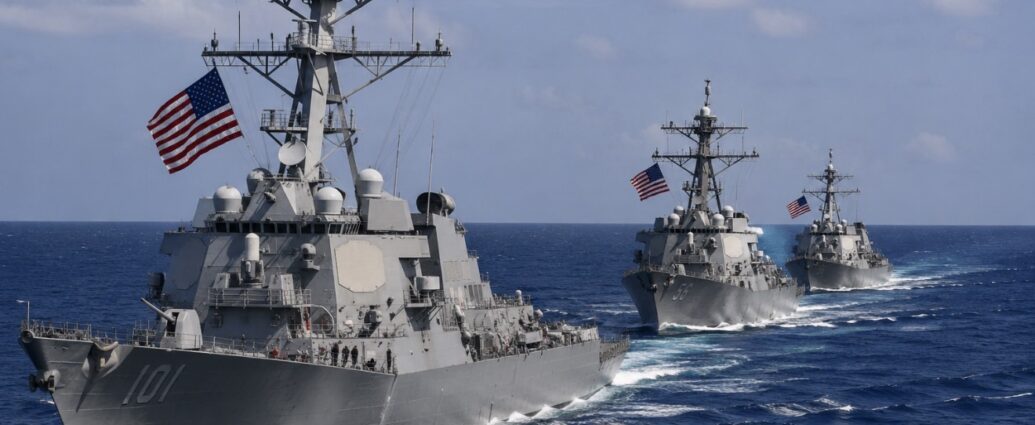
The U.S. Navy’s top officer, Adm. Daryl Caudle, has sharpened his case that the country does not have enough warships — a warning thrown into relief this weekend as a third round of U.S. strikes on Iran and the closure of the Strait of Hormuz stretched a force the admiral says is already running near its limits. Testifying before the Senate Appropriations defense subcommittee in May, the 34th Chief of Naval Operations told lawmakers that escorting commercial ships through the contested strait would “exceed” the Navy’s capacity, a blunt admission that the fleet is spread thin at exactly the chokepoints where global commerce is most exposed.
The numbers behind the warning are stark. The Navy fields roughly 291 battle force ships today, well short of the 355 that Congress set as a statutory floor and further still from the service’s own 2023 assessment calling for 381 manned ships plus 134 unmanned platforms. The Navy’s May shipbuilding plan charts a path to about 450 vessels by 2031 under the administration’s “Golden Fleet” initiative, yet the service concedes a hard truth: despite a budget that has roughly doubled over two decades, today’s fleet is no larger than it was in 2003.
The constraint is not mainly money — it is steel and skilled hands. Only two American yards build nuclear-powered warships: Huntington Ingalls Industries’ Newport News Shipbuilding in Virginia and General Dynamics’ Electric Boat in Connecticut. Submarine production is stuck near 1.2 boats a year against a need above two, attack-submarine readiness has slipped to 62% from 67% a year earlier, and the newest aircraft carrier has slid toward the mid-2030s because the yard cannot physically fit the work. Adm. Caudle has told appropriators the industrial base will not reach a two-carrier-a-year cadence until around 2032, four years later than the target his predecessor named in 2023.
Those bottlenecks land against a competitor moving at industrial speed. China’s People’s Liberation Army Navy is now the world’s largest by hull count, fielding upward of 730 vessels and launching destroyers, frigates and submarines faster than Western shipyards can match. Pentagon planners increasingly frame the coming decade as the window that will decide the balance of power in the Indo-Pacific, and Adm. Caudle’s push for combat mass — manned and unmanned — is aimed squarely at that clock.
For the defense-industrial base, the CNO’s argument is also a demand signal worth billions. The Golden Fleet envisions a “high-low mix” of high-end combatants, cost-effective frigates and drones: continued Arleigh Burke destroyer production, a new nuclear-powered Trump-class battleship, the FF(X) patrol frigate derived from a Coast Guard cutter, and fleets of medium unmanned surface vessels. Acting Navy Secretary Hung Cao has cast the effort as a generational investment meant to revive American shipbuilding and create thousands of high-skill jobs. The fiscal 2027 budget request seeks roughly $65.8 billion for Navy shipbuilding, and Navy leaders have signaled the new plan could more than double the 19 hulls funded in fiscal 2026 — a pipeline that flows directly to publicly traded prime contractors and a web of suppliers across dozens of states.
The weekend’s events made the strain concrete. As the Islamic Revolutionary Guard Corps sealed Hormuz and U.S. forces struck Iranian targets for a third time in a week, the Navy’s presence in the region was a fraction of the June wartime surge — recent tallies put roughly six U.S. warships in the Central Command area, including three Arleigh Burke destroyers and three littoral combat ships. The service has kept a blockade posture and mine-clearing options in play, but Adm. Caudle has been candid that de-mining and escort duty in a narrow, contested waterway are among the hardest missions to run, and cannot be switched on at scale until a durable ceasefire reopens the strait.
That gap between mission demand and available hulls is the heart of the CNO’s message. The Navy has set a goal of surging 80% of its force on short notice, but with about a third of the fleet deployed, a third in maintenance and a third in sustainment at any given time, deferred repairs and aging shore infrastructure leave little slack. Adm. Caudle has called the shortfall a “resource issue,” arguing that sustained shipbuilding near the roughly $38 billion a year the Congressional Budget Office estimates — and defense spending closer to 4% of GDP — is what a fleet of the required size would take.
For businesses tied to sea trade, the stakes are not abstract. A Navy stretched thin at chokepoints like Hormuz means thinner protection for the tankers, box ships and energy cargoes that set fuel prices, insurance premiums and supply-chain timetables worldwide. Whether Washington funds the larger fleet Adm. Caudle is asking for — and whether the yards can build it fast enough to matter — will shape both American sea power and the reliability of the trade routes that the global economy runs on.
JBizNews Desk | Washington © JBizNews.com All Rights Reserved. Reproduction or distribution without written permission is prohibited.