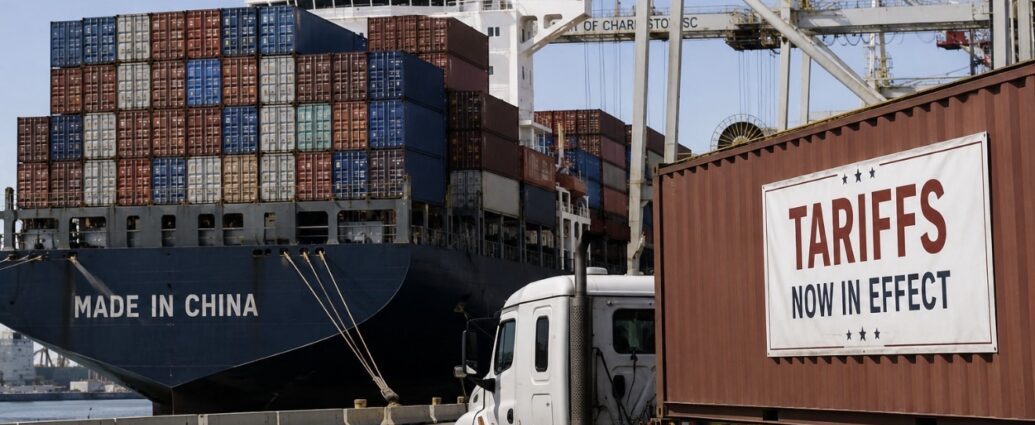
Nearly half of U.S. businesses that have paid import tariffs over the past year expect to raise prices again, suggesting the inflationary effects of trade duties may continue well beyond the initial cost increases, according to new research released by the Federal Reserve Bank of New York.
The report, published Wednesday on the New York Fed’s Liberty Street Economics blog, was authored by economists Jaison Abel, Mary Amiti, Richard Deitz, Sebastian Heise and Nick Montalbano. Drawing on the bank’s regional business surveys, the researchers found that many companies are still gradually passing higher import costs on to customers rather than absorbing them all at once.
The findings challenge the common assumption that tariffs create only a one-time increase in prices.
Instead, businesses continue raising prices months after paying the higher import costs, extending inflationary pressure across the broader economy.
Among service-sector businesses that directly paid tariffs, 47% said they still expect to increase prices. Of those, 31% plan to do so within the next six months, while another 16% anticipate raising prices after six months.
Manufacturers reported similar expectations.
Among manufacturers paying tariffs, 44% still expect additional price increases, with 37% planning them during the next six months.
The survey also illustrates how widespread tariff exposure has become.
Nearly two-thirds of service businesses and almost every manufacturer reported importing at least some materials or products. Among those importers, 40% of service firms and 70% of manufacturers said they had directly paid tariffs during the past year.
Businesses cited several reasons for delaying price increases.
Some companies remain locked into long-term contracts that prevent immediate price adjustments, forcing them to temporarily absorb higher costs until agreements expire.
Others said they deliberately spread price increases over time to reduce customer resistance rather than implementing one large increase.
Continued uncertainty surrounding future tariff policy also plays a role.
With businesses unsure whether tariff rates could change, expand or be reduced, many have adopted a cautious pricing strategy instead of making immediate adjustments.
The report arrives as policymakers continue evaluating inflation trends.
Earlier this week, New York Federal Reserve President John Williams said the economy appears to be approaching the peak impact from tariff-related inflation.
The new survey suggests, however, that additional pricing pressure could still emerge over coming months as more businesses pass along costs.
Other inflationary pressures remain present as well.
Higher energy prices following renewed tensions in the Middle East and continued investment in artificial intelligence infrastructure have increased demand for commodities, construction materials and specialized labor.
Previous research has consistently shown that consumers ultimately bear most tariff costs.
The Tax Foundation has estimated recent tariffs could increase costs for the average American household by hundreds of dollars annually as businesses continue adjusting prices.
For companies, delaying price increases can protect customer relationships temporarily, but few businesses can permanently absorb higher import costs without reducing profits.
Eventually, those additional expenses typically work their way through supply chains and appear in consumer prices.
Although the survey reflects businesses located within the New York Federal Reserve District—which includes New York, northern New Jersey, parts of Connecticut, Puerto Rico and the U.S. Virgin Islands—the findings offer an important snapshot of how companies continue responding to higher trade costs.
For business owners, the report suggests tariff-related pricing decisions remain an ongoing challenge rather than a completed adjustment.
For consumers, it indicates that additional price increases tied to tariffs may still be ahead.
For policymakers, the findings reinforce that inflationary effects from trade policy can unfold gradually, making the path back to the Federal Reserve’s long-term 2% inflation target more complicated than many initially expected.
JBizNews Desk | New York
© JBizNews.com All Rights Reserved. Reproduction or Distribution without Written Permission is Prohibited.