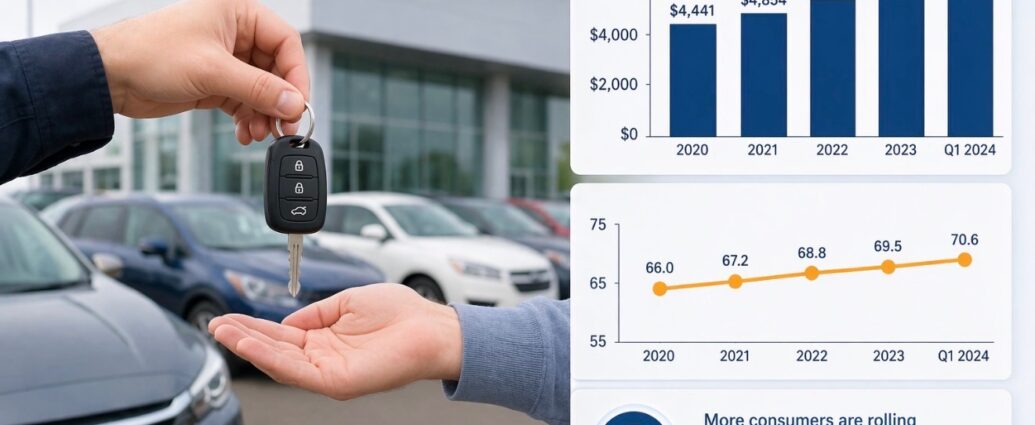
U.S. car buyers entered the spring selling season with a record amount of debt attached to their trade-ins, a sign that elevated vehicle prices and extended loan terms continue to strain household balance sheets. Edmunds said in data released in April that the average amount of negative equity rolled into a new-vehicle loan reached $7,138 in the first quarter, and analyst Ivan Drury said in the company’s release that “buyers are still grappling with affordability challenges,” a trend the pricing firm tied to years of expensive financing and high transaction prices.
The share of trade-ins carrying negative equity also remained unusually high, underscoring how many consumers still owe more than their vehicles are worth. In its first-quarter analysis, Edmunds said 30.9% of trade-ins toward new-vehicle purchases came with underwater loans, just below the 31.9% level recorded in the first quarter of 2021 during the pandemic-era market dislocation. Jessica Caldwell, head of insights at Edmunds, said in prior company commentary on affordability that “consumers are stretching themselves financially” as higher prices and rates reshape buying behavior, and the latest figures suggest that pressure has not eased meaningfully.
That pressure sits squarely in a market where financing costs remain far above pre-pandemic norms. According to Cox Automotive, average auto loan rates have stayed elevated even as some vehicle prices cooled from their peak, and chief economist Jonathan Smoke said in recent market commentary that affordability “remains a major challenge for many households.” Reporting from Reuters and CNBC over the past year has similarly highlighted how buyers increasingly rely on longer repayment periods to keep monthly payments manageable, even if that leaves them carrying debt longer and more vulnerable to depreciation.
The mechanics of negative equity are straightforward but punishing. When a borrower trades in a vehicle worth less than the remaining loan balance, the difference gets added to the next loan, increasing the amount financed and often extending the payoff timeline. Consumer Financial Protection Bureau officials have said in public guidance that rolling debt from one vehicle into another can “increase the risk of becoming upside down again,” and the agency has warned that longer-term loans can leave borrowers exposed if they need to sell or replace a vehicle before the balance catches up with the car’s value.
Automakers and dealers have benefited from resilient demand, but the financing backdrop has become harder to ignore. J.D. Power said in its U.S. auto retail forecasts that monthly payments and interest costs remain key constraints on sales, and analyst Thomas King has said consumers “continue to face affordability headwinds” despite improved inventory. That matters for manufacturers because negative equity can delay replacement cycles, push buyers into lower-priced models, or force them out of the new-vehicle market altogether.
The broader credit picture suggests lenders also face a more fragile consumer. The Federal Reserve Bank of New York said in its Household Debt and Credit reports that auto loan delinquencies have risen, particularly among lower-credit borrowers, and researchers there noted that stress in auto credit has become more visible as pandemic-era savings buffers faded. In separate reporting, Bloomberg and Reuters have pointed to rising repossessions and late payments as signs that some households are struggling to absorb higher borrowing costs across cars, credit cards and housing.
Used-car values, while still historically elevated in some segments, no longer provide the cushion they did during the supply crunch. Manheim, the wholesale vehicle marketplace operated by Cox Automotive, said in its pricing updates that used-vehicle values have normalized from extraordinary pandemic highs, and that shift has made it harder for borrowers to trade out of loans cleanly. Jeremy Robb, senior director of economic and industry insights at Manheim, said in market commentary that depreciation patterns have become more typical again, a development that helps buyers entering the market now but hurts those who financed expensive vehicles at the peak.
For dealers, the trend creates a more complicated sales conversation. National Automobile Dealers Association chief economist Patrick Manzi has said in industry remarks that affordability remains one of the sector’s central issues, especially when high rates collide with still-elevated prices. Buyers carrying thousands of dollars in rolled-over debt often need incentives, longer terms or larger down payments to make a deal work, and each option can compress margins or increase credit risk somewhere in the chain.
What comes next depends largely on rates, used-car pricing and whether automakers keep leaning on incentives to support volume. Edmunds said the first-quarter record reflects a market still digesting the aftereffects of the pandemic pricing boom, while economists at Cox Automotive and the Federal Reserve Bank of New York have indicated that consumer strain in auto finance bears close watching. If borrowing costs stay high and depreciation continues to normalize, more households could find themselves trapped in a cycle of rolling old debt into new cars, a dynamic that matters not just for auto sales but for lenders, manufacturers and the health of U.S. consumer credit more broadly.
JBizNews Desk