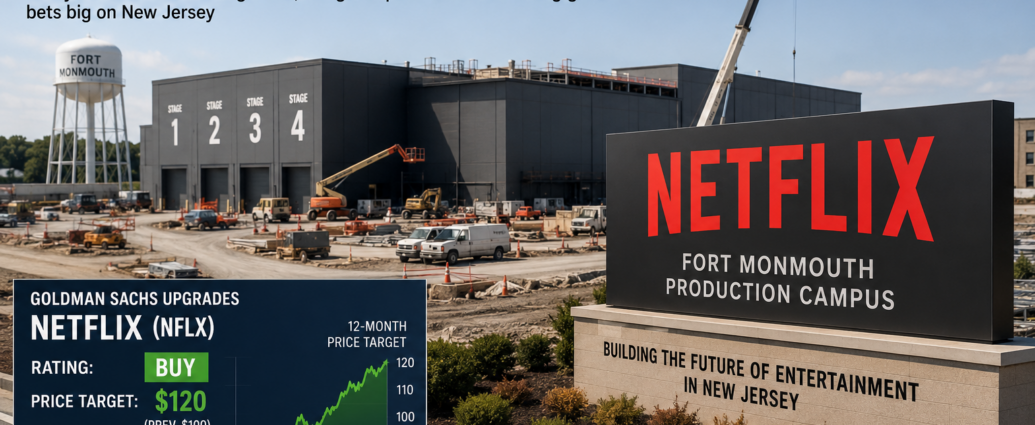
Wall Street is beginning to recognize what business leaders and local officials in Monmouth County have been watching unfold for years: Netflix’s massive redevelopment of Fort Monmouth is evolving into one of the most significant entertainment infrastructure projects on the East Coast. The streaming giant’s planned $1 billion investment at the former Army base in Eatontown and Oceanport is moving steadily forward as analysts increasingly view the project as part of Netflix’s broader long-term growth strategy. Fresh sell-side commentary released through Friday, including reiterated bullish notes following the company’s annual upfront presentation in New York last week, has begun folding the New Jersey build into the broader bull case for Netflix shares.
The renewed investor attention intensified after Eric Sheridan, managing director at Goldman Sachs, upgraded Netflix shares to Buy on April 6 and raised the firm’s 12-month price target from $100 to $120. The analyst described a more favorable risk-reward setup following an extended decline in Netflix stock, which had fallen roughly 18% over the prior six months amid concerns tied to the company’s abandoned $82.7 billion pursuit of Warner Bros. Discovery’s streaming and studio assets. Netflix formally exited the acquisition effort on Feb. 26 after declining to match Paramount Skydance’s higher bid and later collected a $2.8 billion termination fee, shifting investor focus back toward the company’s standalone expansion strategy. Goldman’s bullish stance was reinforced last Friday when Guggenheim reiterated its Buy rating with a $120 price target, joining J.P. Morgan analyst Doug Anmuth at $118 and Jefferies at $134.
While Wall Street analysts debate valuation and advertising growth, construction activity at Fort Monmouth has already transformed large sections of the 292-acre property. Since groundbreaking last May, Netflix has demolished approximately 85 former military structures to prepare for the first phase of studio development. The company is constructing four initial soundstages in Oceanport’s McAfee Zone, with each facility measuring roughly 22,000 square feet. Structural work on the first building is already visible on-site.
The redevelopment effort extends beyond new soundstages. Historic portions of the former military installation are being preserved and repurposed as part of the broader campus design. Vail Hall, one of the site’s most recognizable historic buildings, is expected to become production office space, while several existing warehouse structures totaling more than 40,000 square feet will be renovated for storage and operational support. Netflix also plans upgrades to the Fort Monmouth Economic Revitalization Authority offices and the 92,000-square-foot McAfee Center.
Local officials have emphasized that the project represents far more than a studio complex. The master redevelopment plan includes retail components, open public spaces, support infrastructure, and a potential hotel intended to accommodate cast and production crews during long-term filming schedules. Portions of the site, including Greely Field and Cowan Park, are expected to remain publicly accessible as part of the redevelopment agreement.
The economic implications for New Jersey are substantial. The New Jersey Economic Development Authority approved approximately $387 million in Aspire tax credits to support the project, while additional incentives through the state’s Film and Digital Media Tax Credit program could allow Netflix to qualify for production-related tax credits worth up to 40% of eligible New Jersey expenses if the company maintains long-term occupancy at the site.
State officials have increasingly positioned New Jersey as a growing East Coast production hub capable of competing with traditional entertainment markets in California, Georgia, and New York. Over the past year, Netflix has filmed nearly 20 projects within the state and currently maintains active productions employing more than 500 workers across New Jersey. Once fully completed, the Fort Monmouth studio campus is projected to support as many as 1,500 permanent jobs, in addition to hundreds of ongoing construction positions.
Financially, investors continue to focus on Netflix’s advertising business as a major future growth driver. Goldman Sachs forecasts the company’s advertising revenue could expand from roughly $1.5 billion in 2025 to nearly $9.5 billion annually by 2030 as Netflix scales its ad-supported subscription model globally. At the company’s upfront presentation in New York last week, TD Cowen analyst John Blackledge highlighted that Netflix’s ad-supported tier now reaches more than 250 million global monthly active viewers, up from roughly 190 million in November. Across 32 covering analysts, the consensus rating on Netflix is now Strong Buy with an average 12-month price target near $119. Analysts also expect continued operating margin expansion and the resumption of large-scale stock buybacks following the collapse of the Warner Bros. transaction.
Netflix’s broader financial performance remains strong despite recent market volatility. The company generated approximately $45.2 billion in revenue during 2025, representing roughly 16% year-over-year growth, while net income approached $11 billion. However, shares have remained under pressure following the company’s first-quarter earnings report released in April, with the stock closing Friday at $87.02, well below Goldman’s upgraded entry target and roughly 35% off the 52-week high of $134.12. Not every voice on the Street is bullish. Raymond James analyst Andrew Marok holds a Market Perform rating, arguing the debate over user engagement is far from resolved, while Erste Group earlier downgraded the stock to Hold.
For Monmouth County, however, the investment story is increasingly visible in physical terms rather than financial models. Roads, infrastructure systems, and former military facilities continue to be reshaped into a modern production campus that local leaders believe could permanently alter the region’s economic profile. The first phase of development, known as Phase 1A, is currently scheduled to open in 2027 and will include the initial Oceanport soundstages and support buildings. A second phase planned for Eatontown, including eight additional soundstages, is targeted for completion in 2028.
Industry observers say the Fort Monmouth redevelopment could eventually reshape the geography of U.S. film and television production by creating a large-scale East Coast alternative for streaming-era content creation. As Netflix deepens its operational footprint in New Jersey, the company’s long-term wager on Monmouth County increasingly appears to be both a real estate transformation project and a strategic production expansion designed to support the next phase of global streaming competition.
JBizNews Desk
© JBizNews.com. All rights reserved. This article is original reporting by JBizNews Desk. Unauthorized reproduction or redistribution is strictly prohibited.