By JBizNews Desk
NEW YORK, May 21, 2026 — The economic data says the U.S. labor market is healthy. Employers are still adding jobs, unemployment remains relatively low at 4.3%, consumer spending has not collapsed, and corporate earnings continue beating expectations. By traditional economic definitions, the United States is still operating inside what policymakers hoped would become a soft landing.
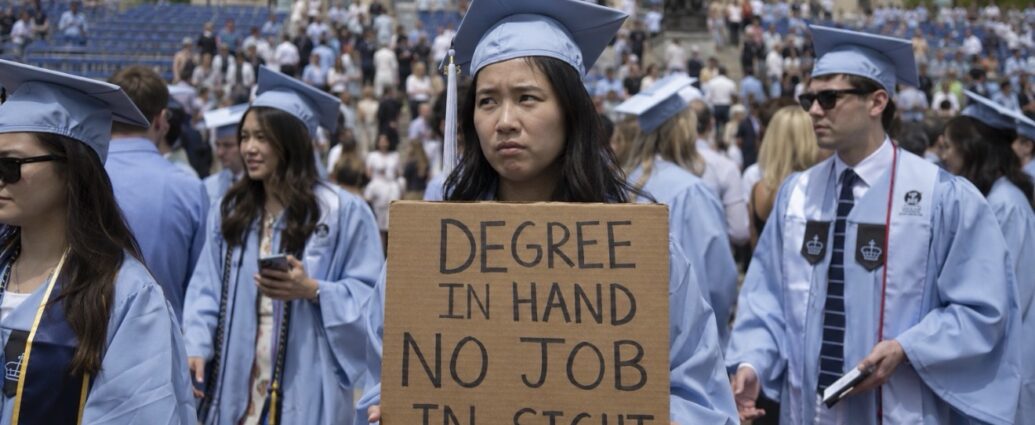
For millions of Americans graduating from college this spring, it does not feel that way at all.
The unemployment rate for recent college graduates has remained above the national unemployment rate for five consecutive years, according to data from the Federal Reserve Bank of New York, a reversal from the decades before the pandemic when college graduates almost always enjoyed materially lower unemployment than the overall workforce. In the first quarter of 2026, unemployment among recent graduates stood near 5.7%, while underemployment — graduates working jobs that do not require a four-year degree — remained above 41%.
In practical terms, more than four out of every ten employed recent graduates are now working positions beneath the education level they were told would unlock opportunity.
Beneath those headline numbers sits a structural shift that economists, universities, and employers are only beginning to fully understand. Entry-level white-collar hiring has slowed sharply since the generative AI boom accelerated in 2023, with companies increasingly automating the routine analytical, administrative, coding, and research tasks that historically served as the first rung on the corporate ladder.
Labor-market tracking data shows entry-level job postings have fallen roughly 35% since early 2023. The industries historically responsible for absorbing large waves of graduates — consulting, technology, finance back-office operations, media, marketing, and advertising — are among the sectors pulling back the hardest.
The result is an economy producing a deeply unusual contradiction: businesses are still profitable, still hiring selectively, and in many cases still growing, while simultaneously reducing the number of junior workers they bring into the system.
The National Association of Colleges and Employers, or NACE, initially projected that hiring for the graduating Class of 2026 would rise just 1.6% from the previous year, effectively flat once adjusted for population growth. But a spring revision showed employers now expect hiring to rise 5.6%, an improvement driven by more than one-third of surveyed companies increasing planned graduate recruitment.
Even that improvement came with an important caveat. The rebound is not broad-based. Hiring growth is concentrated in engineering, information services, construction, logistics, and specialized professional services rather than the traditional office-heavy sectors many graduates spent years preparing to enter.
Mary Gatta, NACE’s director of research and public policy, described the trend as less of a recovery and more of a recalibration. Companies that initially believed AI would allow them to dramatically shrink junior staffing are beginning to realize they still need employees capable of operating, supervising, and integrating AI systems into workflows.
But needing fewer entry-level workers than before is still not the same thing as needing none.
That distinction is now reshaping the bottom layer of the American white-collar workforce.
Research published by the Stanford Digital Economy Lab found employment among workers aged 22 to 25 in AI-exposed occupations has fallen 13% since late 2022. Junior software developer employment dropped roughly 20% during the same period, while older workers in comparable positions actually saw gains.
A separate study released by Harvard researchers in February 2026, analyzing more than 62 million workers, found companies adopting generative AI reduced junior staffing by roughly 9% to 10% while largely preserving senior-level positions.
The emerging pattern is becoming increasingly visible across corporate America: firms are not eliminating experienced workers. They are reducing intake at the bottom.
BlackRock Chief Executive Larry Fink warned earlier this year that the graduating class of 2026 could face one of the most difficult entry-level hiring environments in years because artificial intelligence is replacing portions of junior-level office work faster than the labor market can create new pathways.
Economists increasingly describe the current environment as a “no-hire, no-fire” labor market. Companies are reluctant to lay off experienced workers because skilled labor remains expensive and difficult to replace. At the same time, they are slowing or freezing the hiring pipelines that traditionally replenished future mid-level talent.
That dynamic helps explain why the labor market feels far weaker to young workers than broader economic indicators suggest.
The graduates themselves are adapting in real time. Data from ZipRecruiter’s 2026 Graduate Report shows roughly one in five employed graduates now believes they are overqualified for their current role, while a similar percentage said they deliberately applied for jobs below their education level simply to secure income and experience.
Student debt pressures are intensifying the situation. Higher-education expert Mark Kantrowitz estimates roughly 160,000 federal student-loan borrowers entered unemployment deferment programs during the first quarter of 2026 alone, with interest continuing to accrue for many borrowers despite paused payments.
There are important exceptions to the broader trend.
International Business Machines Corp. said this year it plans to triple entry-level hiring across parts of its U.S. workforce. IBM Chief Executive Arvind Krishna has argued that younger employees often adapt to AI-assisted workflows faster than mid-career workers because they have fewer legacy habits and are more comfortable collaborating directly with machine-learning systems.
The company says junior developers now spend less time performing repetitive coding tasks and more time interfacing directly with customers while AI handles foundational programming work underneath them.
Whether IBM’s approach becomes a blueprint for corporate America or remains an isolated strategy could become one of the defining workforce questions of the next several years.
Universities and workforce researchers are also experimenting with what some are beginning to call “AI apprenticeships” — entry-level programs where graduates use generative AI systems to perform at productivity levels once associated with more experienced workers while still receiving junior-level pay and training.
Supporters argue the model could preserve pathways into white-collar careers. Critics warn it may permanently compress entry-level employment and wages by allowing companies to operate with fewer people overall.
For now, the numbers tell the immediate story clearly: the entry-level labor market has frozen even as the broader economy remains relatively stable.
And beneath that freeze sits a longer-term risk for corporate America itself.
A labor market that automates away too much of the bottom rung may eventually discover there is nobody left prepared to fill the middle one.
JBizNews Desk
© 2026 JBizNews. All Rights Reserved. Reproduction or distribution without written permission is prohibited.