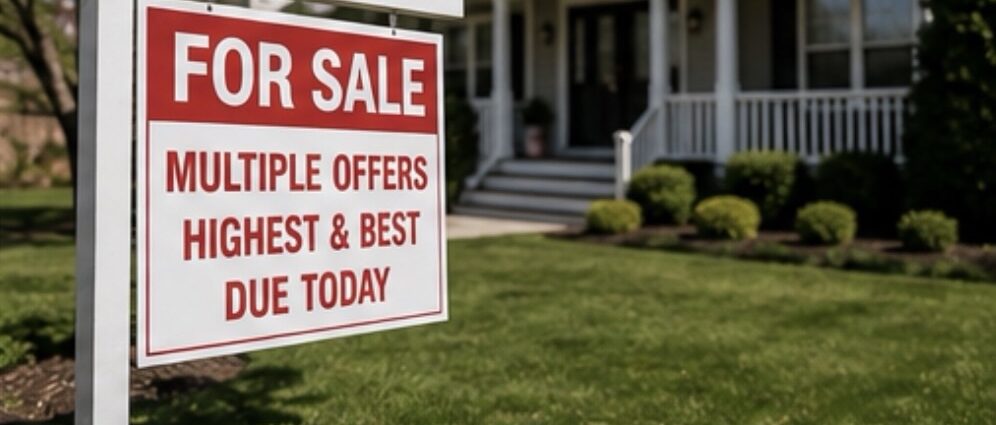
Newark, N.J. — May 24, 2026 — New Jersey’s suburban housing market has entered an increasingly extreme phase of bidding competition as inventory shortages, migration from New York City and land scarcity collide across the state’s highest-demand commuter corridors.
The pressure became visible this month after New Jersey real estate agent Amanda Cruz posted a viral social-media video describing how a client lost a home despite offering $150,000 above the asking price.
“Someone else came in much higher than us,” Cruz said. “Like, we weren’t even in the ballpark.”
The video quickly became a symbol of the broader affordability and supply crisis unfolding across Bergen, Essex, Morris, Hudson and Union counties, where buyers continue competing aggressively for limited single-family inventory near Manhattan.
The structural imbalance is increasingly straightforward: demand continues rising while buildable land for new detached housing has effectively disappeared across many of New Jersey’s wealthiest suburban markets.
As a result, inventory turnover now depends largely on existing homeowners deciding to sell rather than meaningful new supply entering the market.
The migration dynamics are accelerating the pressure further.
Analysts increasingly expect New York Governor Kathy Hochul’s proposed second-home tax targeting pied-à-terre owners and investment properties to push additional high-income households toward permanent residency in New Jersey rather than maintaining part-time Manhattan ownership.
That migration pressure is concentrating heavily in transit-oriented suburbs with direct access to New York City.
Montclair, Maplewood, South Orange, Summit, Millburn, Short Hills, Tenafly, Englewood Cliffs and Hoboken are now routinely seeing multiple-offer scenarios on homes priced below roughly $2.5 million, particularly those located within thirty minutes of Manhattan commuter access.
Similar patterns are emerging across parts of lower Fairfield County, Connecticut, including Greenwich, Westport and New Canaan.
The buyer pool itself is increasingly splitting into distinct tiers.
Younger professional families priced out of Brooklyn Heights, Cobble Hill, Park Slope and Williamsburg are moving into Jersey City, Hoboken, Montclair and Maplewood, while higher-net-worth buyers exiting Manhattan neighborhoods such as Tribeca, the Upper East Side and the Upper West Side are concentrating in Short Hills, Greenwich and Bronxville.
All-cash offers are becoming increasingly common across premium listings, particularly among finance and technology professionals already established in suburban markets and now seeking larger homes or school-district upgrades.
At the same time, institutional capital continues shifting heavily into multifamily and build-to-rent development projects across the state.
Transit-oriented housing remains one of the strongest-performing sectors in New Jersey real estate, with major developers including Roseland Residential Trust, Veris Residential, Mack-Cali and Toll Brothers Apartment Living expanding aggressively throughout key suburban corridors.
Recent projects include a 150-unit condominium development in Robbinsville launched by Sharbell Development Corp., blending market-rate and affordable housing components.
The broader policy environment is also shaping migration and investment flows.
Mayor Zohran Mamdani’s proposed rent freeze covering approximately one million rent-regulated apartments in New York City is increasingly cited by commercial real estate analysts as another factor encouraging both households and capital to shift toward New Jersey, where free-market multifamily economics remain significantly more flexible.
Meanwhile, Governor Mikie Sherrill’s discussions around utility-rate stabilization and affordability have so far done little to slow inbound residential demand.
The core issue remains supply.
Affordable-housing legislation has expanded multifamily development pipelines across the state, particularly in Hudson and Essex counties, but meaningful new single-family construction remains severely constrained by zoning, land scarcity and infrastructure limitations.
That imbalance is forcing many first-time buyers to fundamentally reset expectations.
Real estate brokers across Bergen, Essex and Morris counties increasingly report advising clients to raise target budgets by 15% to 25% compared with late-2025 pricing assumptions simply to remain competitive.
For many households, the question is no longer whether New Jersey housing is expensive.
It is whether there will be anything left to buy at all.
JBizNews Desk
© 2026 JBizNews. All Rights Reserved. Reproduction or distribution without written permission is prohibited.