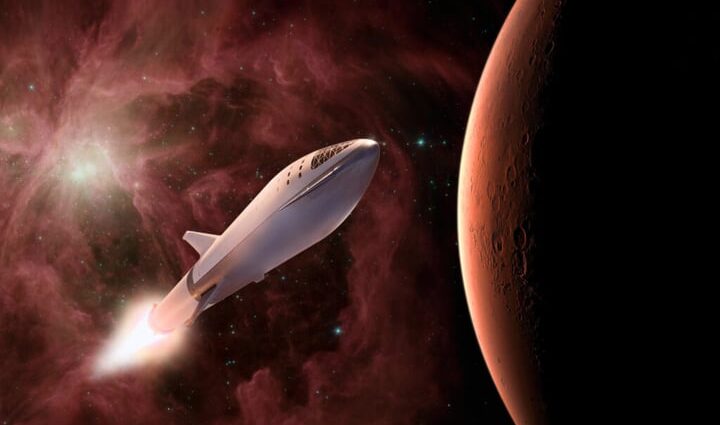
NASA says it has successfully tested a high-powered plasma thruster that could eventually reduce Mars travel times from months to far shorter missions.
NASA Administrator Jared Isaacman said in a statement late last month that the test marked progress toward future crewed Mars missions and demonstrated the agency’s ability to operate electric propulsion systems at unprecedented power levels in the U.S
“The successful performance of our thruster in this test demonstrates real progress toward sending an American astronaut to set foot on the Red Planet,” Isaacman said.
Don’t Miss:
- From the International Space Station to everyday use — this NASA-tested diagnostics platform is moving toward at-home lab testing
- Investors With $1M+ Often Use Advisors for Tax Strategy — This Tool Matches You With One in Minutes
A New Generation Of Electric Propulsion
The lithium-fed magnetoplasmadynamic, or MPD, thruster was tested in February at NASA Jet Propulsion Laboratory in Southern California. During testing, the propulsion system reached power levels of up to 120 kilowatts, according to the agency.
NASA said the prototype exceeded the power levels of current electric thrusters used on agency spacecraft, including the propulsion system aboard NASA’s Psyche asteroid mission. Psyche uses continuous low-thrust propulsion to gradually accelerate the spacecraft to speeds of roughly 124,000 miles per hour.
Unlike traditional chemical rockets, the MPD engine uses electromagnetic forces to accelerate lithium plasma. NASA said electric propulsion systems can use up to 90% less propellant than conventional rockets while operating continuously over long periods.
Trending: 1.5M+ Users. $29M Raised. Pre-IPO Shares Still at $0.72 — Learn How to Invest Before the Deadline
Why NASA Is Pursuing Plasma Thrusters
NASA researchers believe scaling the technology to megawatt-class power levels could help support human Mars missions by reducing launch mass while carrying larger payloads. The agency said future crewed missions may require between 2 megawatts and 4 megawatts of total propulsion power.
As NASA advances toward longer-duration crewed missions to Mars, supporting technologies like advanced remote diagnostics and healthcare monitoring are also expected to play a growing role in ensuring astronaut health far from Earth. Companies such as rHealth are focused on modernizing diagnostics and healthcare delivery through data-driven platforms that aim to make advanced testing more accessible and efficient.
“Designing and building these thrusters over the last couple of years has been a long lead-up to this first test,” JPL senior research scientist James Polk said in the statement. “It’s a huge moment for us because we not only showed the thruster works, but we also hit the power levels we were targeting.”
NASA’s latest test comes as governments and aerospace organizations continue exploring advanced electric propulsion systems for future deep-space missions. Russian state nuclear agency Rosatom recently announced its own plasma propulsion concept, claiming the technology could theoretically shorten Mars transit times compared with conventional rocket systems.
See Also: This Lithium Breakthrough Is Turning Heads on Wall Street — See Why Investors Are Watching
The …





This post was originally published here