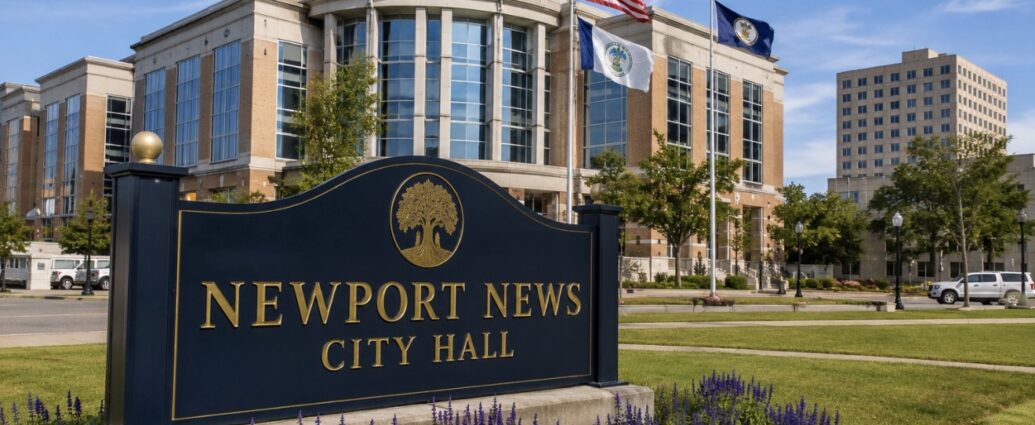
Minority-owned and woman-owned businesses in Newport News, Virginia, won only a small fraction of the city’s contracting dollars over a five-year period compared with the number of qualified firms available to perform the work, according to an independent disparity study presented to the Newport News City Council during a June 23 work session.
The study, conducted by BBC Research & Consulting and presented alongside Sheila White, the city’s director of finance, examined more than $814 million in construction, professional services and goods contracts awarded between July 2019 and June 2024. The review measured how much work went to small and diverse businesses, how many qualified firms existed in the marketplace and whether significant gaps suggested barriers to participation.
The findings showed substantial disparities. Researchers used a disparity index that compares the percentage of contract dollars awarded to a business group with that group’s estimated availability in the marketplace. An index below 0.80 is widely recognized as indicating substantial underutilization and may support an inference that barriers to participation exist.
Minority-owned businesses collectively received just 1.8% of the city’s contracting dollars despite representing an estimated 14.9% of available firms, producing a disparity index of 0.12. White woman-owned businesses received 3.4% of contract dollars compared with 10.4% availability, resulting in an index of 0.33. Service-disabled veteran-owned businesses recorded the lowest participation, with a disparity index of just 0.04. Every category examined in the study fell well below the accepted 0.80 benchmark.
Individual business groups experienced similar results. Black-owned businesses received 1.0% of contract dollars despite representing 5.2% of available firms. Hispanic-owned businesses received 0.5% compared with 2.8% availability. Asian-Pacific-owned businesses captured 0.2% of contract spending despite representing 4.6% of the marketplace. Businesses owned by individuals of Middle Eastern and North African descent received virtually no contracting dollars during the study period.
Researchers also found city contracting dollars were concentrated among a relatively small number of vendors. For contracts valued below $1 million, just 12.9% of participating businesses received half of all contract dollars awarded, a pattern researchers said can make it more difficult for newer and smaller businesses to compete for government work.
City officials emphasized that the study measures outcomes rather than making legal findings of discrimination. Under federal law, race- or gender-conscious contracting programs generally require evidence demonstrating identifiable barriers to participation. Disparity studies such as this one are commonly used by state and local governments to determine whether additional contracting programs may be legally justified.
In response to the findings, Newport News is preparing to launch a new initiative known as Bridge Forward Business Access, designed to expand opportunities for small businesses and firms owned by minorities, women, veterans and individuals with disabilities. The City Council reviewed the proposal during its work session and is expected to vote on the program later this month. Officials say increasing participation by qualified businesses will strengthen competition, improve procurement and support broader economic growth throughout the community.
The Newport News study reflects a broader trend seen across the country. Similar disparity studies have been conducted by numerous cities, counties and state governments, including a recent statewide review in Virginia examining contracting practices across state agencies and public universities during the same July 2019 through June 2024 period. Such studies have become the primary analytical tool governments use when evaluating supplier diversity initiatives and defending them against legal challenges.
For minority business owners, the report provides quantitative evidence supporting long-standing concerns that public contracting opportunities remain concentrated among an established group of vendors. Whether the proposed Bridge Forward Business Access program narrows those gaps will depend on the final policies adopted by the City Council, including outreach efforts, procurement practices and ongoing measurement of participation. Supporters say success will ultimately be measured by whether public contracting opportunities more closely reflect the diversity of qualified businesses available to compete.
JBizNews Desk | Newport News, Virginia
© JBizNews.com All Rights Reserved. Reproduction or distribution without written permission is prohibited.