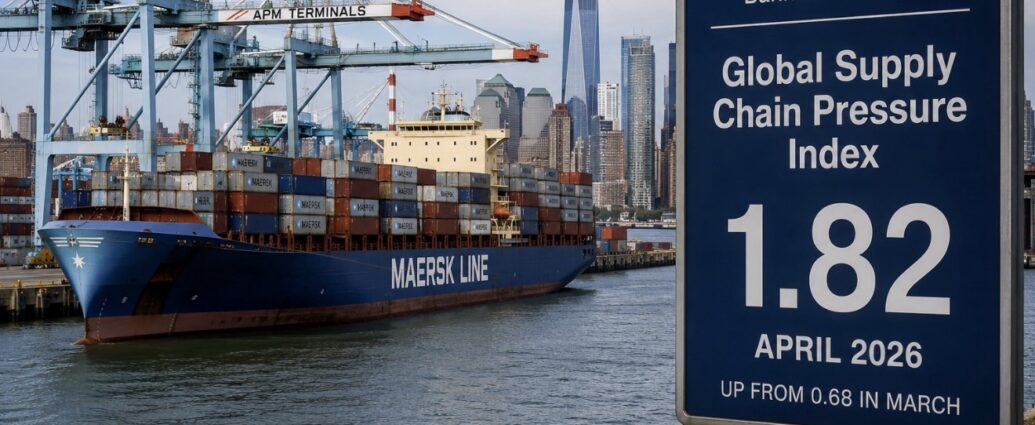
The Federal Reserve Bank of New York’s closely watched supply-chain stress gauge surged to its highest level since the post-pandemic shipping crisis, delivering some of the clearest evidence yet that the Iran war is evolving from an energy shock into a broader global logistics and inflation problem.
The New York Fed’s Global Supply Chain Pressure Index jumped to 1.82 in April, nearly tripling from 0.68 in March and reaching levels last seen during the worldwide container shortages and manufacturing disruptions of 2021 and 2022.
The move lands just days after hotter-than-expected U.S. inflation reports reignited fears that war-related shipping disruption is beginning to spread across the broader global economy.
The index, which combines transportation costs, delivery times and manufacturing surveys from major economies worldwide, treats zero as the long-run historical average. A reading above 1 signals materially tighter-than-normal global trade conditions.
At 1.82, the current environment now reflects some of the most strained logistics conditions since the pandemic supply-chain collapse.
But unlike the COVID-era crisis, economists say the source of the disruption is fundamentally different.
This is not a demand boom overwhelming supply chains. It is the partial shutdown of one of the world’s most strategically important shipping corridors.
Commercial traffic through the Strait of Hormuz has operated at near-standstill levels since the Iran conflict escalated in late February.
According to A.P. Moller-Maersk, roughly 6% of global container trade moved through the Upper Gulf in 2025. U.S. military estimates place more than 1,550 commercial vessels carrying roughly 22,500 mariners inside the Persian Gulf region, with many unable to safely transit.
Marine-insurance premiums tied to Gulf shipping routes have surged sharply.
The stress is now spreading beyond oil markets into broader industrial supply chains.
The latest Institute for Supply Management manufacturing survey included executives describing aggressive procurement strategies, emergency inventory building and supplier diversification efforts across industries ranging from agriculture to industrial manufacturing.
Disruptions are now emerging in fertilizer, aluminum and helium supply chains — with helium shortages particularly concerning for medical-imaging companies and semiconductor manufacturers because the gas remains essential for MRI cooling systems and chip-production facilities.
Agricultural suppliers including Corteva and FMC Corporation have already warned investors about rising input costs heading into the critical summer growing season.
Shipping companies are increasingly sounding alarms about the economics of moving goods through the region.
Maersk chief executive Vincent Clerc said last week that the company’s incremental fuel and insurance costs tied to the conflict are now running approximately $500 million per month. German shipping giant Hapag-Lloyd separately estimated roughly $60 million per week in war-related costs.
Many carriers have rerouted Asia-Europe shipping lanes around the Cape of Good Hope, adding between 10 and 14 days to delivery times and increasing fleet utilization even as global demand softens.
The inflation implications are no longer theoretical.
Research published by the Dallas Federal Reserve estimated that a severe global oil-supply disruption tied to the conflict could add roughly 0.6 percentage points to headline U.S. inflation and approximately 0.2 percentage points to core inflation by late 2026.
That pressure is already beginning to appear in market pricing.
The 10-year Treasury Inflation-Protected Securities breakeven rate climbed this week to roughly 2.5%, the highest level since early 2023, signaling that bond investors are increasingly repricing long-term inflation expectations upward.
For Federal Reserve officials, the worsening supply-chain environment further complicates an already divided policy debate.
Fed Vice Chair Philip Jefferson warned earlier this year that “the longer inflation remains above 2%, the greater the risk that it becomes entrenched in expectations.”
The latest Fed meeting exposed unusually sharp disagreement among policymakers. Regional presidents including Neel Kashkari, Jeff Schmid and Lorie Logan pushed back against easing bias, while Governor Stephen Miran dissented in favor of a rate cut.
With former governor Kevin Warsh now returning to the Board, the central bank enters the summer facing one of its deepest internal policy divides in more than three decades.
Corporate America is already beginning to quantify the impact.
Birkenstock disclosed this week that the Iran conflict reduced quarterly revenue in its Europe, Middle East and Africa business by roughly €6 million, citing shipping disruption and weaker European consumer demand. Energy companies, shipping firms and retailers are increasingly warning investors about rising transportation and insurance expenses.
The broader concern now confronting economists and investors is whether April’s reading represents merely the beginning of a more sustained global supply-chain squeeze.
If shipping disruptions persist through the second half of the year, the New York Fed’s latest report may ultimately prove less a peak than an early warning.
JBizNews Desk
© JBizNews.com. All rights reserved. This article is original reporting by JBizNews Desk. Unauthorized reproduction or redistribution is strictly prohibited.