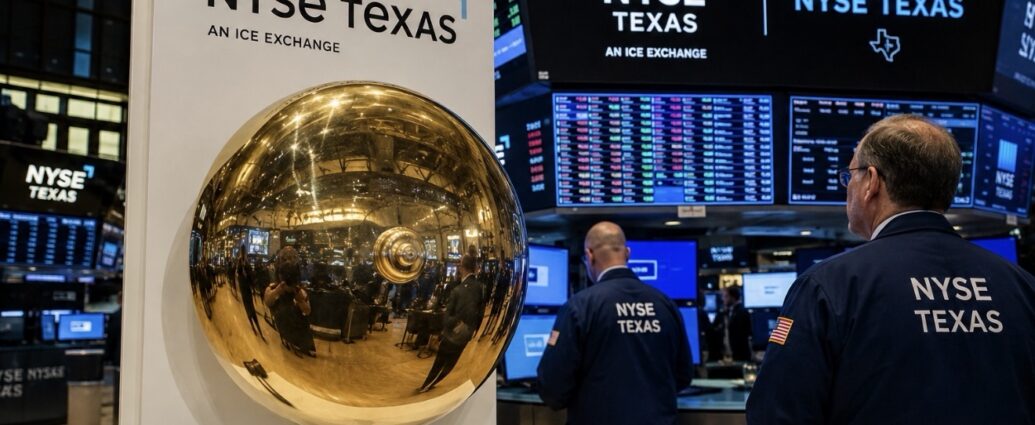
Buda Juice, Inc. became the latest company to dual-list on NYSE Texas this week as competition intensifies between multiple exchanges trying to turn Texas into a new center of American finance.
The Dallas-based juice company officially added its shares to NYSE Texas on May 26, 2026, while keeping its primary listing on NYSE American.
The move itself is relatively small financially.
The broader trend behind it is not.
Texas is rapidly becoming one of the biggest battlegrounds in the future of U.S. capital markets.
Just a few years ago, the state had no major stock exchanges.
Now it has:
- NYSE Texas
- The upcoming Texas Stock Exchange (TXSE)
- Expanding operations from Nasdaq in Dallas
Together, they are reshaping the geography of Wall Street.
Buda Juice CEO Horatio Lonsdale-Hands said the listing reflects the company’s Texas roots as the brand continues national expansion.
The company produces cold-pressed juices and wellness beverages distributed through supermarkets and retailers across the country.
The listing itself is considered a “dual listing,” meaning shares trade simultaneously on more than one exchange.
For companies, dual listings are attractive because they create regional visibility without forcing businesses to move their primary exchange relationship.
That strategy has become central to the Texas exchange push.
NYSE Texas, launched by the New York Stock Exchange in 2025, has already signed more than 100 companies with combined market values exceeding $2 trillion.
The exchange is targeting companies seeking stronger ties to Texas’s rapidly growing business ecosystem while still maintaining connections to traditional financial centers.
Texas officials have spent years aggressively recruiting financial firms, investment companies, technology businesses, and corporate headquarters away from states like New York and California.
Lower taxes, lighter regulation, and faster development approvals have helped fuel the migration.
Texas now hosts more NYSE-listed companies than any other state, with combined market values approaching $4 trillion.
The next phase of the competition arrives later this year with the launch of the Texas Stock Exchange, commonly known as TXSE.
Unlike NYSE Texas, which operates under the NYSE umbrella, TXSE is an entirely separate exchange backed by major Wall Street institutions including:
- BlackRock
- Citadel Securities
- Goldman Sachs
- Bank of America
- JPMorgan Chase
- Charles Schwab
The exchange has already raised hundreds of millions of dollars ahead of launch.
TXSE CEO James Lee has openly criticized the quality of many companies currently trading on traditional exchanges and says his platform intends to operate with stricter standards while offering lower listing fees.
That fee competition could become important for mid-sized public companies looking to reduce costs.
Both Texas exchanges are initially focused more on attracting secondary listings than convincing companies to abandon the NYSE or Nasdaq entirely.
Switching primary exchanges can be expensive and operationally difficult.
Adding a Texas listing is far simpler.
The state’s broader business growth is helping fuel the momentum.
Texas continues attracting:
- Technology firms
- Financial companies
- Energy businesses
- Data-center developers
- Artificial intelligence infrastructure projects
Large-scale data center developments across West Texas have accelerated as companies seek access to cheaper land and large energy supplies.
That growth has strengthened arguments that the state increasingly deserves its own major capital-markets ecosystem.
The biggest missed opportunity for Texas exchanges so far may be SpaceX.
Although Elon Musk’s SpaceX plans one of the largest IPOs in history, the company is expected to list on Nasdaq rather than NYSE Texas or TXSE.
Even so, the company’s massive Texas footprint continues reinforcing the broader narrative of financial and corporate migration toward the state.
The rise of multiple exchanges inside Texas reflects a larger shift happening across American business geography.
For decades, New York dominated capital markets almost entirely.
Now major portions of corporate America are increasingly operating from Texas, Florida, Arizona, Tennessee, and other lower-tax states.
Financial infrastructure is beginning to follow.
Companies like Buda Juice may represent relatively small listings today.
But they are early signs of a much larger battle over where the next generation of American capital markets will operate.
Wall Street is no longer competing only inside Manhattan.
It is now competing with Texas itself.
JBizNews Desk — Dallas
© JBizNews.com All Rights Reserved. Reproduction or distribution without written permission is prohibited.