By JBizNews Desk | Sunday, May 3, 2026
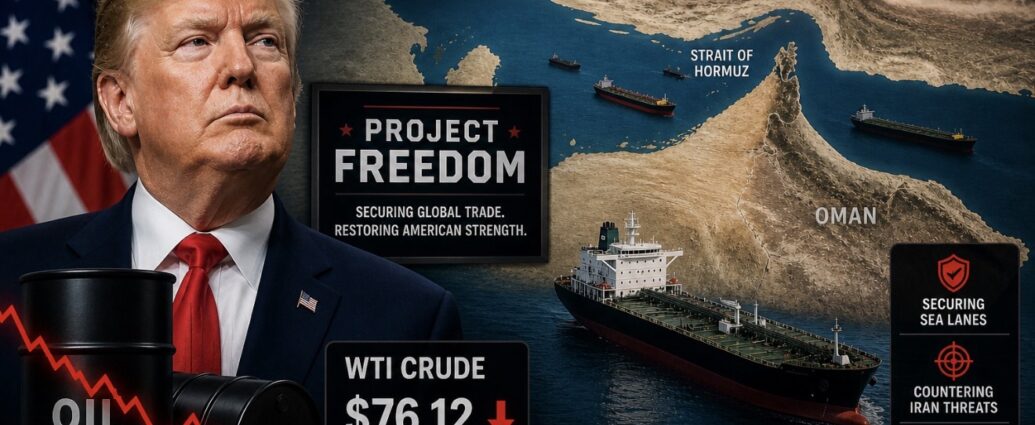
Oil prices slipped modestly Sunday after President Donald Trump announced a U.S. Navy-backed operation he called “Project Freedom” — a pledge to escort stranded commercial vessels out of the Strait of Hormuz beginning Monday morning — offering markets a sliver of hope amid what analysts have called the worst energy supply shock in modern history.
U.S. oil futures dipped 0.77% to $101.16 a barrel, while international benchmark Brent crude eased 0.59% to $107.53. Dow Jones futures added 84 points, S&P 500 futures rose 0.11%, and Nasdaq futures gained 0.06%.  Markets were cautious, with investors wary of acting on a social media post before seeing whether Monday’s operation delivers results on the water.
For American families, the pressure is immediate. Gasoline has risen to $4.44 per gallon nationally, up from under $3 before the war began, driving inflation higher and fueling mounting public frustration with the conflict’s economic toll. 
What Trump Is Proposing
Trump posted on Truth Social Sunday that “neutral and innocent” countries have been caught in the crossfire of the Iran war, and that the U.S. would guide their ships “safely out of these restricted Waterways, so that they can freely and ably get on with their business.” He said Project Freedom would begin Monday morning Middle Eastern time, and that his team is in discussions with Iran that could lead to something “very positive for all.” 
Trump described the operation as a response to requests from “countries from around the world” whose ships are stranded or affected by the navigation restrictions in the waterway.  He warned that any interference would be dealt with by force.
The situation on the water remained tense. A cargo ship near the Strait of Hormuz reported being attacked by multiple small boats Sunday — the first such incident since April 22. Iran has continued to insist that any vessels transiting the strait pay a toll and follow a route approved by the Islamic Revolutionary Guard Corps. U.S. warships have begun anti-mine operations in the waterway, though experts say a full clearance could take weeks or months. 
Oil Dips as Trump’s ‘Project Freedom’ Targets Hormuz Shipping Deadlock
The Strait of Hormuz is the world’s most critical oil chokepoint — and it has been effectively closed since late February. The closure has disrupted roughly 20% of global oil trade, triggering what the International Energy Agency has characterized as the largest supply disruption in the history of the global oil market. 
The damage runs well beyond the gas pump. The strait is also the central artery for the global fertilizer trade, with over 30% of global urea exports flowing through it. Much of the cost of producing staple foods like corn and wheat is tied to fertilizer costs, raising fears of food insecurity not only in Gulf states but around the world. 
ExxonMobil CEO Darren Woods put a sharp point on the risk Friday. Speaking on Exxon‘s first-quarter earnings call, Woods warned that markets have not yet absorbed the full impact of the disruption. Strategic petroleum reserves and commercial inventories have cushioned prices so far, but those buffers will not last indefinitely. “There’s more to come if the strait remains closed,” he said. Exxon estimates its Middle East production could fall 750,000 barrels per day compared to 2025 levels if the closure extends through the second quarter. 
What Needs to Happen Next
Even if Project Freedom moves forward Monday without incident, analysts caution that a full normalization of oil flows will not happen overnight. Woods said that once the strait reopens, oil flows from the Persian Gulf would likely take one to two months to normalize, as tankers need to be repositioned, supply backlogs worked through, and strategic reserves and commercial inventories refilled — all of which will put continued upward pressure on prices.
Treasury Secretary Scott Bessent told Fox News Sunday that Iran’s oil storage is filling rapidly and that Tehran could be forced to begin shutting in oil wells within a week — a development that would significantly weaken Iran’s economic leverage in the standoff. 
Whether Monday brings a breakthrough or a new flashpoint, the world is watching a 30-mile waterway decide the price of almost everything.
© JBizNews.com. All rights reserved. This article is original reporting by JBizNews Desk. Unauthorized reproduction or redistribution is strictly prohibited.