By Julia Parker — JBizNews Desk
Global oil markets closed Friday with Brent crude holding above $107 a barrel and West Texas Intermediate trading above $103 — prices that appear surprisingly restrained given what the International Energy Agency now describes as the largest oil-supply disruption in modern history.
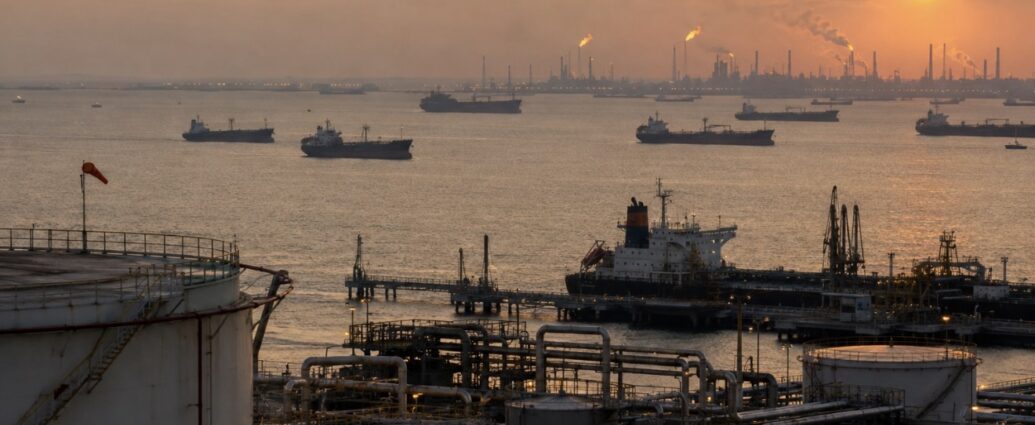
According to the IEA’s May Oil Market Report, roughly 12.8 million barrels per day of global oil supply have been disrupted since the Iran conflict escalated in late February and effectively shut the Strait of Hormuz, the narrow shipping channel through which nearly one-fifth of the world’s oil normally flows.
Yet despite the scale of the shock, oil prices remain well below the $138 Brent peak reached on April 7, creating one of the most unusual energy-market dynamics in decades.
The reason, increasingly, is that several powerful stabilizing forces are offsetting what would otherwise be a catastrophic supply collapse.
The supply disruption itself remains enormous.
The U.S. Energy Information Administration, in its May Short-Term Energy Outlook, estimated that production shut-ins across Iraq, Saudi Arabia, Kuwait, the United Arab Emirates, Qatar, and Bahrain averaged roughly 10.5 million barrels per day in April and could approach 10.8 million barrels per day this month as regional storage systems reach operational limits.
Before the conflict, approximately 20% of global crude exports passed through the Strait of Hormuz. The IEA said crude and fuel flows through the corridor fell by roughly 4 million barrels per day during March and April, while Gulf-region exports across all routes plunged by nearly 16 million barrels per day.
Under ordinary conditions, markets facing a disruption of that scale would likely experience a far sharper price spike.
Instead, three major forces have helped absorb the shock.
The first is demand destruction.
The IEA now expects global oil demand to contract by roughly 420,000 barrels per day in 2026, including an extraordinary 2.45 million barrel-per-day drop during the second quarter — the steepest quarterly decline since the COVID-19 pandemic.
Air travel and petrochemicals have been hit hardest. Jet-fuel consumption has weakened sharply as airports across portions of the Middle East remain disrupted, while lower industrial activity has reduced demand for naphtha and other petrochemical feedstocks.
Goldman Sachs estimates global oil consumption in April ran roughly 3.6 million barrels per day below prewar February levels.
The second stabilizing factor has been inventories.
Global oil inventories entered the conflict near a four-year high of approximately 7.9 billion barrels. The IEA estimates roughly 250 million barrels were released from commercial and strategic stockpiles during March and April alone, effectively adding nearly 4 million barrels per day back into global markets.
The third buffer has been the rapid adaptation of supply routes and non-Middle Eastern production growth.
Saudi Arabia and the UAE have rerouted roughly 5.7 million barrels per day combined through Red Sea terminals and Indian Ocean export facilities, partially bypassing the Strait of Hormuz bottleneck.
At the same time, producers across the Americas have accelerated output growth. The IEA recently revised its 2026 supply-growth forecast for North and South American producers upward by more than 600,000 barrels per day to roughly 1.5 million barrels daily.
The geopolitical structure of the oil market has also changed materially during the crisis.
The UAE formally exited OPEC on May 1, removing one of the cartel’s largest spare-capacity holders and reducing projected global spare production buffers. The EIA now estimates OPEC’s collective spare capacity could fall to roughly 2.5 million barrels per day by 2027, down sharply from earlier projections near 3.8 million.
That leaves the broader Gulf oil alliance navigating both an active regional conflict and a more fragmented OPEC structure simultaneously.
Energy analysts warn the apparent stability in crude prices may understate underlying stress inside physical fuel markets.
Bill Perkins, chief investment officer at Skylar Capital Management, told CNBC that diesel and jet-fuel markets remain significantly tighter than crude benchmarks imply and cautioned that logistical bottlenecks could persist even if hostilities ease.
The IEA separately warned that oil markets may remain materially undersupplied through at least October even under a relatively quick ceasefire scenario.
The EIA does not expect normal Middle Eastern production and export patterns to fully return until late 2026 or early 2027.
Diplomatic developments remain the market’s largest variable.
Iranian officials reported that approximately 30 vessels successfully crossed the Strait of Hormuz between Wednesday evening and the weekend, though shipping traffic remains heavily restricted and insurance costs elevated.
Meanwhile, a U.S.-backed ceasefire framework failed to secure Iranian agreement this week. President Donald Trump warned Thursday that Iran could face “annihilation” if negotiations collapse, while recent talks involving Chinese President Xi Jinping failed to produce any concrete mechanism for reopening the strait or stabilizing regional exports.
Asian economies remain particularly vulnerable because of their heavier dependence on Gulf crude.
South Korean President Lee Jae Myung launched a nationwide energy-conservation campaign this week and approved a supplementary budget worth roughly 26.2 trillion won, or approximately $17 billion, aimed at cushioning the domestic economic impact of higher oil costs.
The IEA noted that Asia is currently absorbing the sharpest demand-side adjustment globally.
For American consumers, the outlook remains mixed.
The EIA projects Brent crude could average roughly $106 during May and June before gradually easing toward $89 by the fourth quarter and approximately $79 by 2027 if Middle Eastern exports normalize.
Residential electricity prices in the United States are still expected to rise roughly 5% next year, with East Coast households likely facing the sharpest increases.
U.S. shale producers are benefiting from elevated crude prices but remain cautious about significantly increasing drilling activity. Surveys conducted by the Dallas Federal Reserve and Kansas City Federal Reserve suggest many shale operators estimate breakeven levels near $60 WTI and remain reluctant to commit large new capital expenditures if prices are expected to retreat sharply once the Strait of Hormuz eventually reopens.
For now, the global oil market remains balanced on a narrow edge.
Strategic inventories, redirected exports, weakened demand, and American production growth have together absorbed a supply disruption that under different conditions could have triggered a historic energy crisis.
Whether that balance survives the summer driving season now depends on diplomacy, shipping security, and how much additional demand destruction consumers around the world are willing to absorb.
JBizNews Desk
© JBizNews.com. All rights reserved. This article is original reporting by JBizNews Desk. Unauthorized reproduction or redistribution is strictly prohibited.