NEW YORK — Global oil markets surged Monday after President Donald Trump declared the fragile ceasefire with Iran to be “on life support,” reigniting fears that the Strait of Hormuz crisis could drag on for months and pushing crude prices sharply higher just as the world enters peak summer fuel demand season.
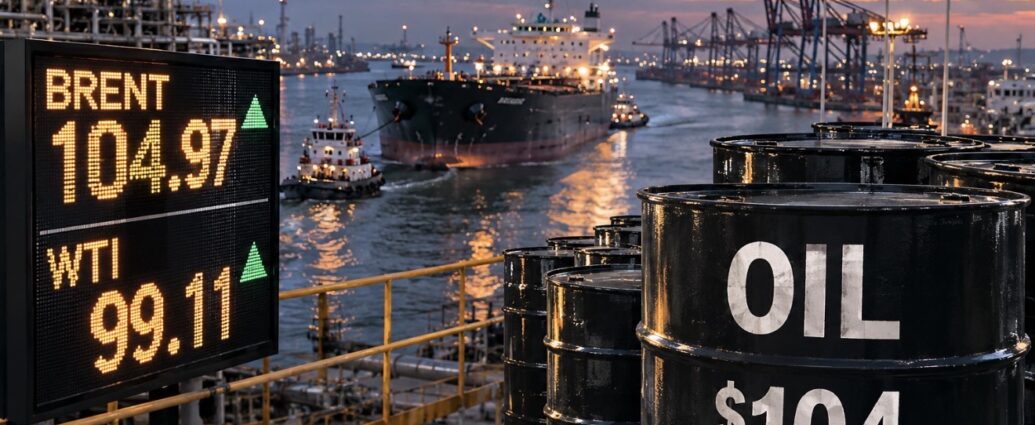
U.S. benchmark West Texas Intermediate crude climbed more than 3% to $99.11 per barrel, while international benchmark Brent crude surged above $104 per barrel, extending one of the largest energy shocks in modern history.
Speaking from the Oval Office, Trump described the diplomatic situation as “unbelievably weak” after rejecting Iran’s latest counterproposal Sunday night as “TOTALLY UNACCEPTABLE.”
According to Iranian state media, Tehran’s proposal included demands for international recognition of Iranian sovereignty rights tied to the Strait of Hormuz along with compensation for war-related damages — conditions the administration immediately rejected.
The renewed tensions landed on top of an already severely constrained global oil system.
In one of the starkest warnings yet from the energy industry, Saudi Aramco CEO Amin Nasser said Monday the world has effectively lost nearly one billion barrels of oil supply since Iran moved to restrict traffic through the Strait of Hormuz following the joint U.S.-Israeli military campaign launched earlier this year.
“The energy supply shock that began in the first quarter is the largest the world has ever experienced,” Nasser told analysts.
According to Aramco, the market is currently losing roughly 100 million barrels of oil supply every week the strait remains effectively closed.
Before the conflict escalated, approximately 70 ships per day typically transited the critical waterway. Now, Aramco says only two to five vessels daily are managing to cross.
Nasser warned that even if the Strait of Hormuz reopened immediately, global energy markets would still require months to stabilize.
“If the Strait of Hormuz opens today, it will still take months for the market to rebalance,” he said. “And if its opening is delayed by a few more weeks, then normalization will last into 2027.”
The comments underscored how deeply the conflict is beginning to affect the global economy.
Saudi Aramco itself reported a major windfall from the disruption. The company posted adjusted first-quarter net income of approximately $33.6 billion, up nearly 26% year-over-year and well ahead of analyst expectations.
Aramco has partially offset the shipping disruption by maximizing use of its East-West pipeline, which allows crude to bypass the Strait of Hormuz by moving oil across Saudi Arabia to the Red Sea export terminal at Yanbu.
The pipeline is now reportedly operating at its full capacity of roughly 7 million barrels per day.
Even so, Nasser cautioned that fuel inventories — especially gasoline and jet fuel supplies — are tightening rapidly ahead of the critical summer travel season.
“Inventories may reach critically low levels ahead of the summer driving and travel season,” he warned.
The ceasefire itself has remained unstable since its announcement on April 7.
Over the past week alone, Iran launched attacks against the United Arab Emirates, U.S. and Iranian forces exchanged fire inside the strait, and the Pentagon confirmed strikes against two Iran-flagged oil tankers.
The crisis is now extending well beyond energy.
The United Nations warned Monday that fertilizer shipments moving through the Persian Gulf region are becoming severely constrained, creating rising risks for global agriculture and food security.
Jorge Moreira da Silva, executive director of the U.N. Office for Project Services, said tens of millions of people could face food shortages or famine risks if shipping disruptions continue for several more weeks.
The Persian Gulf region accounts for roughly 30% to 35% of global urea exports and approximately 20% to 30% of global ammonia exports, both critical inputs for fertilizer production and agricultural yields worldwide.
Wall Street firms are increasingly warning that the risks to oil prices remain tilted upward.
Citi analysts said Monday that Iran still maintains substantial leverage over the timing and terms of any eventual reopening agreement for the Strait of Hormuz, keeping energy markets highly vulnerable to further spikes.
For American consumers, the effects are already becoming increasingly visible.
Jet fuel prices have climbed roughly 70% since the conflict began in February, contributing to higher airline costs and transportation inflation. Elevated oil prices have also pushed Treasury yields and mortgage rates higher, complicating the Federal Reserve’s efforts to resume interest rate cuts.
The longer the ceasefire remains unstable, the greater the risk that inflationary pressures spread further throughout the global economy.
And with one of the world’s most strategically important shipping corridors still operating under extreme disruption, energy markets are increasingly confronting a possibility many investors hoped to avoid: this may no longer be a temporary shock, but the beginning of a prolonged restructuring of global energy supply itself.
JBizNews Desk
© JBizNews.com. All rights reserved. This article is original reporting by JBizNews Desk. Unauthorized reproduction or redistribution is strictly prohibited.