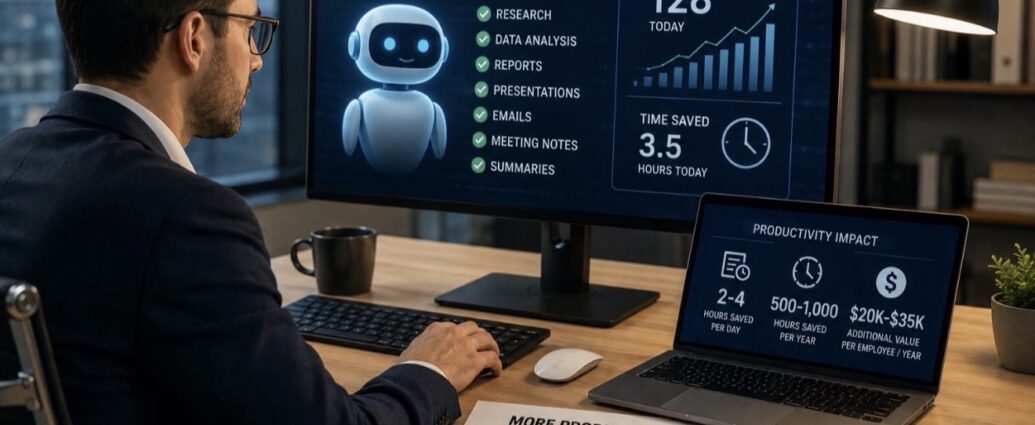
For decades, large corporations were built around a familiar workforce structure: senior leadership at the top, experienced managers and professionals beneath them, and large pools of junior employees handling research, spreadsheets, presentations, scheduling, note-taking, customer responses, formatting, and administrative work.
Artificial intelligence is now rapidly reshaping that model — and dramatically increasing the value of experienced employees who know how to use the technology effectively.
Increasingly, companies are discovering that a properly trained employee using multiple AI systems simultaneously can now perform the functional output that once required several junior workers, assistants, researchers, coordinators, or support staff. Employees using platforms such as ChatGPT, Claude, Gemini, Microsoft Copilot, and other enterprise AI systems are increasingly acting as orchestrators of multiple virtual assistants at once — drafting communications, conducting research, analyzing data, preparing presentations, summarizing meetings, refining proposals, and managing workflow streams simultaneously.
The result is not simply faster work, but a fundamental multiplication of employee productivity that is dramatically increasing the value of experienced workers while creating substantial long-term savings for employers.
Inside corporate America, experienced employees who know how to direct AI systems effectively are increasingly becoming some of the most valuable assets inside organizations. The combination of institutional knowledge, human judgment, AI-assisted communication, and productivity enhancement is allowing companies to operate faster, leaner, and more efficiently than ever before.
Many executives now describe these systems as personalized virtual assistants for employees — tools that allow one trained worker to complete tasks that once required interns, assistants, analysts, or even entire support teams.
One of the clearest examples came this week from Citadel founder and CEO Ken Griffin, who described how dramatically AI capabilities have advanced in a short period of time. Speaking at the Stanford Leadership Forum, Griffin said modern “agentic AI” systems are now performing work inside Citadel that previously required teams of finance professionals holding master’s and doctoral degrees — completing in hours or days what previously consumed weeks or months. Griffin said the productivity of the firm’s AI toolkit had undergone what he called a “step change” over the past nine months.
The financial implications for employers are becoming increasingly difficult to ignore.
A mid-level office employee earning roughly $90,000 annually who is trained to orchestrate multiple AI assistants across communication, research, analysis, and document preparation can generate between $30,000 and $90,000 or more in additional productive value each year, depending on role, workflow, and the depth of AI integration.
For a small business with 25 trained employees earning an average of $60,000, AI-driven productivity gains can translate into approximately $750,000 to more than $1.5 million in additional annual productive value through faster workflow, reduced administrative burden, stronger communication efficiency, and fewer support hires.
Mid-sized companies with 500 trained employees earning an average salary of $75,000 can potentially recover roughly $15 million to $30 million annually in labor efficiency, workflow acceleration, customer responsiveness, and operational productivity.
Applied across a Fortune 500 employer with 20,000 professional employees, the same multiplier effect can imply between $700 million and $1.5 billion or more in annual labor efficiency without proportional increases in staffing levels.
The multiplier effect has also become visible in public corporate disclosures.
Klarna, the global payments firm, reported that its AI assistant handled 2.3 million customer conversations in its first month of deployment — performing the equivalent work of 700 full-time agents and contributing an estimated $40 million in profit improvement, according to disclosures from CEO Sebastian Siemiatkowski. Klarna has since adopted a hybrid model, with humans handling complex cases and AI managing routine inquiries, but the scale of the productivity gains underscored how dramatically AI can multiply workforce output.
Inside many offices, communication itself is becoming one of the largest areas of productivity improvement.
Employees are increasingly using AI to draft emails, summarize meetings, organize follow-ups, refine presentations, prepare reports, respond to customers, and improve the speed and professionalism of daily communication.
For businesses, that creates both productivity gains and direct revenue opportunities.
Sales teams can respond to prospects faster and with more personalized outreach. Customer-service departments can handle higher volumes with quicker turnaround times. Managers can coordinate projects more efficiently. Executives can prepare polished communications in minutes instead of hours. Marketing teams can produce campaigns, presentations, proposals, and client-facing materials dramatically faster than before.
Corporate leaders increasingly view AI-enhanced communication as one of the technology’s most valuable benefits because faster and more effective communication often translates directly into stronger customer relationships, quicker deal flow, improved responsiveness, and ultimately more business.
For many executives, the conclusion is becoming increasingly difficult to ignore:
AI is evolving into a personalized virtual assistant for every trained employee — one that never sleeps, scales instantly, improves communication, accelerates workflow, and allows experienced workers to deliver dramatically greater value to the companies they serve, while employees who fail to learn how to use the technology increasingly risk being replaced by those who do.
By comparison, enterprise AI subscriptions often cost only a few hundred dollars annually per employee, making the economics increasingly compelling for employers.
That economic reality is now beginning to reshape hiring itself.
A new CEO Agenda 2026 survey released by the Oliver Wyman Forum in partnership with the New York Stock Exchange — based on responses from 415 chief executives representing roughly 10% of global market capitalization — found that 43% of CEOs plan to deprioritize hiring for junior roles over the next year, up sharply from just 17% a year earlier.
The survey also found that 34% of CEOs expect staffing to tilt toward more mid-level employees, signaling that companies increasingly view AI-trained professionals as a more efficient path to growth than the traditional model built around large classes of entry-level support staff. Among advanced AI deployment leaders, 49% said their AI investments are already meeting or exceeding expectations, compared with just 17% among slower adopters.
Academic research is increasingly validating the productivity gains executives say they are already seeing inside companies.
A landmark study by Erik Brynjolfsson of Stanford University, Danielle Li of MIT Sloan, and Lindsey Raymond of MIT — published as National Bureau of Economic Research Working Paper 31161 and later peer-reviewed in The Quarterly Journal of Economics — tracked 5,179 customer support agents and found workers using generative AI resolved 14% more tasks per hour on average, with gains reaching 34% for less-experienced employees.
A separate study led by Harvard Business School postdoctoral fellow Fabrizio Dell’Acqua, conducted alongside Karim Lakhani, Edward McFowland III, Ethan Mollick, Katherine Kellogg, and researchers at Boston Consulting Group and Warwick Business School, examined 758 BCG consultants. Consultants using GPT-4 completed 12.2% more tasks, worked 25.1% faster, and produced output rated 40% higher in quality than colleagues who did not use AI. The lowest-performing consultants improved by 43%, meaning AI lifted less-skilled workers significantly closer to the output of top performers.
Those figures, however, largely reflect gains from a single AI platform operating across controlled tasks. Inside real workplaces, where trained employees increasingly route different streams of work to multiple AI assistants simultaneously, executives say the compounding productivity effect is substantially larger.
Those firm-level gains broadly align with projections from the McKinsey Global Institute, which estimated that generative AI could create the equivalent of $2.6 trillion to $4.4 trillion in annual global value across 63 enterprise use cases — roughly the size of the United Kingdom’s entire economy. McKinsey senior partners Alex Singla and Alexander Sukharevsky, who oversee the firm’s AI division QuantumBlack, identified customer operations, marketing and sales, software engineering, and research and development as the largest sources of economic value.
Independent academic research also suggests the workforce restructuring is already underway. A Harvard University working paper by researchers Seyed Mahdi Hosseini Maasoum and Guy Lichtinger, drawing on data from nearly 285,000 firms, found companies adopting generative AI reduced junior-level hiring by roughly 7.7% relative to non-adopting firms, while senior-level employment continued to grow.
A separate Stanford University study by Brynjolfsson and colleagues at the Digital Economy Lab, updated in November, found a 16% relative decline in employment for early-career workers in occupations most exposed to AI automation — a decline researchers attributed primarily to slower hiring of new entrants rather than widespread layoffs.
For many executives, the conclusion is becoming increasingly difficult to ignore.
JBizNews Desk
© JBizNews.com. All rights reserved. This article is original reporting by JBizNews Desk. Unauthorized reproduction or redistribution is strictly prohibited.