By JBizNews Desk | Monday, May 4, 2026
OPEC+ voted Sunday to increase oil production by 188,000 barrels per day starting in June — a slightly smaller hike than the month before and one analysts largely view as a symbolic move to signal stability rather than a meaningful fix to a global oil market still reeling from the closure of the Strait of Hormuz.
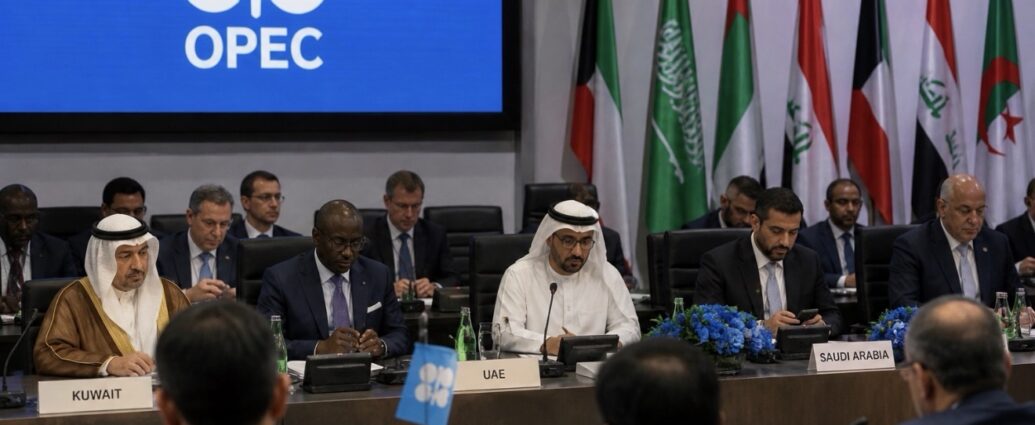
The decision was reached during a virtual meeting of seven participating countries — Saudi Arabia, Russia, Iraq, Kuwait, Kazakhstan, Algeria and Oman — convened to review global market conditions following the shock departure of the United Arab Emirates from the group.  It was the cartel’s first meeting since the UAE‘s exit, which became effective May 1 after nearly six decades of membership. The UAE had been the group’s third-largest oil producer behind Saudi Arabia and Iraq. 
The 188,000 barrel-per-day figure is essentially the prior 206,000 barrel increase minus the UAE‘s approximate 18,000 barrel-per-day share — meaning the remaining members are continuing on the same trajectory, just without their former partner’s contribution. 
A Gesture, Not a Solution
The market’s reaction was muted — and for good reason. Analysts described the increase as largely symbolic, aimed at signaling political cohesion after the UAE’s departure rather than delivering any meaningful expansion of real supply. In practice, many Middle Eastern OPEC+ members face serious geopolitical and technical constraints that make rapid export increases difficult, especially with the Strait of Hormuz still effectively closed. 
Brent futures settled near $108 a barrel on Friday, easing from recent four-year highs, as oil prices have increasingly looked past the UAE’s exit and focused instead on diplomatic signals around the Iran war. Both WTI and Brent remain roughly 78% higher than where they started 2026. 
The cartel reiterated its commitment to full compliance with the Declaration of Cooperation, saying the voluntary output adjustments could be returned gradually depending on evolving market conditions. 
The UAE’s Departure Changes the Math
The most consequential development from Sunday’s meeting was not the output decision itself but rather what the meeting confirmed: OPEC+ is now operating without one of its most influential members. The UAE‘s departure represents the most significant exit in the coalition’s history and further erodes OPEC+’s ability to influence global oil prices — a power already under pressure from the continued rise of U.S. shale production. 
Abu Dhabi National Oil Company — known as ADNOC — has announced plans to award approximately $55 billion in contracts between 2026 and 2028 as it pursues an accelerated production and strategic expansion strategy outside of OPEC+ constraints. 
What This Means for Consumers
The bottom line for everyday Americans and global consumers is straightforward: Sunday’s announcement does almost nothing to ease the energy crisis. Rising diesel, gasoline and jet fuel costs are already beginning to change consumer behavior, and analysts warn that demand destruction could escalate as global inventories are depleted, raising the risk of a broader economic slowdown. 
The real variable that would move prices remains the Strait of Hormuz — and whether President Trump‘s “Project Freedom” operation, launched Monday, can begin restoring commercial shipping through the world’s most critical oil chokepoint. Until that happens, no OPEC+ output decision is large enough to close the gap left by a waterway that normally carries one fifth of the world’s daily oil supply.
— JBizNews Desk
© JBizNews.com. All rights reserved. This article is original reporting by JBizNews Desk. Unauthorized reproduction or redistribution is strictly prohibited.