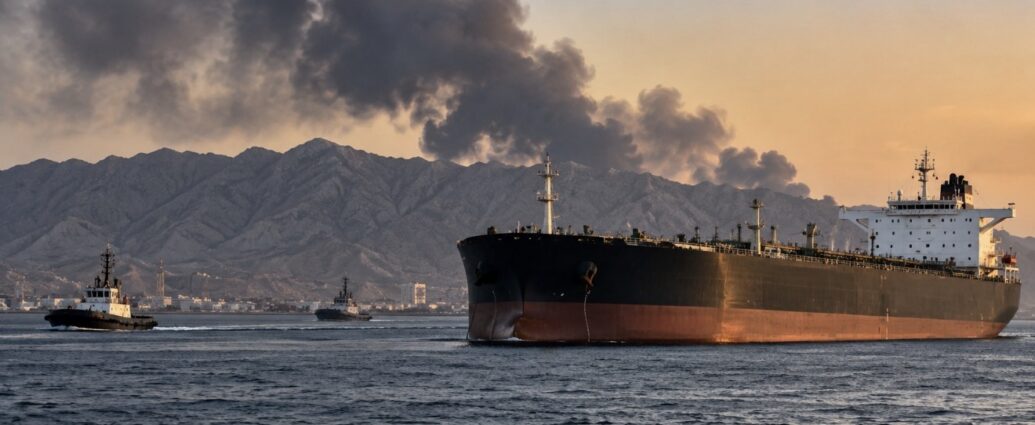
Global energy markets enter the new week under renewed pressure after the oil alliance declined to add more barrels while fighting around the Strait of Hormuz continues to threaten one of the world’s most important shipping routes.
OPEC+ agreed Sunday to keep its oil-production policy unchanged for October, choosing not to increase supply further as the continuing U.S.-Iran conflict disrupts shipping through the Strait of Hormuz and pushes crude prices toward levels not seen in months.
The decision means the group will maintain October production at September levels after six consecutive months of increases.
The timing is especially important.
Brent crude finished Friday at $96.28 a barrel, gaining approximately 7.6% for the week, while U.S. West Texas Intermediate crude settled at $91.48, up nearly 10% for the week.
Oil markets were already dealing with restricted shipping through the Strait of Hormuz before another round of military escalation over the weekend.
U.S. forces struck three Iranian oil tankers after Iran launched missiles toward American naval vessels, adding another layer of uncertainty before global crude trading resumes.
For businesses, the danger extends far beyond the price of oil itself.
Higher crude prices feed directly into gasoline, diesel, jet fuel, trucking, shipping, agriculture and manufacturing costs. U.S. diesel prices have already climbed to record territory, putting additional pressure on companies that move physical goods.
That makes the OPEC+ decision significant.
Normally, higher prices could encourage major producers to put more barrels onto the market. But the current problem is increasingly about whether oil can physically move through the region rather than simply how much producers are willing to pump.
The Strait of Hormuz is the narrow maritime passage connecting the Persian Gulf with global markets and is one of the most important energy chokepoints in the world. Continued disruption there can affect oil and liquefied natural gas supplies regardless of official production quotas.
OPEC+ also faces its own limitations. Several members have struggled to reach their assigned production targets, meaning a higher quota would not necessarily translate into the same amount of additional oil reaching global buyers.
The seven OPEC+ countries participating in Sunday’s decision include Saudi Arabia, Russia, Iraq, Kuwait, Kazakhstan, Algeria and Oman.
The group had been gradually restoring production that was removed from the market through earlier voluntary cuts. September’s increase of approximately 188,000 barrels per day completed another stage of that process.
But for October, producers are stopping there.
The next OPEC+ meeting is scheduled for October 4, when members are expected to consider November production.
What It Means for You
The number to watch now is $100 oil.
If Brent crude breaks decisively above that level, the consequences could begin appearing throughout the economy — at gas stations, in airline fares, freight bills and ultimately consumer prices.
That creates an additional problem for the Federal Reserve.
The Fed is already confronting stronger-than-expected employment data and renewed concerns that inflation may remain stubborn. Another sustained energy-price increase could make lowering interest rates considerably more difficult — and could even strengthen the argument for keeping monetary policy tighter.
For businesses, the equation entering the new week is becoming increasingly clear:
The Middle East conflict is no longer simply a geopolitical story.
It is becoming an inflation, transportation, interest-rate and economic-growth story — and OPEC+ just decided it will not provide additional oil to soften the impact, at least for now.
JBizNews Desk | New York
© JBizNews.com All Rights Reserved. Reproduction or distribution without written permission is prohibited.