OpenAI, the company that ignited the generative AI revolution with the 2022 launch of ChatGPT, is facing its most consequential internal reckoning yet. A bombshell report from The Wall Street Journal published Monday revealed that the company has fallen short of its own benchmarks for both revenue and user growth — a disclosure that rattled markets Tuesday, sent partner and supplier stocks tumbling, and raised urgent new questions about OpenAI’s ability to sustain its astronomical capital commitments ahead of a closely watched initial public offering.
CFO Sarah Friar has expressed concerns to other company leaders that OpenAI might not be able to pay for future computing contracts if revenue doesn’t grow fast enough. Specifically, OpenAI fell short of an internal milestone of one billion weekly active ChatGPT users by year-end — a target it never publicly announced. The company also missed its annual revenue target as Google’s Gemini surged late in the year and claimed a bigger slice of the market, and Anthropic’s gains in coding and enterprise pushed OpenAI below its monthly revenue goals on several occasions earlier this year.
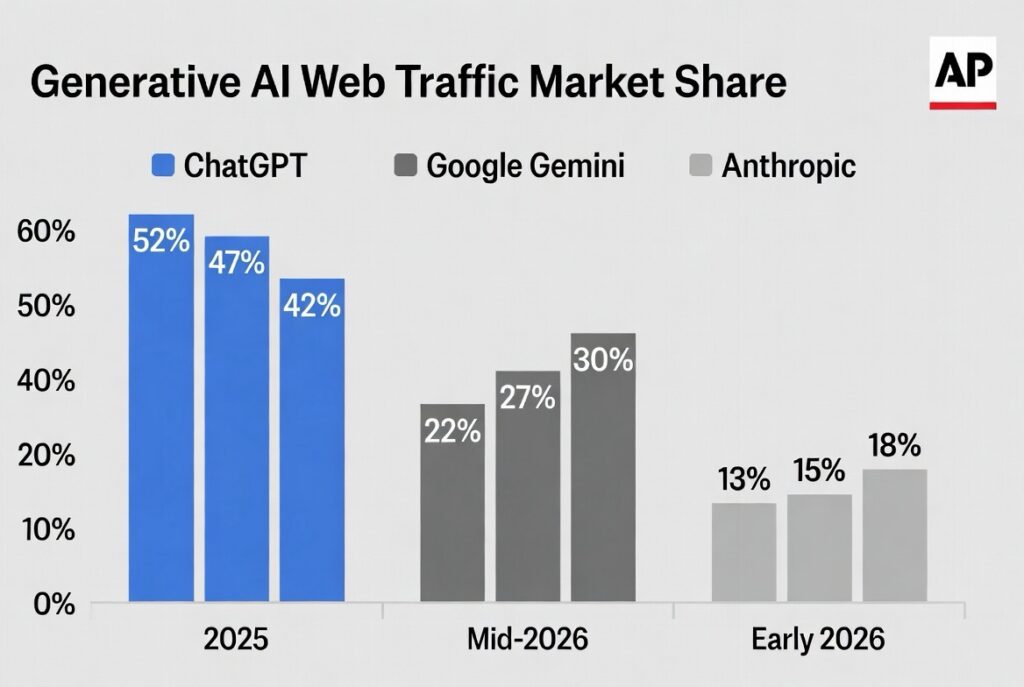
The competitive dynamics have shifted measurably. ChatGPT’s share of generative AI web traffic dropped from 86.7% a year ago to 64.5% in January 2026, while Gemini rose sharply from 5.7% to 21.5%. The company also grappled with subscriber defection rates.
The financial picture is made more precarious by the sheer scale of OpenAI’s infrastructure commitments. OpenAI has been saddled with approximately $600 billion in future spending commitments stemming from a series of massive deals spearheaded by CEO Sam Altman. Internal projections suggest that cash expenditures will exceed $200 billion before the company reaches positive cash flow. Friar has raised doubts about OpenAI’s readiness to go public on Altman’s preferred schedule, telling executives and board members that the company still lacks the financial infrastructure that public-market regulators demand.
The boardroom tension between Altman and Friar over spending discipline and IPO timing is now a central subplot. Friar wants more discipline over spending, which has caused disagreement with Altman, though both called the report “ridiculous” in a joint statement. The optics are nonetheless damaging for a company with an $852 billion post-money valuation. OpenAI closed a $122 billion funding round — the largest in Silicon Valley history — anchored by SoftBank, Amazon, and Nvidia, among others, with monthly revenue of $2 billion and full-year 2025 revenue of $13.1 billion, though the company had not turned a profit.

The market reaction Tuesday was swift and severe. Oracle, which holds a $300 billion, five-year partnership to supply computing power to OpenAI, dropped more than 3%. Chipmakers including Nvidia, Broadcom, and Advanced Micro Devices declined between roughly 3% and 4%. Leveraged neocloud stock CoreWeave dropped more than 4%. In Asia, SoftBank Group, one of OpenAI’s largest investors, sank about 10%.
Analysts were divided on what the miss actually signals. John Belton, portfolio manager at Gabelli Funds, said he viewed the report as “largely a rehash of what we already knew,” adding that OpenAI’s growth appears to have slowed in late-2025 into early-2026 as the business ceded share to Anthropic and Gemini. Luke Rahbari, CEO of Equity Armor Investments, said shortfalls in revenue targets should be viewed with caution, given how imprecise forecasting remains in a rapidly evolving industry.
OpenAI pushed back vigorously. Oracle defended OpenAI’s growth trajectory, saying it is seeing firsthand how quickly adoption of OpenAI’s technology is accelerating. “We’re incredibly excited about our partnership with OpenAI and remain focused on building and delivering the capacity they need to support rapidly growing demand,” an Oracle spokesperson said. OpenAI separately told Bloomberg the company is firing on all cylinders and seeing strong demand from enterprise customers and emerging interest in its advertising business.
There are pockets of genuine momentum. Codex, OpenAI’s coding tool, has been gaining users, and GPT-5.5 earned top marks across several industry benchmarks after its recent release. But with Alphabet, Amazon, Meta Platforms, and Microsoft all set to report quarterly results this week, investors will be scrutinizing every earnings call for fresh intelligence on the AI spending cycle — and whether OpenAI’s stumble is an isolated data point or a broader signal of a sector recalibration.
JBizNews Desk — April 28, 2026
© JBizNews.com. All rights reserved. This article is original reporting by JBizNews Desk. Unauthorized reproduction or redistribution is strictly prohibited.