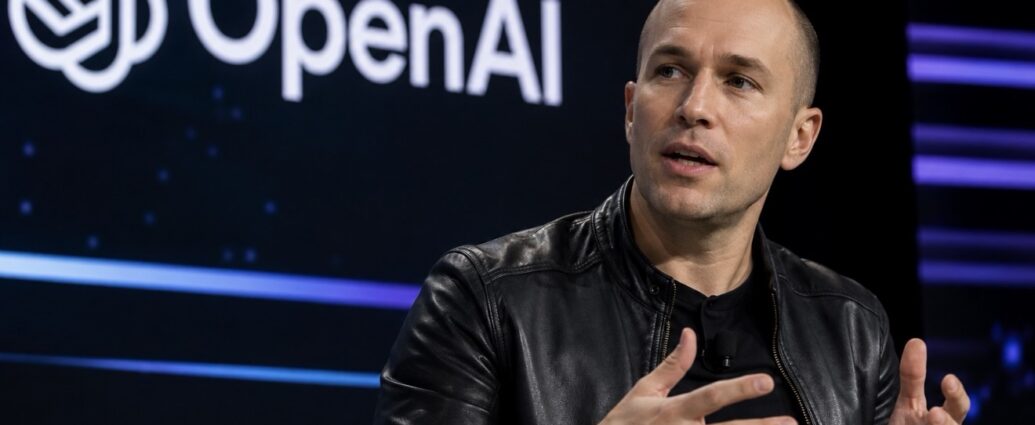
OpenAI President Greg Brockman conceded this week that Chinese startup Moonshot AI has built a genuinely competitive model in its newly released Kimi K3, while stopping short of saying whether the firm had leaned on OpenAI’s own technology to get there.
In an interview Tuesday, Brockman called K3 “a pretty good model” and said there was no question about its quality — a notable acknowledgment from an executive at the company whose flagship systems the Chinese release is chasing. Pressed on whether Moonshot had piggybacked on OpenAI’s technology through distillation, Brockman said he wasn’t sure. The remark keeps alive a contentious industry accusation without escalating it, even as OpenAI and its American rivals weigh how seriously to take the fast-narrowing gap with Chinese labs.
Moonshot unveiled Kimi K3 on July 16, and the specifications alone drew attention. The model is a 2.8-trillion-parameter mixture-of-experts system that Moonshot describes as the largest open-weight model built to date, with a one-million-token context window and native vision. It activates only a small fraction of its experts on any given token, a design choice that keeps running costs down relative to its enormous size. Full weights are scheduled for release, which would let any company self-host or fine-tune the model rather than pay to access it through an API.
On performance, Moonshot’s own benchmarks position K3 just behind the leading American systems — Anthropic’s Claude Fable 5 and OpenAI’s GPT-5.6 Sol — while claiming it outperforms the next tier down, including Claude Opus 4.8 and GPT-5.5, on coding and agentic tasks. Independent evaluators have been broadly supportive. One widely watched testing platform ranked K3 first in its front-end coding benchmark, placing it ahead of Fable 5 in blind developer trials. Analysts caution that some of Moonshot’s efficiency claims still await independent verification through the model’s full technical report.
The commercial pressure comes from price. Bank of America analysts noted that while K3 carries the highest usage price yet for a Chinese model, it still runs at roughly half the cost of OpenAI’s top-tier GPT-5.6 Sol. For enterprise buyers weighing capability against spend, a model that lands near the frontier at half the price of the most expensive American option is a direct competitive threat — and the open-weight release only sharpens it, since distilled, smaller versions of K3 could soon run on consumer hardware while retaining much of the original’s ability.
That open-weight strategy is reshaping the economics of the industry, and markets took notice. K3’s debut, which coincided with a speech by Chinese President Xi Jinping at the World Artificial Intelligence Conference in Shanghai, rattled investors. U.S. chip stocks sold off, with shares of Nvidia among those pulled lower as traders reassessed the competitive landscape. The reaction cut across China’s own AI sector as well: shares of rival model builder Z.ai plunged 28 percent, and MiniMax fell 16 percent, as the release raised the bar for every lab trying to prove its own systems.
Moonshot itself has become one of China’s better-capitalized model builders. Founded in 2023, the Beijing-based company raised $2 billion at a valuation north of $20 billion earlier this year, with backing from Chinese technology giants Alibaba and Tencent. It has not disclosed what hardware it used to train K3, though it is a partner of Huawei — a detail that feeds the broader question of how Chinese labs are advancing despite U.S. restrictions on access to advanced chips.
The distillation issue that Brockman declined to settle is a live dispute across the industry. Distillation involves training a smaller or newer model on the outputs of a stronger one, and while it can be a legitimate technique, American labs have accused Chinese firms of using it to extract capabilities they didn’t build. Anthropic earlier this year accused Moonshot, DeepSeek, and MiniMax of campaigns to illicitly draw on its Claude models to improve their own systems — a charge Beijing has called groundless. Brockman’s uncertainty leaves OpenAI’s position deliberately open.
For the business of artificial intelligence, K3 crystallizes a shift that executives on both sides of the Pacific are now confronting: the performance gap between open Chinese models and closed American ones appears to have shrunk from a comfortable lead to a matter of a few months. That compression pressures pricing, upends assumptions about proprietary moats, and forces U.S. labs to justify premium costs against increasingly capable, cheaper, and freely available alternatives.
JBizNews Desk | San Francisco
© JBizNews.com All Rights Reserved. Reproduction or distribution without written permission is prohibited.