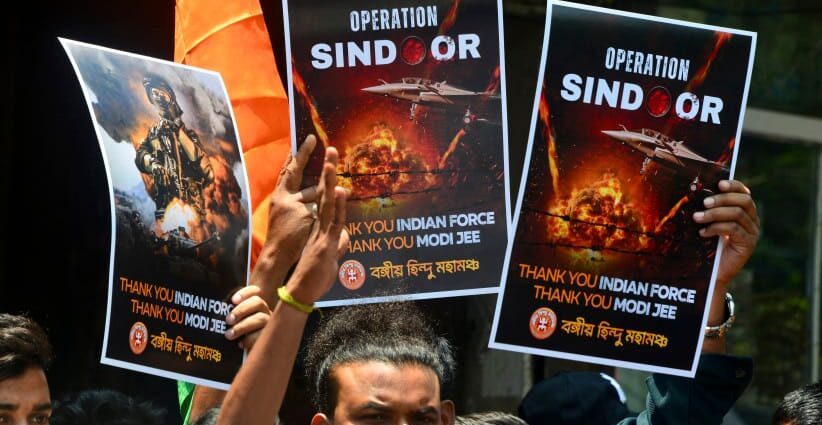
This time last year, one of the giant sleeping theaters of global conflict erupted when India launched Operation Sindoor against Pakistani-based terror groups following the Pahalgam terror attacks two weeks earlier.
A year on, India’s military leadership gathered in Jaipur on Thursday to present Operation Sindoor as the template of a doctrine governing how India will respond to cross-border attacks going forward.
“Misadventures will not go unanswered, and acts of terror will have consequences,” Air Marshal AK Bharti, who served as director general of air operations during the strikes, said on Thursday at a tri-services briefing at the South Western Command in Jaipur.
The trigger for Operation Sindoor was the April 22, 2025, attack near Pahalgam in Indian-administered Kashmir, where 26 civilians, most of them Hindu tourists, were killed by gunmen linked to The Resistance Front (TRF), a proxy of the Pakistan-based Islamist terrorist group Lashkar-e-Taiba.
The attack immediately escalated tensions in a region already shaped by decades of conflict. India accused Pakistan of backing cross-border terrorism. Pakistan denied involvement and described the incident as a “false-flag operation” by the Indians.
Within days, both sides began preparing for escalation. India mobilized air assets and repositioned air defense systems, while the Pakistanis warned that a strike was imminent.
In the early hours of May 7, India acted.
Operation Sindoor began shortly after 1 a.m. local time, when, over a window of roughly 25 minutes, Indian forces struck nine targets across Pakistan and Pakistan-administered Kashmir.
Seven of those targets were engaged by the army using precision artillery and loitering munitions. The remaining strikes were carried out by the air force using Rafale aircraft equipped with long-range cruise missiles and guided bombs.
Indian officials said the targets included facilities linked to groups such as Jaish-e-Mohammed and Lashkar-e-Taiba. Among the locations cited were sites in Bahawalpur, Muridke, and Muzaffarabad.
“The objective was clear, and the forces were given full operational freedom,” Bharti said in Jaipur, recalling the planning phase. Pakistan said the strikes hit civilian areas, including mosques. India maintained that only terror targets were engaged.
Initial strikes triggered rapid escalation
However, the initial strikes triggered a rapid escalation. Pakistan responded with artillery fire across the Line of Control, where civilian casualties were reported, while drone incursions and missile exchanges followed on both sides.
More than 100 aircraft were involved in what has been described as one of the largest beyond-visual-range aerial engagements in decades. In the days that followed, India carried out additional strikes, including attacks on Pakistani air bases and air defense systems.
In Jaipur, Bharti described how what began as a counter-terror operation became “an act of self-defense” once, in India’s view, the Pakistani establishment became directly involved.
“When we responded, it was lethal and ruthless,” he said, adding that the response remained focused on operational targets.
One of the most important lessons learned from Sindoor was the level of coordination between India’s armed forces. Additionally, it was a perfect opportunity to witness the rise and success of India’s domestic military arms market in action.
Naval Vice Admiral AN Pramod stated on Thursday that the operation demonstrated “seamless integration” of all three services, supported by cyber and electronic warfare units and coordinated with other arms of the state.
Scenes from Sindoor were instantly recognizable in Israel. Cross-border terror attacks. Military response, notably from the air.
Several officers speaking with The Jerusalem Post while embedded with the Indian military in February cited Operation Sindoor as a formative factor in recent doctrine.
Sindoor, which is a mark of pride for the Indians in their response, was characterized by Indian Army planners as a limited, intelligence-led use of force intended to impose costs without necessarily risking escalation.
A glimpse of the Indian Army’s capabilities was on show during Sindoor, according to officers who spoke to the Post during February’s military exercise Agni Varsha, where justice and not revenge was the dish of the day, according to the officers.
In off-the-cuff conversations on the sidelines of the range, comparisons to Israel naturally arose.
For India, the challenge from Pakistan-supported extremist groups has been an old one.
The change that has occurred in recent years is the willingness to act with speed and precision while being politically and militarily restrained.
This, according to officers, is in line with Israel’s experience in dealing with Hamas and Hezbollah, especially after the October 7 attacks.
Indian Ambassador to Israel JP Singh also made the cross-country comparison when he spoke with the Post last year, stating, “The methodology is more or less similar to October 7. You are attacking soft targets here; the people who are partying [at Nova] and celebrating, they are the people who are the tourists [in Kashmir].
“If you kill tourists, soft targets, you agitate people. But if you kill innocent people, and if you kill tourists or people partying? That creates a lot of anger.”
However, unlike the recent Israel-Hamas War, by far the longest of Israel’s existence, Operation Sindoor was much more like previous Israeli campaigns – over in a matter of hours. After four days of exchanges, both sides moved to de-escalate.
India-Pakistan ceasefire following external diplomatic pressure
On May 10, India and Pakistan announced a ceasefire following direct communication between their military leadership. External diplomatic pressure, including from the United States, played a role in the background.
Indian commanders stated the ceasefire was a decision taken after achieving operational objectives, although there were further military operations later in July to target and neutralize the terrorists. Three of the perpetrators were killed.
A year after the strikes, Operation Sindoor is being used by India’s military leadership as a reference point for how it intends to respond to future attacks, with an emphasis on coordination, precision targeting, and limited escalation before full-blown conflict.
The underlying situation in Kashmir has not changed, where cross-border attacks remain a risk, and the broader dispute between India and Pakistan continues.
What has changed, according to India’s leadership, is the response method, defined in May 2025 and now formalized as standard practice.