
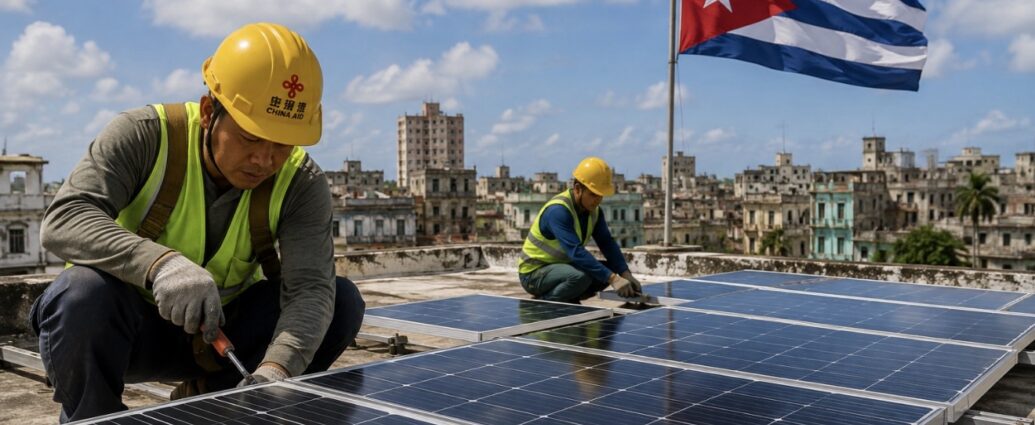
Cuba has run short of the oil that powers its electric plants, and it is replacing that supply with Chinese solar panels — fast enough that China now sends the island roughly 40 times the volume of panels it sent three years ago.
Chinese exports of solar panels to Cuba ran about $3 million in 2023. That figure reached $117 million in 2025, according to the energy research group Ember. Cuba has built dozens of solar parks with Chinese investment, under an agreement to open 92 across the country by 2028. Imports of Chinese photovoltaic panels have risen more than 1,800% in five years.
The turn toward renewable energy has helped the island absorb increased pressure from the United States, though it has not stopped the grid from failing.
How the oil disappeared
The crisis stems from a U.S.-imposed oil blockade enacted after January 2026, when Washington ousted Venezuelan President Nicolás Maduro. Venezuela had long been Cuba’s primary oil supplier, and imports from Mexico were halted as well under U.S. pressure. Washington authorized a single Russian tanker carrying 100,000 tons of crude in March; those reserves are long exhausted. Domestic production covers a fraction of demand, and emergency diesel generators have become largely unusable for lack of fuel.
The grid was fragile before any of that. Cuba’s electricity system runs on fuel-oil, diesel and gas thermoelectric plants, and most of the seven main plants forming the backbone of the national grid have operated for more than 40 years. Peak-hour deficits routinely exceed 2,000 megawatts against demand near 3,100 megawatts.
The result has been repeated total failures. The island suffered its sixth nationwide blackout of the year on the night of August 2, the eleventh since late 2024. There were two islandwide collapses in March and three in July, along with several partial outages, and rolling blackouts now run more than 20 hours a day in places. The Cuban government attributes the crisis to the U.S. embargo and oil restrictions; independent analysts point to a lack of domestic investment and poor economic management as the main drivers, compounded by chronic maintenance shortfalls.
What solar can and cannot do
Solar accounts for only about 9% of Cuba’s electricity generation, because the aging grid cannot efficiently absorb new capacity and lacks battery storage. Panels without storage produce during daylight hours and nothing after sunset — which is precisely when household demand peaks.
That is the limit on the strategy, and it is a physical one. Cuba can keep installing capacity, but until it can store the output and stabilize the network that carries it, the panels reduce daytime fuel burn rather than end the blackouts.
China’s side of the trade
China controls close to 80% of the global solar supply chain and has positioned itself as Cuba’s leading renewable energy partner while working through its own industrial overcapacity. That last clause is the commercial logic. Chinese manufacturers built far more panel capacity than global demand absorbs, and placing that output — through financing, donations and state-backed projects — serves both an industrial and a diplomatic purpose.
Beijing has extended other support as well, including $80 million and 60,000 tons of rice approved by Xi Jinping.
A crack in the state’s grip
The most interesting development for business readers is what the fuel shortage has forced Havana to permit. The government recently authorized its first foreign-backed fuel import venture and allowed nearly 200 Cuban businesses to take part in wholesale fuel distribution — a cautious opening of an energy sector the state has controlled tightly for decades.
Scarcity did what ideology would not. A government that could supply fuel through state channels had no reason to license private distributors; one that cannot has every reason.
For American companies, direct opportunity remains foreclosed by sanctions. The relevant lesson runs the other way. An economy whose grid fails eleven times in twenty months is a live demonstration of what happens when generating capacity ages past its service life and no capital goes in behind it — a scenario that utilities in the United States are now arguing about in the context of data center demand. The difference is capital availability, not physics.
Cuba’s solar buildout is real, and it is among the fastest anywhere. It is also a country installing the future while the present keeps going dark.
JBizNews Desk | Havana
© JBizNews.com All Rights Reserved. Reproduction or distribution without written permission is prohibited.




