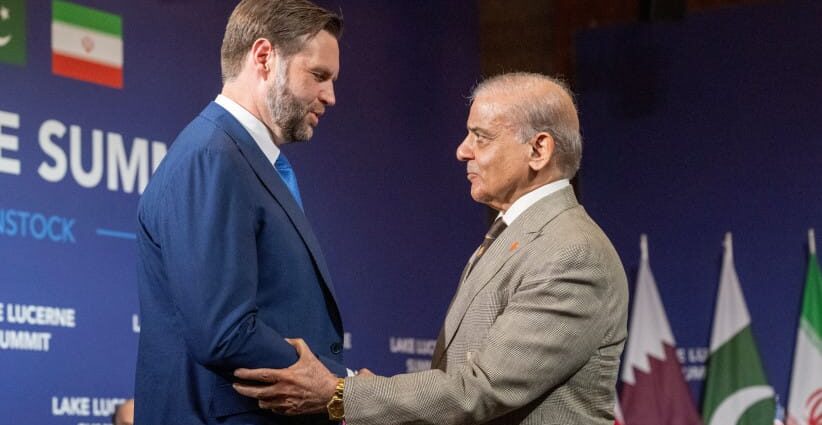
Pakistan continues to play a key role in Iran talks. The warm embrace between US Vice-President JD Vance and Pakistan’s army chief, Field Marshal Asim Munir, alongside Pakistan’s Prime Minister Shehbaz Sharif, is important. Vance praised the Pakistanis for everything they have done to help along the talks with Iran. Sharif had arrived in Switzerland on Sunday for the technical talks with the US, Iran, and other countries.
As Turkey’s Anadolu noted, “Sharif, along with army chief Field Marshal Asim Munir, will represent Pakistan in the talks on the implementation of the Islamabad Memorandum of Understanding in Burgenstock, a statement from Pakistan’s Foreign Ministry said.” Pakistan is working to advance the implementation of the Memorandum of Understanding between the US and Iran. Sharif is also holding talks with Qatar, according to reports. This is part of Pakistan’s “enduring commitment to dialogue and durable peace in the region.”
The visuals at the Lake Lucerne Summit in Switzerland are important. Vance was clearly very interested in showing US support for Pakistan. They met in front of a banner announcing the summit. The banner shows the flags of Pakistan, Qatar, the US, and Iran. Pakistan and Qatar are in the middle, while the US and Iran flags are on the ends of the four-flag arrangement on the poster.
There is a lot of focus on the photos and videos coming out of Switzerland as the meetings get underway. Hiba Nasr, Washington Bureau chief of Asharq al-Awsat news, noted the following “The visuals in Switzerland: The US delegation entered well before the Iranians, [Mohammed Bagher] Ghalibaf didn’t enter while the press was inside, Vance did; Iranian FM entered last & didn’t shake hands.”
Margaret Brennan, CBS Chief Foreign Affairs Correspondent, noted on X that “I’m told the Iranian delegation refused to participate in the photo spray. The TV pool was not allowed back into the Swiss boardroom after the Iranian delegation joined the meeting. The producer on site did spot Speaker Mohammed Bagher Qalibaf & Foreign Minister Aragchi walking in.” Iran, in the past, has refused direct talks with the US.
Vance praises Pakistan delegation
Vance was quoted as saying by Reuters correspondent Humeyra Pamuk: “What the President has asked us to do is turn over a new leaf to transform our relationship with the people of Iran, and to extend an outstretched hand that says to the people of Iran that if your leadership is willing to give up being a driver of regional instability, if they are willing to give up nuclear weapons ambitions for the long term, then the United States is willing to fundamentally transform our relationship…”
There is a lot of focus on the warmth between Vance and the Pakistan delegation. Vance clearly has a close relationship with the Pakistan Field Marshal, as indicated by a joke he told about how the Marshall was one of several important people in his life. “I have joked that I have two very, very important people in my life. An Indian and a Pakistani. The Indian is my wife, and the Pakistani is Field Marshal Munir.” He said he has spoken to Munir more than anyone else in the last few months. He said the Pakistani military chief had shown himself to be a good diplomat. He noted that the Pakistan prime minister and Field Marshall had welcomed Vance in Pakistan during the negotiations there.
These are words that will mean a lot to Pakistan. Pakistan prides itself on receiving the respect it believes it deserves. It has sometimes felt eclipsed by other countries, and it also feels it has to compete with its much larger neighbor, India. In the past, Pakistan and the US were close partners. This was the case since the era of Richard Nixon and was true during the US backing of the Mujahideen in Afghanistan.
However, after 9/11 things shifted. The US had a complex relationship with Pakistan under Pervez Musharraf. The US had also navigated other Pakistani leaders such as Nawaz Sharif, as well as Benezir Bhutto and Imran Khan. The US raid into Abbotabad to eliminate Osama Bin Laden was controversial in Pakistan. Pakistan has not been portrayed well in most US films about the global war on terror. As such, the new warmth with the Trump administration matters a lot to Islamabad.
Pakistan wants to play a larger role
Pakistan wants to play a larger role alongside Saudi Arabia, Turkey, and Qatar in the Middle East. It is shifting its view West, rather than dealing with India or China. Pakistan was a conduit for US ties to China decades ago, but things have also shifted there. In addition, the US role in Afghanistan was not always greeted with approval in Pakistan. Now that the US has left Afghanistan, Pakistan has a more nuanced approach.
From Israel’s point of view, the role of Pakistan and Qatar in the talks is concerning. Israeli commentators have become more critical of Qatar in the last year and a half. In addition, commentators have become critical of Saudi Arabia, Egypt and Turkey, viewing them as “Sunni” powers that may challenge Israel in the future. There is growing talk in Israeli leadership circles about how these Sunni countries could be a challenge now that Iran is weakened.
These countries likely want close ties with the US because they are concerned about Israeli threats in the future. Having seen Israel’s military power create air superiority for Israel over Lebanon, Syria, Iraq, and Yemen, these countries now feel they are basically on a border with Israel. This is true of Turkey’s influence in Syria and also of Egypt on the actual border with Israel, as well as Pakistan on the border with Iran and Qatar, which suffered an Israeli airstrike in 2025.
Pakistan is a potential major winner from the Iran talks. However, it will want to make sure that Iran actually stays the course in the talks. Iran has shown in the past that it will want to drag this out and create a crisis. Vance’s personal warm relationship with the Pakistani leadership may help smooth things over.