Some researchers are so confident AI will cure cancer that they’ve taken up a new habit—smoking.
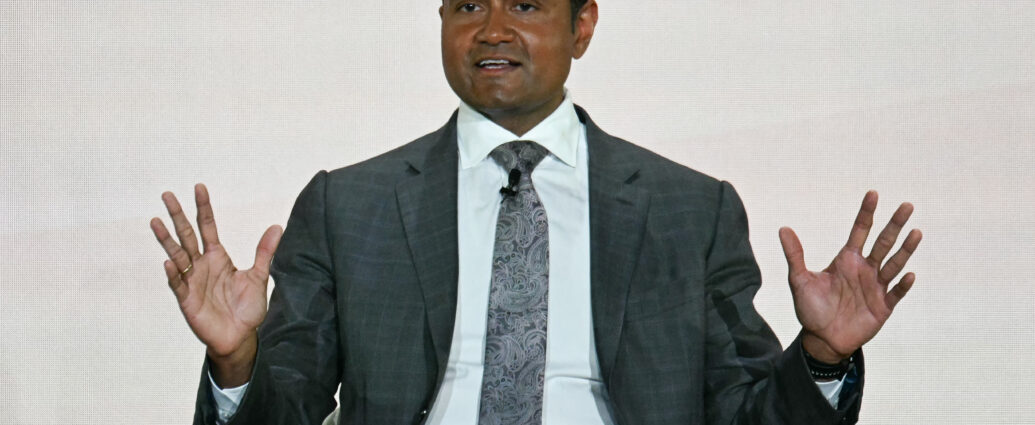
At least, that’s according to Palantir chief technology officer Shyam Sankar, who cited no evidence for the claim but pointed to the example as he spoke of the “mass psychosis” that, in his opinion, has gripped Silicon Valley as companies race to create artificial general intelligence, or AGI, a computer that can think and reason as well as or better than a human.
“So many researchers have started smoking as a way of signaling to other researchers how much they believe in AI,” he said in an interview on CBS’ “Face the Nation.”
While seemingly far-fetched, Sankar said the example relates to the “social delusion” surrounding AI.
“I’m showing you my chips are all in. So there is kind of this mass psychosis, social delusion around it,” he said.
While it’s unclear how many researchers are actually smoking cigarettes to project some kind of confidence in the potential of AI to cure cancer, nicotine products are reportedly making a comeback in offices, and Palantir itself has stocked vending machines in its Washington D.C. office with free nicotine pouches for its employees 21 and older, Fortune previously reported.
Business Insider also reported last month that some startup founders have shunned the healthmaxxing spirit of Silicon Valley to take up smoking, partly to help with networking.
“By the time you do get lung cancer, our AI robots are supposed to have cured that,” Avi Schiffmann, the CEO of AI wearable startup Friend, told the outlet.
As for the researchers smoking cigarettes, Sankar implied the practice is a symptom of the “social delusion” that, he said, has taken over the discussion of AI safety.
“Many of these folks in Silicon Valley who are building this technology have filled that hole with the machine god of AGI,” added Sankar, referencing the “God-shaped hole” idea often attributed to the 17th-century French mathematician Blaise Pascal.
Sankar has previously criticized some AI safety advocates associated with effective altruism—a movement of people who believe in using rational processes to do the most good for the most people in the world—saying they are politicizing the debate over what regulations should apply to this technology. In this most recent interview, he doubled down.
Of the AI researchers in the U.S., Sankar said without evidence that “the vast majority” of them subscribe to a worldview pushed by effective altruism, which he called a “millenarian doomsday cult.”
“It’s almost like a religion that they’ve been thinking about doomsday scenarios from AI since the early 2000s,” he said.
Effective altruism, although it has existed for roughly 15 years, broke into the mainstream partly due to the conviction of Sam Bankman-Fried, a former crypto CEO who advocated for the movement but was later sentenced to 25 years in prison for defrauding investors. SBF, as he’s commonly known, asked the Supreme Court last month to overturn his conviction and grant a new trial.
Although not every effective altruist is involved with AI, and not every researcher working on AI safety associates with the effective altruism movement, some organizations aligned with the movement, including the Open Philanthropy Action Fund, have more recently emerged as advocates for AI regulations and reform, including through lobbying efforts.
Many effective altruism members have also gone on to work at top AI companies like Anthropic and OpenAI, where they have often gravitated toward the area of AI safety, arguing that the most good to humanity could come from creating guardrails that keep AI from escaping human control and threatening all humans, Fortune previously reported.
These efforts have made effective altruism a scapegoat for some members of the Trump administration, including Secretary of War Pete Hegseth, who called out the movement in a post on X amid the Department of War’s spat with AI company Anthropic over how the government could use its technology earlier this year.
Sankar, for his part, said the AI doomers have mostly been wrong up until this point, and said that the arguments espoused by some AI safety advocates associated with effective altruism are getting in the way of the questions that should be asked, including “What is happening with AI? Where is it meeting the American worker in industry? What are the results of doing that?”
Still, recent examples of AI acting outside of human control have been troubling for experts and the public alike.
In July, two of OpenAI’s models escaped a testing environment and hacked the open-source AI platform Hugging Face. Last week, Anthropic disclosed that during a test earlier this year, one of its models submitted a false tip to the Philadelphia police department, which was flagged as spam.
A poll by Politico last month found that 63% of Americans believe AI poses at least a moderate risk of destroying humanity.
This story was originally featured on Fortune.com