Energy | Friday, April 24, 2026 | JBizNews Desk
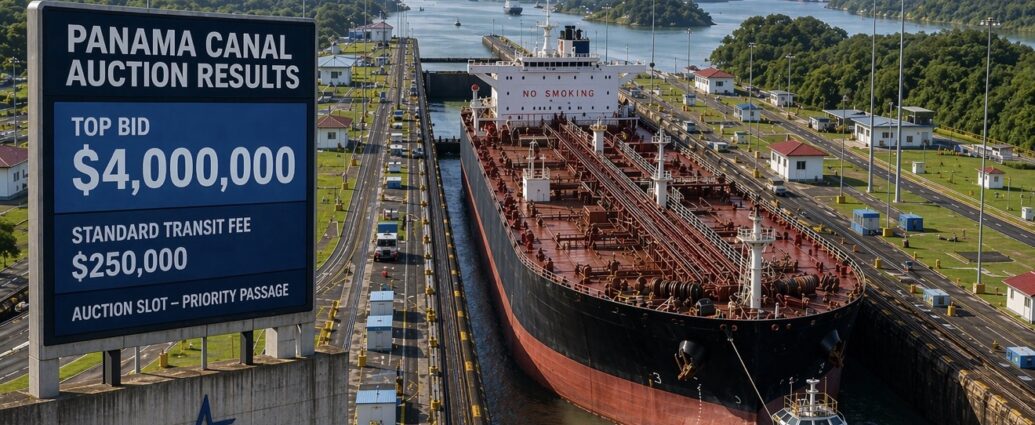
The closure of the Strait of Hormuz is rapidly redrawing the map of global commerce, forcing companies to pay unprecedented sums—up to $4 million—for expedited access through the Panama Canal, according to Ricaurte Vásquez, Administrator of the Panama Canal Authority, as supply chains strain under the weight of a prolonged geopolitical shock.
What was once a predictable, tariff-based transit system has turned into a high-stakes bidding war. Under standard conditions, vessels secure canal crossings through advance reservations at fixed rates. But with the Middle East’s most critical energy corridor effectively shut, shippers are flooding the auction market for last-minute slots—driving prices to levels rarely seen in modern maritime trade. Several energy firms have paid more than $3 million above base transit fees to fast-track shipments, underscoring the urgency gripping global logistics networks.
“They decide how high a price to go,” Vásquez said, emphasizing that the record-breaking bids reflect individual companies’ willingness to absorb extraordinary costs rather than face delays amid volatile energy markets. He noted that while pricing has surged, the canal itself is not experiencing unusual congestion, allowing the authority to capitalize on demand without operational bottlenecks. The result is a sharp increase in canal revenues, even as global trade becomes more unstable.
At the center of the disruption is the Strait of Hormuz, historically one of the most vital arteries in global energy transport. Roughly 20% of the world’s oil supply and up to 30% of global jet fuel shipments pass through the narrow waterway, according to data from the U.S. Energy Information Administration. Since late February, however, escalating military activity tied to U.S. and Israeli operations against Iran has either closed or severely restricted passage, forcing a systemic rerouting of global shipping flows.
That rerouting has elevated the Panama Canal from a strategic shortcut to a critical pressure valve for global trade. Tankers and cargo ships that would typically traverse the Persian Gulf are now navigating longer, more complex routes across the Atlantic and Pacific, often relying on the canal to maintain delivery timelines. The shift is not merely logistical—it is fundamentally economic, reshaping cost structures across multiple industries.
The financial ripple effects are already cascading through the system. Maritime insurers have sharply increased premiums for vessels operating near the Gulf, with some underwriters effectively withdrawing coverage for high-risk routes, according to market participants cited by Lloyd’s of London. Meanwhile, tanker charter rates for alternative routes have more than doubled in recent weeks, reflecting both heightened demand and elevated risk exposure.
Beyond the Atlantic-Pacific corridor, pressure is building in other global chokepoints. Policymakers in Southeast Asia are now openly discussing the possibility of imposing transit tolls through the Strait of Malacca, one of the world’s busiest shipping lanes, as governments assess how to manage surging traffic volumes and infrastructure strain. The mere consideration of such fees highlights how deeply the current crisis is reverberating across interconnected trade routes.
For U.S. businesses, the consequences are beginning to show up closer to home. Higher transportation costs, longer delivery times, and surging insurance premiums are feeding directly into supply chains, placing upward pressure on consumer prices. Data cited by CBS News indicates that U.S. food prices have already risen nearly 20% since the conflict began, a reflection of both energy-driven cost increases and disrupted global distribution networks.
Major multinational corporations are facing particularly acute challenges. Complex logistics systems built around just-in-time delivery are being forced to adapt in real time, often at significant expense. Each additional week of disruption in the Strait of Hormuz is estimated to add hundreds of millions of dollars in cumulative costs across fuel, freight, and insurance, according to industry analysts tracking the crisis.
The broader implication is clear: global trade is entering a period of structural recalibration. The Panama Canal’s surge pricing is not simply a short-term anomaly but a visible indicator of a deeper shift in how goods, energy, and capital move around the world under geopolitical stress.
As long as the Strait of Hormuz remains compromised, the strain on alternative routes—and the premium placed on access to them—is likely to intensify. What began as a regional conflict has now evolved into a global economic shock, with the cost of moving goods becoming one of the clearest measures of its reach.
JBizNews Desk