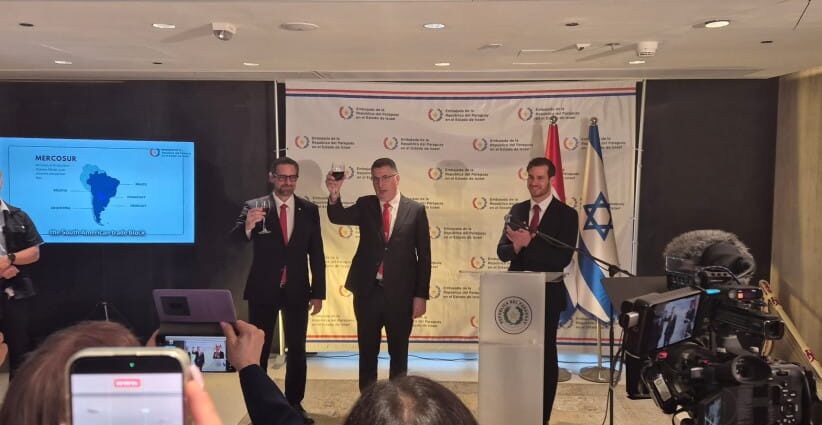
There were flags, speeches, glasses of wine, and the usual greetings between diplomats. But the line that carried the reception came from Ambassador Alejandro Rubin Cymerman, who used Paraguay’s Independence Day ceremony to speak less about protocol and more about why his country chose Jerusalem for the location of its embassy.
“Paraguay is in Jerusalem because it believes in Israel,” Rubin said during the ceremony. “Paraguay is in Jerusalem because it honors its word. Paraguay is in Jerusalem because it understands that true friendship is shown with actions.”
The reception brought together Israeli Foreign Minister Gideon Sa’ar, Knesset members Boaz Toporovsky and Evgeny Sova, diplomats from several countries, and representatives from religious and civic organizations, giving the event the tone of a diplomatic statement as much as a national commemoration.
Rubin tied Paraguay’s national story to Israel’s own calendar. Paraguay’s independence began on the night of May 14, 1811, and was consolidated in the early hours of May 15.
Israel declared independence on May 14, 1948, shortly before the British Mandate expired at midnight. For Rubin, the parallel offered an image of two peoples, born out of different histories, crossing the night between May 14 and May 15 and affirming their right to live freely in their own land.
This year, he noted, Paraguay’s national celebration also coincided with Jerusalem Day.
‘It stayed in the genes of the Paraguayan’
“Some coincidences are not invented. They simply exist,” Rubin said. “They wait to be seen with attention. And they invite us to think.” He described Jerusalem not only as a capital but as memory, faith, history, identity, and future.
Paraguay’s decision to be in Jerusalem, he said, was not directed against anyone, but made in favor of what his government regards as historical truth and sincere friendship. “Peace is not built by asking a people to hide its history, to hide its identity, or to put aside what is essential to its national soul,” he said. “Peace is built when people truly recognize each other.”
Speaking afterward, Rubin told The Media Line that Paraguay’s relationship with Israel is not simply a government policy, but something rooted in Paraguayan society. He said President Santiago Peña has described how, during his campaign, ordinary Paraguayans asked him to stand with Israel.
Paraguay’s foreign policy, Rubin said, rests on three central pillars: the United States, Taiwan, and Israel. The alignment, he argued, reflects a country that often chooses loyalty and values over the easier language of immediate economic convenience.
Rubin pointed to Paraguay’s own history of national trauma, especially the War of the Triple Alliance in the 19th century, in which the country lost a devastating share of its male population.
That experience, he said, left Paraguayans with a memory of existential war that creates an emotional link with Jewish history and the Holocaust.
“It stayed in the genes of the Paraguayan,” he said, arguing that this helps explain why support for Israel is widely understood in Paraguay in ways that may seem unusual elsewhere in Latin America.
He compared Paraguay’s support for Israel with its continued recognition of Taiwan, despite the economic benefits many countries associate with relations with China. “Paraguay does not move by convenience,” Rubin said.
“Paraguay moves by values.” The embassy’s presence in Jerusalem, he said, is part of that same approach and has changed the way Israelis see his country. When he arrived in Israel in January 2024, he said, many Israelis knew little about Paraguay or confused it with Uruguay. Now, he said, the reaction is different. “Today I say Paraguay, and the Israeli tells me: Thank you.”
Sa’ar used his remarks to place Paraguay inside a wider Israeli diplomatic strategy. He praised the country as a “stable friend” of Israel, saying that such stability matters not only to governments but also to businesspeople considering long-term investments.
Some countries, he said, can be friendly at one moment and less friendly after a political change. Paraguay, he argued, belongs to a different category.
“With Paraguay, Ambassador, it’s not only that you really enjoy political stability and economic stability,” Sa’ar said. “It’s a stable friend of the State of Israel. Its friendship is stable.”
Sa’ar recalled his visit to Paraguay roughly six months ago, saying it had left him with affection for the country. Then, looking around the room, he noted that Paraguay had made his schedule easier by moving its embassy to Jerusalem, only a short distance from his office. “That’s a hint for other embassies,” he said.
The foreign minister said his approach to foreign policy was straightforward. Israel, he said, would invest in its friends. “We want to be friendly with those who are friendly to us,” Sa’ar observed. “It is very simple.”
He then widened the point beyond Paraguay, noting that Fiji had also opened an embassy in Jerusalem, and that Somaliland was expected to do so next. For Israel, he argued, those moves matter precisely now, when the country is facing pressure in international forums. “This is becoming fashionable,” he said, urging ambassadors not to be “last.”
In a city built around memory, a name can be a lasting sign of friendship
The economic part of the relationship was also prominent. For Rubin, moving the Paraguayan embassy to Jerusalem in December 2024 has already changed the relationship in practical terms.
He pointed to visits in both directions, new agreements, and a busier bilateral agenda than in previous years. Even the decision to name a place in Jerusalem after the Republic of Paraguay, he said, was not just ceremonial.
In a city built around memory, he argued, a name can become a lasting sign of friendship.
Paraguay was already selling meat to Israel, but Rubin said one of his goals was to make the country visible behind the product, so Israeli consumers would know where the meat came from. “We have worked to put the flag of Paraguay in Israel’s supermarkets,” he said, making the point that this was not only a commercial issue but also one of national presence.
The numbers, Rubin said, show the shift. The change can be measured in beef exports. Rubin said Paraguay’s annual sales to Israel were once around $110 million.
Last year, they came close to twice that amount. This year, he said, the figure could move beyond $300 million if the pace holds, after more than $80 million in sales in the first quarter.
But Rubin insisted that Paraguay does not want to be known only for meat. He described the country as a platform for food, energy, water, agro-industry, applied technology, logistics, services, maquila, and investment.
Rubin told The Media Line that Paraguay’s next task is to become visible to Israeli investors and travelers in a broader way. As part of Mercosur, he said, Paraguay offers not only a domestic market of about 7.5 million people but access to a regional market of hundreds of millions.
South American business leaders, he said, already understand Paraguay as a stable and competitive base for growth.
“Israeli businesspeople are starting to discover that big things can be done from Paraguay,” he said. He added that he also wants Israeli backpackers to visit, describing Paraguay as beautiful, affordable, fun, and safe for Israelis.
The presence of Israeli lawmakers at the reception gave the relationship a parliamentary dimension beyond the government.
Toporovsky, who attended shortly after resigning from the Knesset, told The Media Line that he and Rubin have developed a close friendship and that Israeli public officials value Paraguay’s clear support.
He said Israelis recognize and appreciate Paraguay’s backing, including the embassy move to Jerusalem, and argued that the two countries have room to expand cooperation in business, economics, diplomacy, politics, education, research, and other fields.
Sova, deputy speaker of the Knesset from the Yisrael Beitenu party, told The Media Line that he visited Paraguay as a Knesset member two years ago and has remained in regular contact with Paraguayan lawmakers and the speaker of parliament, Raúl Latorre.
He called Paraguay’s leaders “true friends” and said the country’s support for Israel is especially important in Latin America, where positive attitudes toward Israel are not always common.
“It is important to preserve the relationship, and it is important to support our friends,” Sova said. “Regardless of the identity of the government in Israel, our relations with Paraguay will only grow stronger.”
That cross-party language reflected one of the central messages of the event. Paraguay was not presented only as a country friendly to the current Israeli government, but as a long-term partner whose support is recognized across political lines.
In a period when Israel’s foreign relations are often discussed through the prism of war, diplomatic pressure, and isolation, Paraguay’s Independence Day reception offered a different scene: a Latin American embassy in Jerusalem celebrating sovereignty while openly placing itself among Israel’s most loyal allies.
Rubin ended his remarks by returning to the connection between symbols and action. Diplomacy, he said, should not be limited to ceremonies or documents.
At its best, it can “help bring good closer,” and give order to realities. His comments underscored that Paraguay’s embassy in Jerusalem is meant to be more than a symbolic move.
For Asunción, it is a public statement of alignment with Israel and a deliberate effort to make that friendship visible.